The Estonian Tatars kept the Estonian language even in exile
In exile — above all in Sweden and the United States — the Estonian Tatars kept more than their Tatar heritage. They also preserved the Estonian language and an Estonian identity. By the community's own definition, an Estonian Tatar is “a person who is culturally Estonian and ethnically Tatar” — and so they remained far from home.
The Estonian language in exile
The Estonian Tatars spoke Estonian as a mother tongue. When Ibrahim Zarip walked into the editorial office of an exile-Estonian newspaper, the piece “Eesti türklased” (“The Estonian Turks”, Stockholms-Tidningen Eestlastele, 18 February 1948) recorded him thus: the young man spoke clear Estonian “like an ordinary Estonian,” yet “one senses foreign blood in him — his dark eyes are like glowing coals. Estonians do not have such eyes.” Asked how he commanded Estonian so well, he answered: “I was born in Estonia and am an Estonian citizen, and so is my sister.” The story also notes that Ibrahim served on a Swedish ship and had a flawless command of Swedish as well, and that the same afternoon he handed in a collection sheet at the Estonian Committee, having raised 20 kronor for the Estonian school. The piece ends: “Our homeland formerly had Estonian Swedes, Estonian Germans, Estonian Russians and Estonian Jews. Now we know that we also had Estonian Turks.” Estonian was a natural part of their home life and identity, which they carried with them abroad.
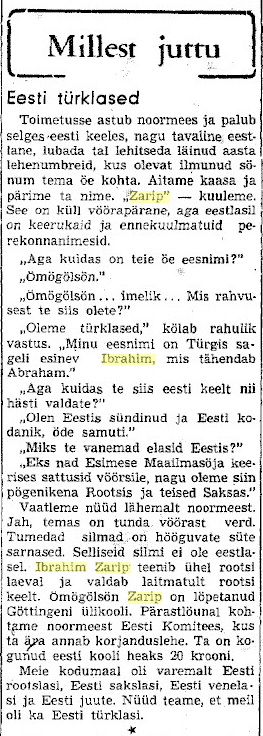
“Eesti türklased” (Stockholms-Tidningen Eestlastele, 18 February 1948) — a piece in which the editors marvel at Ibrahim Zarip's clear Estonian and he answers: “I was born in Estonia and am an Estonian citizen, and so is my sister.”
Life in the exile-Estonian community
In exile the Estonian Tatars joined not only Tatar-Turkish but also Estonian refugee organisations. Ibrahim Zarip sat on the board of the Foreign Section of the Estonian Socialist Party (ESPVK) — an exile party of Estonia's social democrats that fought against the Soviet occupation and is the forerunner of today's Social Democrats — was secretary of the New York Estonian Philatelic Society, helped renovate the New York Estonian House and took part in the preparations for ESTO ’92. His activity was covered by the Estonian-language exile paper Vaba Eesti Sõna. They lived a full part in the exile-Estonian community.
Loyalty to a free Estonia
Their bond with Estonia was not only linguistic. On Umugulsum Zarip's 1945 displaced-persons registration record, the desired-destination field states that she wished to go to Great Britain or its Dominions “when the independence of Estonia as it was before 28 September 1939 is not restored.” Their home and hope was a free Estonia.
The exile Estonian Tatars carried a double loyalty: their Tatar heritage — they founded Sweden's first Muslim congregation — and the Estonian language and the Estonian cause. That double belonging, culturally Estonian, ethnically Tatar, endured abroad too.
See also
Sources: “Eesti türklased”, Stockholms-Tidningen Eestlastele, 18 February 1948 (dea.digar.ee); For Estonia (including Umugulsum Zarip's D.P. registration record); the exile Estonian press (Vaba Eesti Sõna).