The Estonian time — the best of times
This page is the summary of everything. The historical Estonian Tatars have travelled a long road — from the Kipchak steppe and the Golden Horde, across the centuries, from the villages of Nizhny Novgorod to Tallinn and Narva. It is a story full of losses. Yet one conclusion stands above all of it.
The long road from the steppe
The Tatars' roots lie in the Kipchak (Cuman) steppe and the Golden Horde. The same old steppe language written down by the Codex Cumanicus in 1303 is carried on to this day by Mišär. Before reaching Estonia, the people had lived for centuries under foreign rule — “700 years of slavery,” as the Estonians themselves say.
The Estonian time: freedom and dignity
In the Republic of Estonia (1918–1940) — the “Estonian time” — the Tatars could live truly freely for the first time. They had a congregation, a school opened in 1938 and their own cemetery; they prayed for the Estonian government and celebrated Eid al-Fitr in Narva. In 1934 the Volga Tatar imam Alimdžan Idris said: “Consider the Estonian Republic as your state!” Estonia treated them as equals — unlike tsarist or Soviet Russia, where Muslims were second-class citizens. This was their best time.
What was lost
28 September 1939 and the 1940 Soviet occupation ended it. The congregations were dissolved, the old Muslim cemetery destroyed, the language and customs faded, and many hid their origins out of fear. For many, only a name remained of their Tatar origin. The “Estonian time” became a memory.
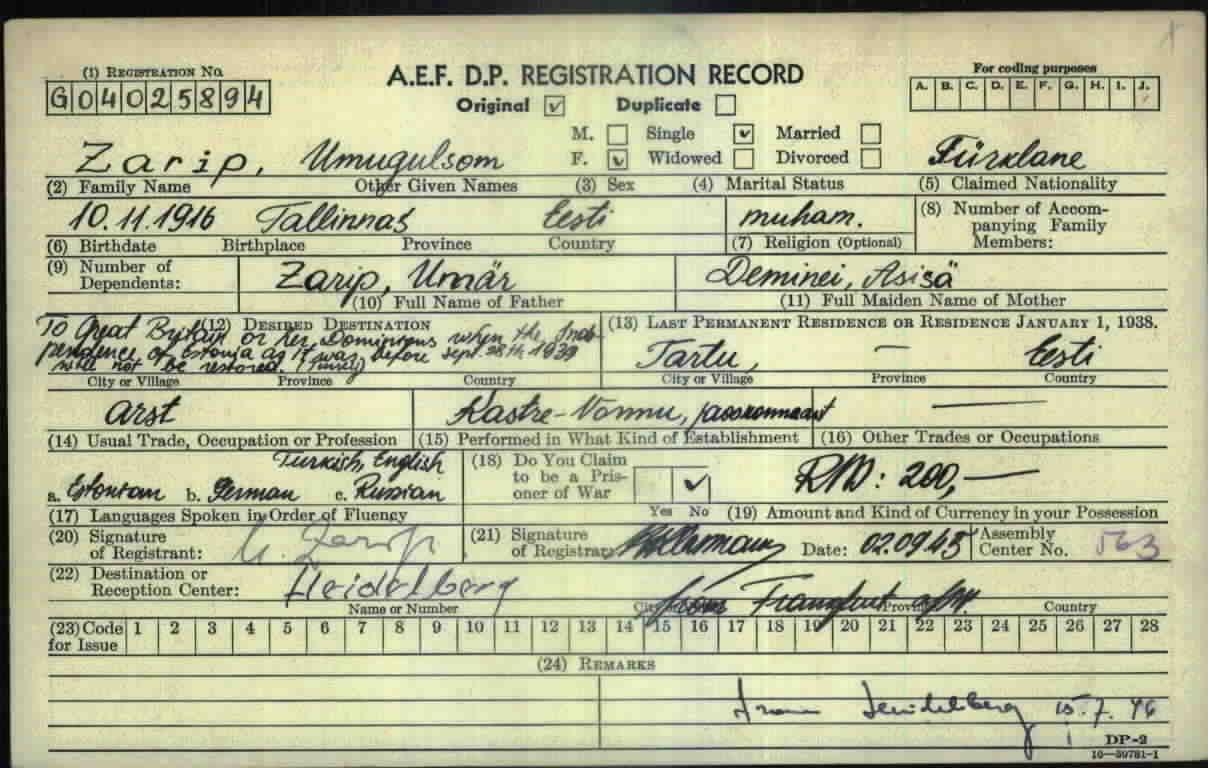
Desired destination: To Great Britain or her Dominions when the independence of Estonia as it was before Sept 28th 1939 will not be restored.
Umugulsum Zarip's displaced-persons registration record (1945), field no. 12. If home was impossible, then anywhere — but not an occupied Estonia.
In summary
For the historical Estonian Tatars, home is Estonia, and the best time is a free Estonia — that short, bright window in which the community could be who it is. Keeping that memory and saving the Mišär language is an attempt to bring a piece of that time back, because Estonia is back after all.
See also
The Estonian Tatar community in the Republic of Estonia (1918–1940)
28 September 1939: A dance of death between two devils under Satan's gaze
We are the Estonian Mišär Tatars
Sources: the related pages of this knowledge base (see “See also”).