The old Muslim cemetery of Tallinn
The old Muslim cemetery — officially Tallinna Muhamedi kalmistu (the Muhammadan Cemetery of Tallinn) — is the historical burial ground of the Estonian Tatars in Tallinn's Juhkentali neighbourhood, at Tehnika street 171, in the southern part of the Siselinna necropolis. The community simply called it the old cemetery — as opposed to the new one laid out at Liiva in the 1930s; in popular usage it was also known as the Tatar cemetery. For decades it was the community's backbone; under the occupations it was left to perish and families were forced to rebury their dead at Liiva. Today the grounds belong to the area of government of the Ministry of Defence; in cooperation with the Estonian War Museum, plans are under way to turn the site into a dignified memorial.
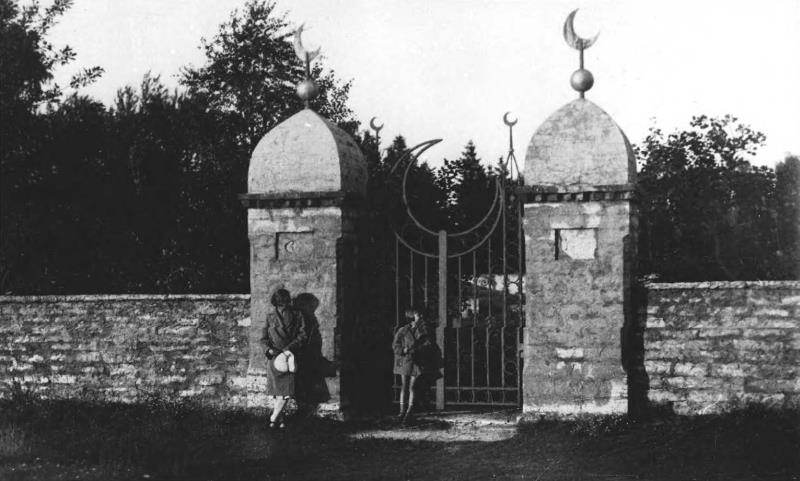
The wrought-iron gate in its original, pre-war form. The gate posts, damaged in the bombing, were rebuilt after the war in an altered shape.
When was the cemetery founded?
The exact founding date is not known. The Tallinn Encyclopaedia claims an 18th-century founding, but according to the 2022 heritage expert assessment this is probably erroneous — maps, known documents and oral tradition do not confirm it. The 18th century is when the Siselinna necropolis as a whole began (burials on the Alexander Nevsky grounds from 1775).
The earliest and most precise map showing the Muslim cemetery is the town surveyor Friedrich Eurich's plan of 1879–1881 (it may already appear on A. Mickwitz's 1876 plan). On Eurich's 1885 German-language town plan the cemetery already bears the name Muhammedanischer Kirchhof. By the Estonian Wikipedia, Tallinn's oldest Muslim cemetery would instead have been in the Hundipea area; the 2022 assessment does not mention Hundipea — the sources diverge here.
The community itself is much older: a permanent Tatar settlement formed in Tallinn after the Great Northern War, when Tatars discharged from the Russian navy stayed on in the town (see The Mišärs' road to Tallinn).
The railway cuts the cemetery
The cemetery's original territory (about 1,900 m²) bordered the Alexander Nevsky cemetery on the north. In the late 1880s or the 1890s the Tallinn–Viljandi narrow-gauge railway was built, and its embankment cut off part of the original grounds; in compensation the cemetery was extended by about the same area along the railway to the west and north-west. It kept those borders until its liquidation.
Mähdejev's wall and gate (1904)
The cemetery received its familiar form in the early 20th century. By the tradition current in the Tatar community (recorded by Raine Linnas), the fur merchant Sibgadulla Mähdejev — the “king of the Tatars” — bought land from the city in 1904, on the occasion of the birth of his son Ibrahim, ringed the cemetery with a limestone wall and had a splendid crescent-adorned iron gate forged. By family memory, the merchant Fateh Zakerov also took part in building the wall and gates.
Tradition adds a beautiful turn to the story: Mähdejev received the money for the wall and gate in gratitude from Tallinn's Jewish community, whom he had helped negotiate land from the governor-general for a cemetery of their own (probably the new Jewish cemetery at Rahumäe, burials from 1911). Two minorities helped each other — and the same occupation power later destroyed both communities' sacred places.
Life at the cemetery
By the recollections of the old Tallinner Edgar Neimar (1914–2012), in the 1920s–1930s the cemetery was a secluded, little-visited but well-kept place. The gate was usually kept locked — unusual at the time — and the Tatars asked for the key from the Siselinna necropolis warden; curious boys peeked at the cemetery over the limestone wall.
Graves were as a rule unmarked: there were mounds that levelled out with time, and everyone knew where their loved ones lay. No flowers or wreaths were brought, no candles lit, there were no benches; the custom barring women from entering was at least partly kept (loosening by the 1930s). The first grave with a cement border was made for Ämer Arslanov, who died as a conscript in the Estonian army — he was honoured with a gun salute and a metal wreath. The best-known person buried here is Sibgadulla Mähdejev († 1939), whose funeral was covered by Uudisleht in the long report “The funeral of the king of the Tatars in Tallinn”.
Expropriation and destruction
The Soviet occupation expropriated the cemetery: under an ESSR decree, an act was drawn up on 3 April 1941 by which the representatives of the Tallinn Muhammadan Religious Society — F. Sakerov, I. Mähdejev and A. Megdejev — handed the cemetery (0.19 ha) over to the city's communal-economy department, together with the burial list and the key to the gate. The partial burial list compiled by the society's clerk A. Megdejev (49 names, 3 March 1941) survives in the Tallinn City Archives.
In the March 1944 bombing the cemetery was badly damaged: the drainage-ditch system was wrecked and the cemetery went under water. The occupation authorities refused to let it be repaired — the land had been expropriated and the authorities had other plans for it. The bomb damage probably also explains why the gate posts were rebuilt after the war in an altered shape.
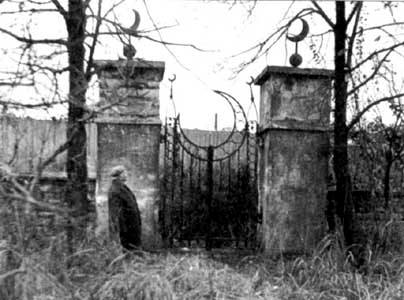
The gate in its altered post-war form — photographed in the years of decay.
Burials nevertheless continued through the 1940s and 1950s. Among the last buried was the merchant Fateh Zakerov (Sakeroff, 1880–1951), a photograph of whose gravestone “with oriental texts” survives in the National Archives; the last known burial is his wife Bebefaticha Zakerova (7 January 1953). The cemetery was closed for burials by decision no. 83 of the Tallinn Executive Committee (29 March 1955), effective 1 April 1955 — together with the whole Siselinna cemetery; Muslims were assigned quarter F of the Liiva cemetery instead. When in 1956 burials in family plots were again allowed at Alexander Nevsky and Vana-Kaarli, the Muslim and Catholic cemeteries stayed closed. In Islamic teaching the peace of the dead is sacred and reburial as a rule forbidden — yet in the second half of the 1950s families had to dig up the remains of their loved ones themselves and rebury them at Liiva (see The cemetery as the community's backbone and cultural genocide).
In the course of the cemetery's closure and liquidation the community also experienced forced reburial: families were compelled to rebury the remains of their loved ones. This violated Article 27 of the Fourth Geneva Convention, which protects the family rights and religious customs of the population of an occupied country.
Around 1959 warehouses rose on the plots bordering the cemetery on the south; a 1965 aerial photo shows the cemetery itself still untouched. As late as the 1970s Karl Laane saw on the cemetery “massive grave slabs with oriental texts” and a wrought-iron gate worth preserving. In the 1980s the west wall, with the gate, was demolished, along with most of the south wall; Karl Laane photographed the gate on 20 October 1980, shortly before its disappearance. The gate's fate is unknown — according to Timur Seifullen (2008) it was allegedly taken to Crimea. A motor depot and a wood yard operated on the former cemetery (the latter into the early 1990s); in the 2000s the city used the grounds to dump snow cleared from the streets.
Today: protection and restoration
The plot (2,613 m²) belongs to the Republic of Estonia in the Ministry of Defence's area of government, which has recognised it as a historic cemetery: it is mown and kept largely free of rubbish. Of the limestone wall, the stretches facing the Alexander Nevsky and Defence Forces cemeteries partly survive, as do two corner posts; the surrounding drainage has been repaired in recent years and the area no longer floods. The burial layer has probably survived underground.
In 2022 the architectural historian Carl-Dag Lige completed, on commission from the Tallinn urban-planning department, an expert assessment proposing state protection for the cemetery as a historical and archaeological monument, and its restoration as a memorial park — rebuilding the wall, marking the gate's location and installing information boards. In cooperation with the Estonian War Museum, plans are under way to turn the site into a dignified memorial. The community's burial ground to this day is the Muslim section of the Liiva cemetery.
Sources
Carl-Dag Lige, “Tallinna Muhamedi kalmistu. Eksperthinnang vastavusest kultuurimälestiste riikliku kaitse kriteeriumitele” (Tajumaailm OÜ, commissioned by the Tallinn urban-planning department, 2022) — incl. Tallinn City Archives files (the 1941 handover act TLA.1148.1.16; the burial list TLA.1148.1.1; the 1955 closure decision TLA.R-411.1.14) and Eurich's town plans; Carl-Dag Lige & Oliver Orro, “Tallinna hüljatud kalmistud”, Muinsuskaitse aastaraamat 2007; Raine Linnas, “Islam Eestis”, Akadeemia 9/2004; Toomas Abiline's articles in the Tallinn City Museum yearbook 2006/2007; Karl Laane, “Tallinna kalmistud” (2002); the Estonian Wikipedia; the community document “The cemetery as the community's backbone”. Where the sources diverge (the founding date; the oldest-Muslim-cemetery question; closure 1953 in community memory = the last burial vs the official 1955), the divergence is stated in the text. See also: Sibgadulla Mähdejev, Tatar life in Tallinn, The cemetery as the community's backbone.
Two photos of the cemetery gate by Karl Laane (1972 and 1980, the gate in decay) survive in the National Archives film archive (references EFA.683.0.200150 and EFA.683.0.202003) — they are under copyright but searchable in the National Archives FOTIS.