Alimdžan Idris
Alimdžan Idris (Tatar Ğalimcan İdrisi, Turkish Alimcan İdrisi; 1 May 1887 Petropavlovsk – 22 September 1959) was a Tatar Islamic theologian, imam and teacher who from the late 1920s taught the children of the Finnish and Estonian Tatar communities. In the history of the Estonian Tatars he is known above all for his teaching in Narva and Narva-Jõesuu and for his 1934 address, in which he called on the local Tatars to regard the Republic of Estonia as their own state.
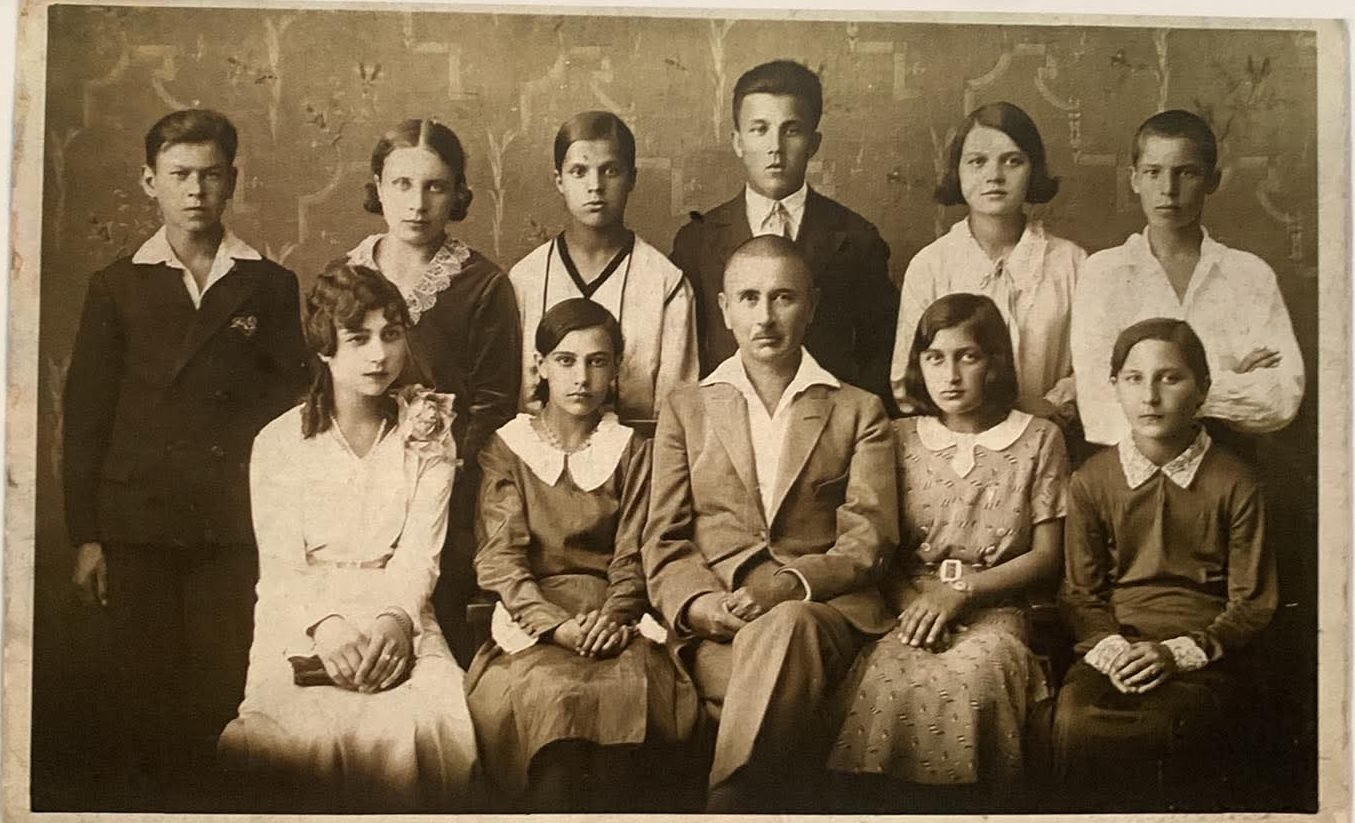
Imam Alimdžan Idris (centre) with his pupils in the 1930s. Private collection.
Origins and education
Idris was born on 1 May 1887 in Petropavlovsk (in present-day Kazakhstan) into a Volga Tatar family: his father Jafar came from Kazan and his mother from Buinsk. In 1902–1907 he studied at a madrasa in Bukhara, then continued his studies in theology and philosophy in Istanbul. He worked at the teachers' institute in Orenburg and in 1912 furthered his education in Europe, among other places at the University of Lausanne. Such a path — Bukhara, Istanbul and a European university at once — was rare among the Tatar intelligentsia of the time and made him one of the internationally best-known Tatar religious teachers.
The First World War: imam to prisoners of war
During the First World War Idris was a contributor to the pan-Turkic magazine Türk Yurdu in Istanbul and in the service of the Ottoman War Ministry. In 1916 he was sent to Germany, where he became the religious leader of some 12,000 Muslim prisoners of war — mainly Volga Tatars and Bashkirs — held at the camp at Wünsdorf-Zossen. He led prayers, organised language teaching, edited the prisoners' own newspaper Tatar Ili and helped prisoners return home or emigrate. About 400 Tatars were buried during those years in a cemetery near Zahrensdorf.
A teacher in Finland and Estonia
At the end of the 1920s Idris moved to Finland, where he became a teacher for the children of the Finnish Tatar community. Contemporaries described him as a demanding teacher and a tenacious spokesman of a Turkish identity: in 1929 he gave a speech at a wedding in which he called founding a Turkish-language school the community's first task — and the school was indeed founded.
In the early 1930s he taught in Estonia as well. The Estonian Tatar community then had schooling and community life in its mother tongue: a Sunday school at Raua Street 57 in Tallinn, an evening school in the congregation's rooms at Kiriku Street 14 in Narva, and children's summer schools and camps at Narva-Jõesuu in the summers. It was at these summer schools that Idris taught Arabic — the language of religious literature and of reading the Qur'an, then the foundation of Tatar religious education. He visited Estonia repeatedly during the 1930s.
The Estonian and Finnish Tatar communities were sister communities — both sprung from the same Mišär emigration from the Nizhny Novgorod region — and Idris's teaching linked them both.
The 1934 address
In his 1934 address to the local Tatars, Idris said:
You now live in Estonia. The present government of the Republic of Estonia has no connection with the former Tsarist Russia or with present-day Soviet Russia, where Muslims were and are second-class citizens. The constitution of the Republic of Estonia grants the minority nationalities the same rights as the indigenous population, and the government and the other executive authorities have followed this principle. There is not a single Muslim who could complain that the government has wronged them. Consider the Republic of Estonia your own state!
— Imam Alimdžan Idris, 1934
The address is one of the clearest contemporary testimonies to how the Tatar community saw its position in the Republic of Estonia: freedom of religion and minority rights were secured, and the community consciously tied itself to the Estonian state. The words were set down by a man who had seen the Tsarist empire, prisoner-of-war camps and Western European universities alike — and who therefore had a basis for comparison.
Later life
Idris lived for a long time in Germany; after the war he settled in Munich, where his children studied, and later in Saudi Arabia. He did not break his ties with the Finnish Tatar community, visiting repeatedly in the 1940s and 1950s, above all in Tampere. He died on 22 September 1959 and is buried in the Waldfriedhof cemetery in Munich.
From his marriage to Shamsebanat he had three children — Orhan, Ildar and Gulnar. His son Orhan Sadik-Khan (1929–2007) emigrated to the United States; his daughter Janette Sadik-Khan is the former commissioner of the New York City Department of Transportation.
See also
The Estonian Tatar community 1918–1940 · History of Estonia's Muslim Tatars · Tatar life in Narva · Finnish Tatars · The Estonian era — the best of times
Sources: Toomas Abiline and Ringo Ringvee, “Estonia”, in Muslim Tatar Minorities in the Baltic Sea Region (Brill, 2016), pp. 105–127; David Motadel, “Alimjan Idris and Islam in Four Germanys, 1916–59” (American Historical Association annual meeting, 2015); Muazzez Baibulat, The Tampere Islamic Congregation: the roots and history (2004); Ramil Belyaev, Tatars of Finland (Kazan, 2019); community private collection (photo).