History of Estonia's Muslim Tatars (Abiline and Ringvee)
This article digests what the historian Toomas Abiline and the scholar of religion Ringo Ringvee write about the history of Estonia's Muslim Tatars in the academic volume Muslim Tatar Minorities in the Baltic Sea Region (Brill, 2016). The chapter spans the whole arc from the 16th century to the present, drawing on archives, pre-war newspapers and interviews with community members — including one of the oldest, Nadir Aizatullin (1928–2009).
The first Tatars (16th century)
The first Tatars reached Estonia in the 16th century as soldiers in Russian troops during the Livonian War (1558–1583). In 1552 Ivan IV conquered the Kazan khanate, in 1556 Astrakhan; in 1558 Tatars took part in Russia's campaign against the small states of Livonia, led by the former Khan of Kazan, now a Moscow vassal, Shig-Alei (1505–1567), whose 40,000-strong army also included Maris and Bashkirs. In 1570 a Russian force besieged Tallinn with 40,000 men, 10,000 of them Tatars and other peoples of Kazan and Astrakhan. Some Tatars went over to the Swedish king and settled in Estonia; the best-known defector was the Tatar boyar Bulaat Murssov, who joined Tallinn's defenders in 1577.
The Baranov noble family
The best-known family of Tatar origin among the Baltic nobility is the Baranov (Baranoff) family, founded by four brothers who in the Livonian War switched allegiance from the Russian tsar to the Swedish king. Their ancestor Mursa-Shdan Baran had already declared loyalty to the Grand Duke of Moscow in 1430 and been baptised Orthodox. The Baranovs served as high officials and officers of the Russian Empire until the 1917 Revolution; the Kasari River and a western-Estonian village are named after them.
Under Russian rule (1721–1918)
The first larger Tatar community formed after the Great Northern War in 1721, when Estonia became part of the Russian Empire. It was founded by soldiers who stayed on after 25-year military service; imperial policy diversified the border population through forced marriages between discharged soldiers and Estonian women. The registers of Tallinn's Holy Spirit congregation from 1794 record marriages of Tatar marines and Estonian women contracted simultaneously 'according to the government's order'. The Muslim servicemen were numerous enough that a small mosque operated in the garrison town of Uuslinn (Neustadt).
In the 18th–19th centuries some Muslims were sent to Estonia as convicts to build coastal fortresses. After Pugachev's rebellion (1775) the Bashkir peasant leader and bard Salavat Yulayev was sent to Paldiski for life, with his father Yulay. Convicts earned a kopek a day, slept in barracks and usually survived only a few years — 'Paldiski was justly called another Siberia'. Salavat Yulayev lived in Paldiski from 1775 to 1800 and died there in penal servitude in 1800.
The Tallinn Tatar quarter
The community of discharged soldiers concentrated in certain Tallinn districts. The oldest was the 18th-century Tatar settlement (Tatar Sloboda), where retired soldiers bought land and built houses; the main street is still Tatari Street (the name in use since the late 18th century). Kadriorg was nicknamed the 'Tatar Nest'. Between 1834 and 1862 about 50 Muslims, mostly Tatars, lived in Tallinn, with their own mosque and imam. According to the Tallinn City Archives, two marriages between Tatar men and Estonian women were contracted in 1838 and one in 1842.
The Mišär merchants (1861→)
A new wave came after the abolition of serfdom in Russia in 1861: many freed Tatar peasants became itinerant merchants and arrived in Estonia by horse cart, often mistaken for wandering Roma. One main place of origin was the village of Kuy-Su in Sergach County, Nizhny Novgorod. The merchant Zakir Zakerov, with a successful clothing shop on Viru Square, brought a dozen young men from his home village as apprentices at a time. The 1897 census counted 109 Tatars in Tallinn; by 1914 the estimate was up to 2,000 (many uncounted).
Sibgadulla Mähdejev, 'the king of the Tatars'
Before the First World War the most honoured and richest Tatar was Sibgadulla Mähdejev (b. 1863 in Nizhny Novgorod province, arrived in Tallinn 1885). He opened his first shop in 1892 and traded in fur, rugs and jewels, with partners in Saint Petersburg and Pskov and dukes among his customers. In the early 20th century he founded the Tatar cemetery beside the Siselinna cemetery, walled in stone with a crescent-topped iron gate — by tradition built with money the Jewish community gave him in thanks for help in obtaining land for their own cemetery. When Mähdejev died in 1939, the paper Uudisleht wrote on 14 April: 'The king of the Tatars is dead!'
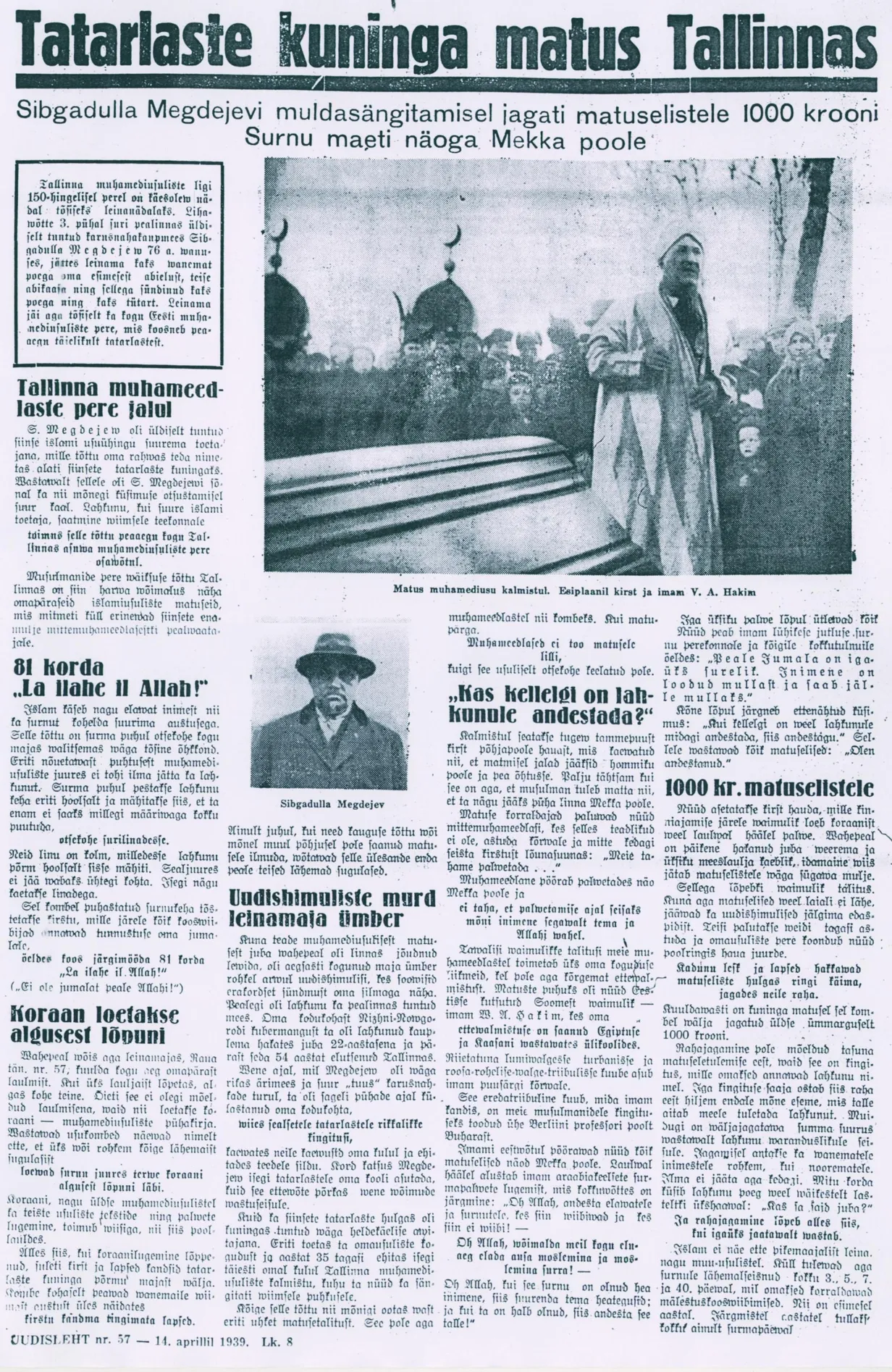
The funeral of Sibgadulla Mähdejev, 1939. Photo: Tallinn City Museum.
The Republic of Estonia (1918–1940): a 'golden time'
The Tatars regarded the pre-war republic as a 'golden time'. The main centres were Narva and Tallinn. The 1934 census counted 170 Muslims, 166 of them Tatars; the community itself estimated ~180, half in Narva and half in Tallinn. The first religious society was registered in Narva — the Narva Muhammadan Congregation on 18 May 1928 (renamed the Narva Muhammadan Religious Society in 1937); the Tallinn community became a legal entity on 13 March 1940. The first mosque opened on 29 July 1935 in Narva at Kiriku Street 2, the ceremony led by the spiritual head of Finnish Muslims, Väliahmäd Hakim.
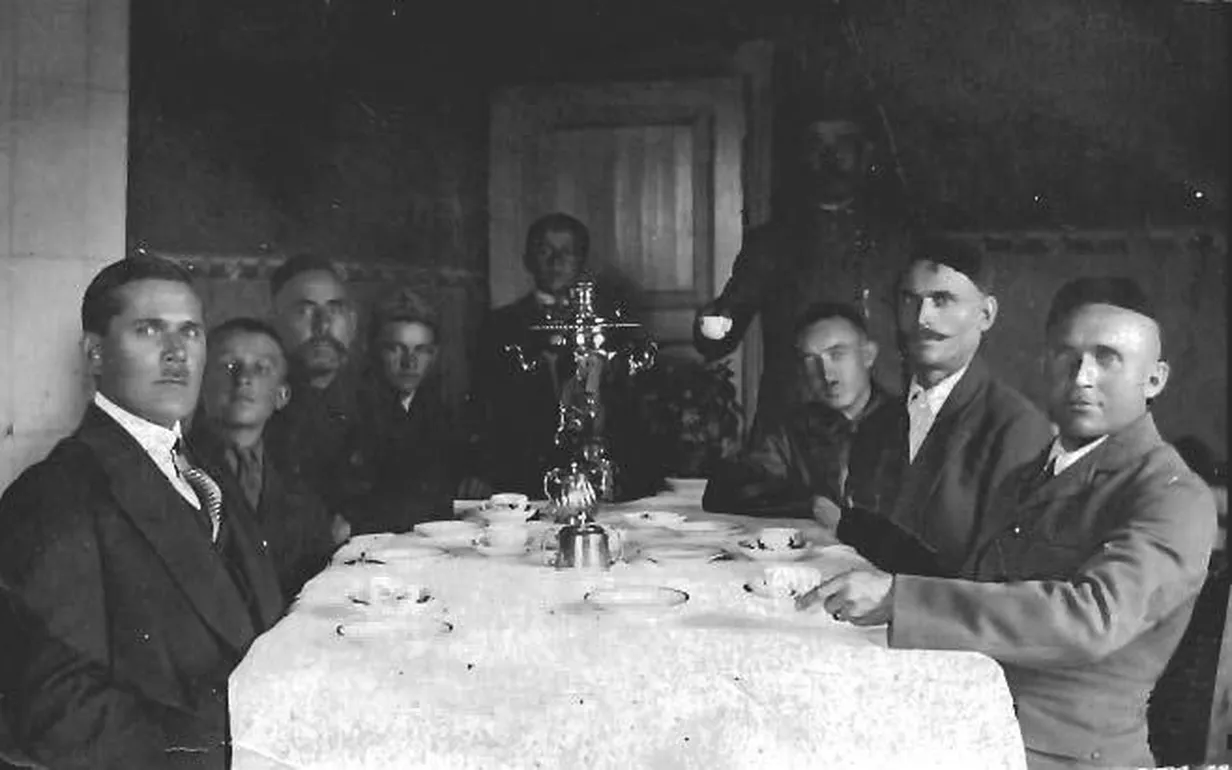
Estonian Tatars at the tea table in the 1930s. Photo: Tallinn City Museum.
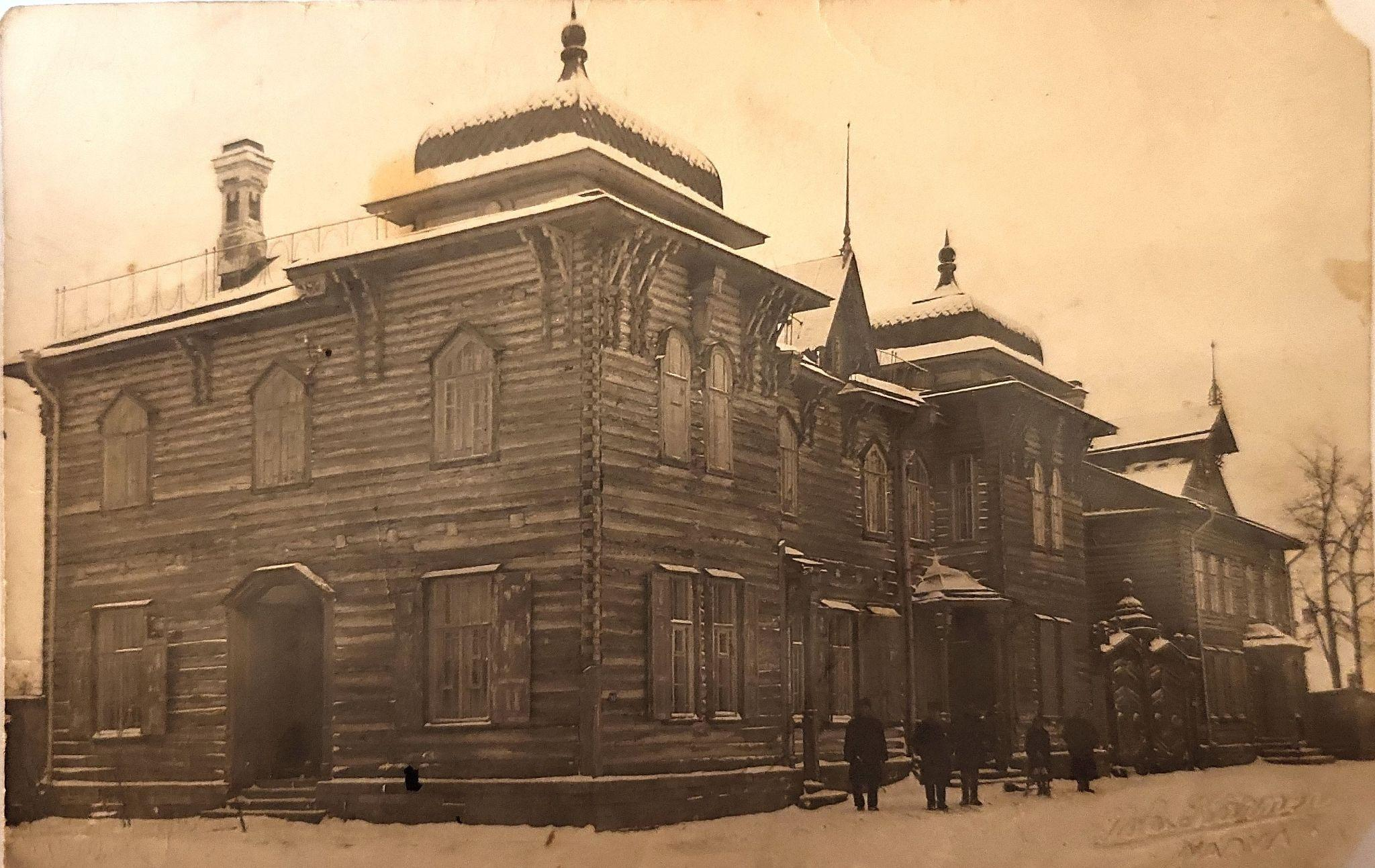
The Narva community building — the former North Estonian Bank — on a postcard.
In the 1930s Tallinn's Friday prayers were held in the mulla's flat at Raua Street 57 and a prayer room at Sube Street 4; 60–70 Tatars gathered on holidays. In 1935 the paper Rahvaleht described the Sube Street prayer hall: 'a large but poor room on the second floor … almost the entire floor covered with carpets … on the southern wall, towards Mecca, a two-stage minbar.' Religious life was led by imam Adiatulla Minahztetin (educated in Kazan and Bukhara, having served in Nizhny Novgorod and Saint Petersburg) and muezzin Ismael Devlet-Shahh; the Narva imam was Mustafa Haerdinov. A Sunday school ran in Mähdejev's house at Raua 57 (teacher Arif Rami from Finland), and an evening school in Narva.
At the summer camps in Narva-Jõesuu, the Berlin-based Volga Tatar imam Alimdžan Idris taught, visiting Estonia repeatedly in the 1930s. In his 1934 address he said: 'You live now in Estonia. The current government of the Estonian Republic does not have any connection with the former tsarist or the present Soviet Russia, where Muslims were and are secondary citizens … Consider the Estonian Republic as your state!' The last great Tatar summer gathering was held at Narva-Jõesuu in 1939.
The Soviet occupation (1940→)
The 1940 Soviet occupation ended the Tatar societies; the Tallinn and Narva religious societies were closed and the cemeteries in Tallinn, Narva and Rakvere municipalised. The fur merchant Hairulla Mähdejev (Mehdi) was arrested and died on 18 November 1941 in a Gulag camp in the Gorky (Nizhny Novgorod) region. In 1944 many Tatars left Estonia for Sweden, Finland, Germany, Canada and Australia. The Narva community was destroyed entirely, as the occupation authorities resettled Narva's whole population elsewhere. The old Tallinn cemetery's drainage was wrecked in the 1944 bombing, the cemetery closed in 1955, relatives reburied at Liiva; a park and a petrol station were built on the old ground.
During the German occupation (1941–1944) the Narva Muslim congregation was re-registered in 1943 — 81 members, with Zinnätulla Seifullin elected spiritual leader (Abiline and Ringvee, p. 118).
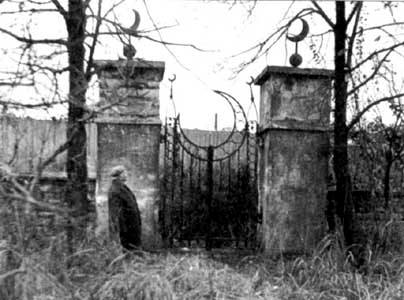
The Muslim cemetery gate.
Under Soviet rule the community grew through in-migration: in 1947 hundreds of Tatars were brought from the Nizhny Novgorod region to build a chemical factory in Maardu, in the 1950s a hydroelectric plant in Narva, in the 1970s facilities for the 1980 Moscow Olympics sailing regatta. By 1989 there were 4,058 Tatars in Estonia. Relations between older and newer Tatars were largely good, though newcomers often spoke Russian rather than Tatar. With no official mulla, home rites were led by elders, one of them Zinnätulla Seifullin.
Restored independence and today
In 1988, during perestroika, Tatars with pre-Soviet roots founded the Tatar Cultural Society (chairman Timur Seifullen), which also supported Estonia's independence movement; in 1995 it was renamed (the Tatar Community in Estonia). Today there are six registered Tatar societies (in Tallinn Idel from 1997 and Yoldõz from 2003, plus Maardu, Sillamäe, Narva and Pärnu). In 1989 the Tallinn Islamic Congregation was re-established; after the 1993 law it was renamed the Estonian Islamic Congregation, uniting all Estonia's Muslims, with Tatars still the largest group.
One of the Cultural Society's aims was to restore the Muslim congregation. On 7 August 1989 the Tallinn Islamic Congregation was registered: Hasjan Murtazin (1913–1997) was elected its spiritual leader and Gaiar Zarip the chairman of its board. The congregation sent Ali Harrasov to study at a madrasa in Ufa; in 1990 the spiritual directorate there sent him back to Estonia as the local imam. At the 1993 re-registration the congregation took the name Estonian Islamic Congregation, becoming the congregation of all Muslims in Estonia.
The number of Tatars has fallen: 4,058 (1989) → 3,546 (1994) → about 1,993 (the 2011 census; the same chapter also gives 1,998). Most live in Tallinn, Maardu, Kohtla-Järve and Narva. In 2007 the first full Estonian translation of the Quran appeared under the title “Koraan. Koraani tähendused” (“The Quran. The Meanings of the Quran”, publisher Avita). The initiative came from Timur Seifullen; it was translated by the renowned Orientalist Haljand Udam (1936–2005), who had begun the work in the late 1990s but died before publication — the text was edited and standardised by the Assyriologist Amar Annus. The first print run was 2,000 copies, the first thousand selling within a few hours. By Seifullen's estimate about half of Estonia's Tatars speak Tatar at least at a satisfactory level. The community is split in two: Tatars with pre-war roots, Estonian-speaking and identifying with Estonia, and occupation-era arrivals who are Russian-speaking.
See also
Source: Toomas Abiline and Ringo Ringvee, 'Estonia', in Ingvar Svanberg & David Westerlund (eds), Muslim Tatar Minorities in the Baltic Sea Region (Brill, 2016, Muslim Minorities 20), pp. 105–127. The chapter draws on archives, pre-war newspapers (Postimees, Uudisleht, Rahvaleht, Vaba Maa, Uus Eesti) and community interviews; name-forms vary between sources (e.g. Mähdejev ~ Megdejev).
See also: The Baranovs — a noble family of Tatar origin.
See also: The life of Muslims in the Soviet Union.