The Finnish Tatars
The Finnish Tatars are Finland's oldest Muslim community — Mišär Tatars who migrated to Finland in the late 19th and early 20th centuries from the villages of the Sergach country in the Nizhny Novgorod governorate, the same region (partly the same village of Aktuk) as the ancestors of the Estonian Tatars. Today they number about 600–700; their fate, however, turned out quite differently from the Estonian Tatars', because Finland remained independent after the Second World War.
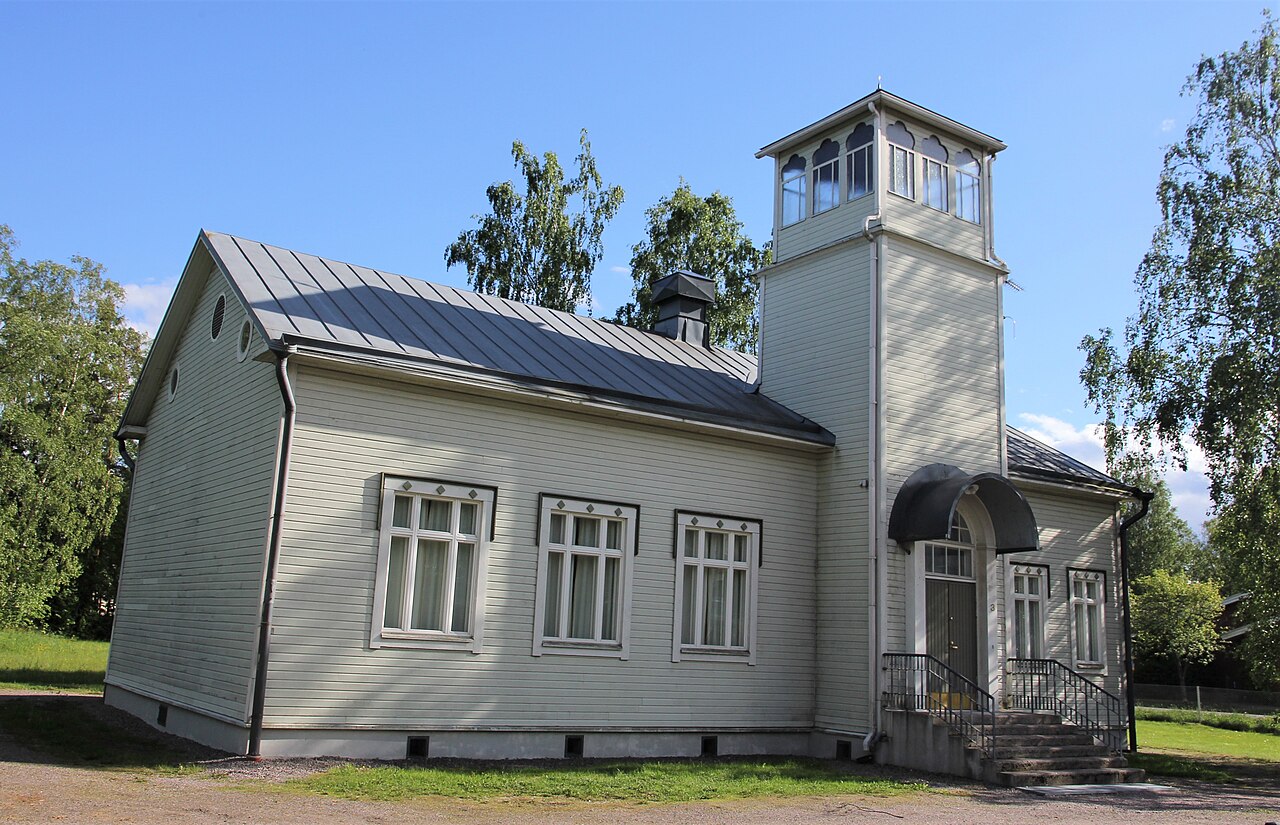
The Järvenpää Mosque, Finland's only purpose-built mosque, established by the Finnish Tatar community (Paju~commonswiki; CC BY-SA 3.0; Wikimedia Commons)
Origin and arrival
Like the Estonian Tatars, the Finnish Tatars were Mišärs — Turkic-speaking Muslims from the Sergach country. In their home villages they were peasants, but because of poor soil they turned to itinerant trade: fabrics, furs, clothes and soap. By tradition the first Tatar merchant — Hamidulla Mohammed-Rahim — arrived in Vyborg via Saint Petersburg in 1868; other early arrivals were Samaletdin Yusuf and Alautdin Salavat. By the 1880s there were already many dozens of them in Finland.
At first they returned home after trading, but once it became clear that business went better on Finnish soil, they began to settle. The main migration ran from the 1880s to the 1920s, with a final wave in the 1920s when settled merchants brought their families — migration was largely possible until 1929. The first generation numbered about 160 families, and two-thirds of them married within the community, which helped preserve the language and faith.
The Finnish Islamic Congregation
Communal life began in 1915 with the Charity Society of Helsinki Muslims. Finland's 1922 Freedom of Religion Act made Finland the first Western country to give Muslims official recognition, and on 24 April 1925 the Finnish Mohammedan Congregation was registered (from 1963 the Finnish-Islamic Congregation, Suomen Islam-seurakunta). It gained the right to conduct weddings in 1932. The congregation admits only Tatars and their spouses (after a three-year trial) and is closely tied to Tatar ethnic identity; in creed it is Hanafi Sunni.
The congregation has a prayer house in Helsinki (Fredrikinkatu 33, built 1958–1961), chapels in Turku and Kotka, and cemeteries in Helsinki's Hietaniemi and in Turku. Since 2020 it has been chaired by the banker and economist Gölten Bedretdin; the imam since 2004 is Ramil Belyaev.
The Järvenpää mosque
In 1938–1941 the Tatar community built, by volunteer work, a wooden mosque in Järvenpää, opened in 1942. It is the only purpose-built mosque in Finland and has the country's only minaret. The Tatars taught language and religion to their community's children in the mosque as late as the 1980s. It belongs to the Finnish Islamic Congregation.
Language and cultural life
The Finnish Tatars' mother tongue is the Mišär Tatar language, and preserving it is the core of the community's identity. From the 1930s they moved gradually from the Arabic to the Latin script: by the 1950s publications were mostly in Latin, and by the 1960s children were taught in the Latin alphabet. So the Finnish Tatars — unlike the russified Soviet Tatars forced onto Cyrillic — kept their language alive in the Latin script.
Associational life was rich. In 1935 the Finnish Turkish Society was founded in Helsinki, and the Tampere Turkish Association; the sports club Yolduz was active (it played a goodwill match in Algeria in 1954), and a Tatar school ran from 1948 to 1969. The community published books and magazines in its own language. Well-known Finnish Tatars include the entrepreneur and publisher Zinnetullah Ahsen Böre, and the figures Hasan Hamidulla, Ibrahim Arifulla and Habibur-Rahman Shakir.
In the Second World War 156 members of the Tatar community served in the Finnish armed forces, of whom 10 fell and 26 were wounded; 21 women served in the Lotta Svärd organisation. The Finnish Tatars' loyalty to their new homeland was as clear as that of the Estonian Tatars, who prayed for Estonia's leaders.
Ties with the Estonian Tatars
The two communities share one root and were closely linked. By the 1920s about 200–300 Tatars lived in Estonia (in Tallinn, Narva, Jõhvi, Rakvere); in the era of the Republic the Estonian Tatar Cultural Society arranged outings to the kindred community in Finland. During the war, in late 1943, several Estonian Tatar families fled to Finland; their guarantors included well-known Finnish Tatars and the imam Weli-Ahmed Hakim, who had also blessed the Estonian mosque. Three Estonian Tatars joined the Finnish armed forces (see the Estonian Tatar Finnish Boys) before many continued on to Sweden.
The difference in fate, however, is stark. Because Finland stayed independent, its Tatar community could carry on its language, faith and culture freely — keeping the Latin script and building its own mosque. The Estonian Tatars, by contrast, lost their community, congregation and cemetery under the Soviet occupation and were forced onto Cyrillic. The Finnish Tatars show what the Estonian Tatars' path might have been without the occupation.
Sources
This article draws on: Finnish Tatars (English Wikipedia); Suomen tataarit (Finnish Wikipedia); Finnish-Islamic Congregation (English Wikipedia); Järvenpään moskeija (Finnish Wikipedia); Tatars in Helsinki (City of Helsinki history). See also this knowledge base's pages: The Mišärs' road to Tallinn, the Nizhny Novgorod migration, the Estonian Tatar Finnish Boys and the Turk-Islamic Association in Sweden.
See also
The Mišärs' road to Tallinn · The Estonian Tatar Finnish Boys · The Turk-Islamic Association in Sweden · The Lipka Tatars · The Nizhny Novgorod migration