Estonian science that changed the world
A small land, a large trace: Estonia — above all around the University of Tartu and its old observatory — has produced discoveries still taught in every school on Earth, and working even on the rovers of Mars. This story gathers the greatest of them: the measuring of the Earth, the birth of embryology, two classics of physics, dark matter, and the world's first professor of neurosurgery. Many of these scientists were Baltic Germans, whose heritage belongs to Estonia.
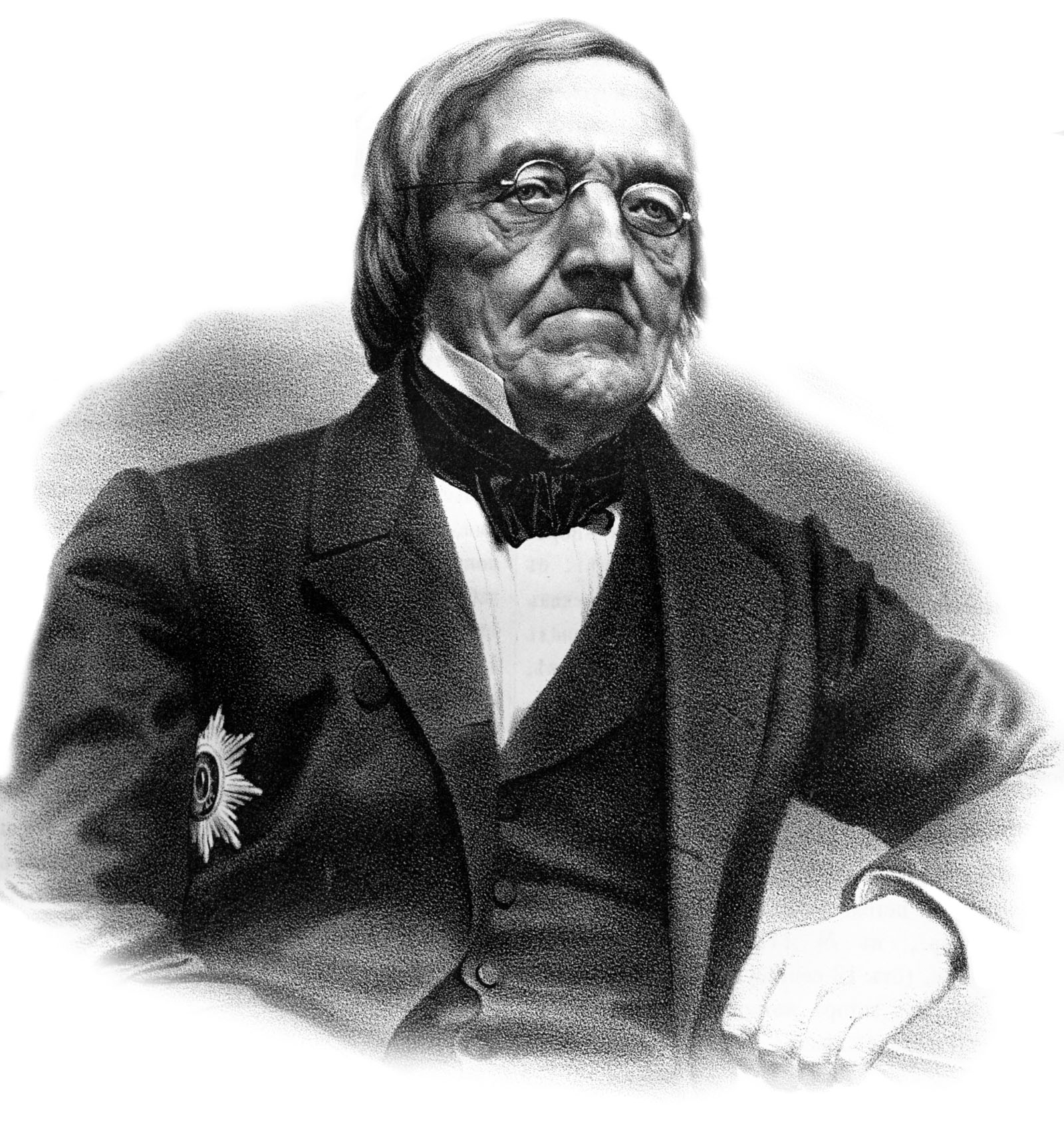
Karl Ernst von Baer — the founder of embryology.
Measuring the Earth began in Tartu: the Struve Arc
In 1816 Friedrich Georg Wilhelm von Struve, director of the Tartu observatory, began the survey chain that became the first accurate measurement of the Earth's size and shape: the Struve Geodetic Arc — 2,820 kilometres of triangulations from Hammerfest in Norway to the Black Sea through ten countries, completed in 1855. The arc's zero point is the Tartu observatory. Today the Struve Arc is on the UNESCO World Heritage list — a monument of science that begins in Estonia.
The birth of embryology: Karl Ernst von Baer
Estonian-born Karl Ernst von Baer (1792–1876) discovered the mammalian ovum in 1826 — the breakthrough from which all of modern developmental biology grew. Baer is held to be the founder of embryology; his statue sits on Toomemägi hill in Tartu, and students wash its head on Walpurgis Night.
Umwelt and biosemiotics: Jakob von Uexküll
Born at Keblaste manor in Estonia, Jakob von Uexküll (1864–1944) founded biosemiotics — the study of signs and meaning in living nature. His key concept, the Umwelt, is the perceptual world particular to each species: an ant, an eagle and a human live physically in the same forest, yet each senses it utterly differently. The idea reached far beyond biology — into philosophy, ethology and cybernetics — making a man born in Estonia the father of a whole school of thought.
Two classics of physics, born in Estonia
Tallinn-born Thomas Johann Seebeck (1770–1831) discovered the thermoelectric effect in 1821 — the Seebeck effect — by which heat is turned directly into electricity. The same effect today powers, among other things, the generators of NASA's Mars rovers. Tartu-born Emil Lenz (1804–1865) formulated Lenz's law in 1834 — the law of the direction of induced current that every physics student in the world learns.
A Nobel chemist from the University of Tartu: Wilhelm Ostwald
One of the founders of physical chemistry, Wilhelm Ostwald (1853–1932) defended his doctorate at the University of Tartu and did part of his early work there. In 1909 he won the Nobel Prize in Chemistry for his research on catalysis and chemical equilibria. His name lives on in the Ostwald process — the making of nitric acid from ammonia, on which much of the world's fertilizer industry, and thus its food production, rests. Ostwald was born in Riga, but it was in Tartu that he became a scientist.
The world's largest telescope and the first stellar distance
In 1824 the Tartu observatory received the Great Dorpat Refractor, built by Joseph von Fraunhofer — the largest achromatic telescope in the world of its day and the first to use a clock-driven German equatorial mount that let stars be tracked automatically. It was with this telescope that Struve measured the parallax of Vega in 1835–1837 — one of the first measurements of a star's distance ever, published in 1837, a year before Friedrich Bessel's measurement, generally regarded as the first reliable one. The old Tartu observatory, founded in 1810, where the telescope still stands, is today a museum, while modern research continues nearby at Tõravere.
The Estonian who invented a new kind of telescope: Bernhard Schmidt
The Great Dorpat Refractor was built for Estonia, but a second kind of telescope, still in use today, was invented by a man who was himself from Estonia. Bernhard Schmidt (1879–1935) was born on the island of Naissaar near Tallinn and became a world-famous optician. In 1930 he invented the Schmidt telescope (the Schmidt camera) — a corrector plate that cancels spherical aberration, coma and astigmatism at once, making wide-field, short-exposure astrophotography possible for the first time. The Schmidt design is still used for large sky surveys today. Remarkably, Schmidt did his ultra-precise optical work with a single hand: at fifteen he lost his right hand and forearm in a gunpowder experiment.
Tartu and dark matter
In the 20th century a world-class school of astronomy grew out of the Tartu observatory. Ernst Öpik determined the distance to the Andromeda Nebula with an original method (presented already in 1918, published in 1922) and showed it to be an independent galaxy far beyond the Milky Way — one of the first confirmations that the universe reaches far past our own galaxy; the Öpik–Oort comet cloud also carries his name. His successor Jaan Einasto showed in a landmark 1974 paper that clusters of galaxies are held together by unseen mass — one of the key works in the recognition of dark matter — and in 1977 that the universe has a cellular structure: galaxies surrounding vast voids. Tartu is thus one of the places where modern cosmology's picture of the universe was born.
The world's first professor of neurosurgery
Ludvig Puusepp (1875–1942) became the world's first professor of neurosurgery (in 1910, in Saint Petersburg), continued from 1920 at the University of Tartu, and in 1921 performed Estonia's first brain-tumour operation in Tartu. The spinal operation he devised is called Puusepp's operation to this day.
The mapper of memory: Endel Tulving
Born in Petseri and raised in Tartu, Endel Tulving (1927–2023) became the most famous psychologist of Estonian origin. He was the first to distinguish episodic from semantic memory — the difference between how we remember events we have personally lived through and how we know facts about the world — and brought the term mental time travel into science. In 1944 Tulving fled west as a war refugee and did his life's work at the University of Toronto; so one of the world's most influential memory scientists, too, shared the fate of Estonia's exiles.
Today's gene lab: the Estonian Biobank
The same story of science continues today in the blood of gene donors. The University of Tartu's Estonian Biobank (Eesti geenivaramu) is one of the world's largest population-based biobanks: more than 210,000 people have joined — about a fifth of Estonia's adult population — their tissue samples, genomic data and health data gathered for research. Collection began in 2002 and leapt in 2018–2019, when 150,000 donors were added; every donor's genome has been analysed on a single technical platform. So large and uniform a dataset makes Estonia one of the pioneers of personalised medicine — medicine that treats a person according to their own genes.
Genes and the migration story of humankind
Alongside the biobank, a world-class school of human genetics has grown out of Tartu. Led by Richard Villems (b. 1944) and his colleagues, Tartu scientists have traced, through DNA — above all mitochondrial DNA and Y-chromosome lineages — humanity's great migration story: the exodus out of Africa and the peopling of Europe. So little Estonia helps write the family tree of all humankind.
Honey with its own DNA fingerprint
One of the newest and most unexpected applications of Estonian genetics is a DNA test for honey. Created by Tartu scientists together with a couple of hundred Estonian beekeepers, the test gives each honey sample a unique, fraud-proof DNA fingerprint: it identifies the DNA of plants, bacteria, fungi and insects in the honey, describing its botanical make-up, origin and authenticity. It is one of the broadest honey analyses in the world. Fraud is hard to hide — if the DNA mix contains plants that do not grow in Estonia, the foreign origin is exposed at once. The test also helps monitor bee diseases and parasites.
Tartu, a world centre of semiotics: Juri Lotman
In the 20th century the University of Tartu became one of the world's centres of semiotics — the study of signs and meaning. Behind it stood Juri Lotman (1922–1993), who founded the Tartu–Moscow Semiotic School and built the theoretical framework of the semiotics of culture. His 800-plus works and the legendary Tartu summer schools made a small university town a name known across the humanities worldwide.
And today: a land of startups and a digital state
The same daring to think big lives on in today's Estonia, which has risen to become one of the world's densest startup nations. Per capita, Estonia has the most unicorns in Europe — startups grown past a billion dollars in value, of which Estonia has produced close to ten in all. It began with Skype (2003), whose engineers, enriched by its 2005 sale — the so-called Skype Mafia — went on to found and fund a new generation of companies. Among them: Wise (formerly TransferWise), which upended international money transfer; the ride-hailing app Bolt (whose founder was just nineteen, now in more than 40 countries); the gaming-platform maker Playtech; the sales-software firm Pipedrive; and the identity-verification company Veriff. More than a thousand startups operate in Estonia today.
Alongside the startups, Estonia's digital state is a model for the world, and the Tartu observatory and university still work at the front line of world science. So the small country has become a name in both technology and science weighing far more than its population — the science of a small nation has always had to think big.
And a few more fragments: in 1995 the Tartu scientists Marika Mikelsaar and Mihkel Zilmer isolated the lactic-acid bacterium ME-3, Estonia's first patented probiotic; Estonia's mushroom scientists are, for the country's size, among the world's best; and the Tartu observatory has built cameras for a NASA lunar mission and is developing Estonia's first lunar rover.
See also
More stories of interesting Estonia: Explorers from Estonia, The Kaali meteorite crater, Bernt Notke's Danse Macabre, The world's first Christmas tree, Tchaikovsky and Estonia, Tenet in Tallinn and Arvo Pärt.
Sources: Struve Geodetic Arc (UNESCO); Karl Ernst von Baer (Wikipedia); Thomas Johann Seebeck (Britannica); Emil Lenz (Wikipedia); Jaan Einasto (Wikipedia); Two hundred years of galactic studies in Tartu Observatory (arXiv); On Öpik’s distance evaluation method in a cosmological context (Astronomy & Astrophysics); University of Tartu Old Observatory (Wikipedia); Bernhard Schmidt (Wikipedia); Jakob Johann von Uexküll (Wikipedia); Wilhelm Ostwald (Nobelprize.org); Meditsiiniteaduste valdkonna lõpetajad (Puusepp) (Universitas Tartuensis); Endel Tulving (Wikipedia); Juri Lotman (Wikipedia); Richard Villems (Wikipedia); A unique DNA test for Estonian honey (Research in Estonia); Honey bulk DNA metagenomic analysis (npj Science of Food); University of Tartu Estonian Biobank (University of Tartu); Science Town — achievements of Estonian scientists (University of Tartu); Estonia leads Europe in startups and unicorns per capita (Invest in Estonia); Unicorns per capita (e-Residency).