Bernt Notke's Danse Macabre
In Tallinn's St Nicholas' Church (Niguliste) hangs a painting like no other anywhere in the world: the Lübeck master Bernt Notke's Danse Macabre is the only medieval Dance of Death painted on canvas to survive to our day. In it a pope, an emperor, an empress, a cardinal and a king dance with grinning Death — a reminder that before death, all are equal.
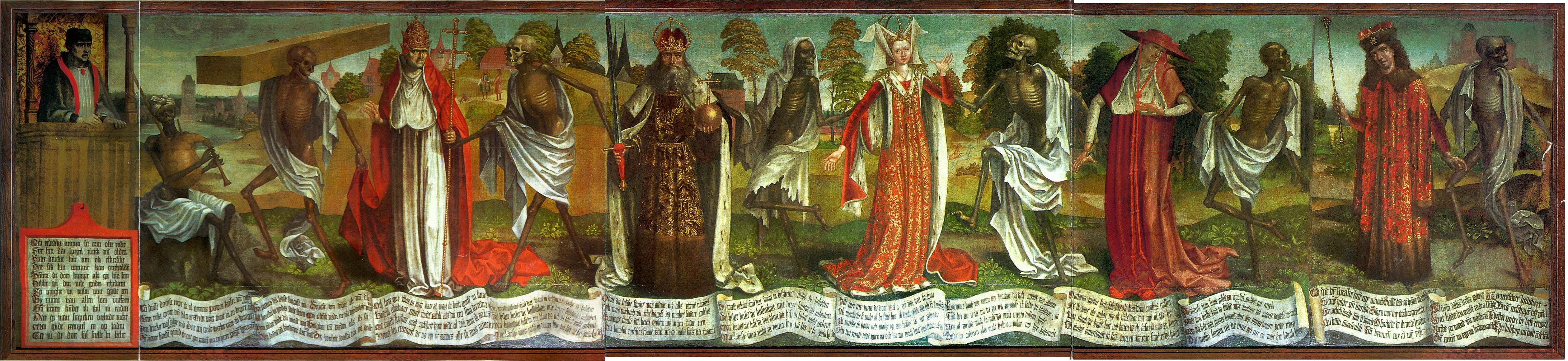
Bernt Notke's Danse Macabre (fragment), Niguliste Museum.
The genre: a dance everyone dances
The Dance of Death (danse macabre) was a late-medieval European genre born in the shadow of plague waves and wars: Death — a grinning skeleton — leads a dance in which every estate walks hand in hand, from pope to peasant. The message was memento mori: remember that you die — whatever your power and wealth. The imagery was at once horrifying and mocking: in the genre Death is often downright merry, while the estates are reluctant dance partners.
Notke and the Tallinn painting
Bernt Notke (c. 1435–1509) was the most famous late-medieval master of Lübeck. In 1463 his workshop completed a Dance of Death with 49 figures for St Mary's Church in Lübeck; at the end of the 15th century the same theme was painted for Tallinn — presumably for the St Anthony's Chapel of St Nicholas' Church, rebuilt in 1486–1493. The painting was originally some 30 metres wide; what survives is a 7.5-metre fragment with 13 figures (160 × 750 cm, tempera and oil on canvas). Beneath each figure speaks a Low German verse — Death's summons and the mortal's dismayed reply. The Tallinn painting differs from the Lübeck one: behind the figures lies not a town panorama but an autumn landscape.
How the painting survived two wars
The Lübeck original was lost as early as 1701, when it was replaced by Anton Wortmann's copy; the copy was destroyed in the bombing of 1942 — leaving Tallinn's the only one in the world. The Tallinn fragment escaped narrowly too: on 9 March 1944 a Soviet air raid shattered St Nicholas' Church, but the Danse Macabre and the other precious artworks had already been hidden elsewhere in anticipation of the raids. The fragment was restored in Moscow in 1962–1964 and then returned to Niguliste, which today serves as a museum.
The meaning
Notke's Danse Macabre is held to be Estonia's best-known and most valuable medieval artwork. It is also a cultural key image: when this knowledge base describes Estonia's fate between two totalitarian regimes, the page bears this painting's very name — Dance of death between two devils. A five-hundred-year-old memento mori that speaks to this day.
See also
More stories of interesting Estonia: The Kaali meteorite crater, The world's first Christmas tree, Tchaikovsky and Estonia, Tenet in Tallinn and Arvo Pärt.
See also: Estonian science that changed the world.
See also: Explorers from Estonia.
Sources: Dance of Death (Niguliste Museum); Danse Macabre (Notke) (Wikipedia); Surmatants (Tallinn) (Wikipedia); St Nicholas' Church Danse Macabre (Atlas Obscura).