Explorers from Estonia
From the small soil of Estonia came men whose names are on the world map to this day — from Antarctica to the atolls of the Pacific and the ice-fields of the Arctic. They were born on Saaremaa and in Tallinn, belonged to Baltic German noble families, and sailed to the farthest corners of the world in the service of the Russian imperial navy. Their discoveries lasted — and some of their names still cling to the places they found.
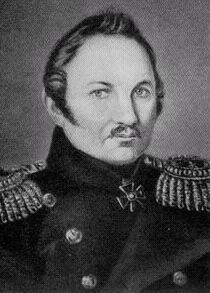
Fabian Gottlieb von Bellingshausen — the discoverer of Antarctica.
Bellingshausen: the discoverer of Antarctica, from Saaremaa
The greatest of them is Fabian Gottlieb von Bellingshausen (1778–1852), born on the island of Saaremaa. In 1819–1821 he led a circumnavigation whose aim was to seek land near the South Pole. On 27 January 1820, Bellingshausen and his second-in-command Mikhail Lazarev became the first people to sight the Antarctic mainland — overturning James Cook's conviction that no land could be found in the southern ice-fields. The expedition circled the continent twice. So the world's sixth continent was discovered by a man born on an Estonian island.
Krusenstern: the first Russian circumnavigation
Born at Hagudi manor in Estonia, Adam Johann von Krusenstern (1770–1846) led the first Russian circumnavigation of the globe in 1803–1806. Aboard the Nadezhda he sailed around Cape Horn, across the Pacific to the Marquesas and Japan. Krusenstern became a famous cartographer and hydrographer; his atlas of the Pacific was a reference work for decades — and left on the world map a name still borne today by a whole people (see below).
Kotzebue: explorer of the Pacific and Alaska, from Tallinn
Born in Tallinn, Otto von Kotzebue (1787–1846), a pupil of Krusenstern, led two voyages of exploration into the Pacific. Aboard the Rurik (1815–1818) he searched for a passage into the Arctic and discovered many Pacific atolls, including in the Marshall Islands. On the north-west coast of Alaska Kotzebue Sound bears his name — the mark a Baltic German seafarer from Tallinn left on the map.
Toll: lost in the Arctic
Born in Tallinn, Eduard von Toll (1858–1902) was a geologist and Arctic explorer. He surveyed the New Siberian Islands and led the Russian polar expedition of 1900–1902 in search of the legendary Sannikov Land — a phantom island thought to lie off Russia's Arctic coast. In 1902 Toll and his companions vanished without trace on the ice. Sannikov Land was never found — but his expeditions mapped some of the remotest islands of today's Russian Arctic.
Names that stayed on the world map
An explorer's mark often survives precisely as a name. In his atlas of the Pacific in the 1820s, Krusenstern named a southern island group the Cook Islands in honour of James Cook — and the name stuck. So the name given by a man from Hagudi is borne to this day both by the islands (the nation of the Cook Islands) and by a people: the islanders are called Cook Islanders after the home islands christened by a man from Estonia.
From the very same atlas comes a whole country's name. In 1820 Krusenstern named another Pacific group the Gilbert Islands, in honour of the British captain Thomas Gilbert. Those islands are the heart of today's Kiribati — for the name Kiribati is simply the Gilbertese-language rendering of the English word “Gilberts”. So the name of an independent nation of the Pacific descends, through its own tongue, from a name set down by a man born at Hagudi in Estonia.
Bellingshausen, too, left names where no one had reached before him. In 1821 he christened the first lands sighted beyond the Antarctic Circle in honour of the Russian emperors: Peter I Island and Alexander Island (Alexander I Land) — the latter now known to be the largest island of Antarctica. These names stand on the world map to this day, set there by the hand of a man born on Saaremaa.
The scientific harvest of the voyages
Kotzebue's Rurik voyage (1815–1818) brought home not only new islands but a rich scientific harvest. Aboard were the naturalists Adelbert von Chamisso and Johann Friedrich von Eschscholtz and the artist Louis Choris. They made the first ethnographic records of the people of the Marshall Islands and gathered thousands of plant and animal specimens. On this voyage Chamisso discovered the alternation of generations in salps (drifting sea creatures) — the first description of the phenomenon in the animal kingdom (De Salpa, 1819).
One of the shipmates was himself from Estonia: Johann Friedrich von Eschscholtz (1793–1831), a naturalist born in Tartu and later a professor at the University of Tartu. When the Rurik entered San Francisco Bay in 1816, Chamisso and Eschscholtz collected the golden poppy there; in 1820 Chamisso named it Eschscholzia californica in honour of his friend. So the state flower of California bears, to this day, the name of a man born in Tartu.
Bellingshausen's mark on Antarctica
Bellingshausen's name, too, stayed on the continent he discovered. Along the west coast of Antarctica lies the Bellingshausen Sea, and the Bellingshausen Station, founded in 1968 on King George Island, is still in operation. The name of the man who first sighted Antarctica has become a permanent part of the sixth continent.
Who they were
These men were descendants of Baltic German nobility, born on Estonian soil and making their careers in the service of the Russian Empire — like many of the educated class of the Estonia of their time. What unites them is not nationality in the modern sense but birthplace: a small land by the Baltic Sea, from whose soil grew men whose discoveries reached from pole to pole. Their names are on the world map to this day.
See also
More stories of interesting Estonia: Estonian science that changed the world, The Kaali meteorite crater, Bernt Notke's Danse Macabre, The world's first Christmas tree, Tchaikovsky and Estonia, Tenet in Tallinn and Arvo Pärt.
Sources: Fabian Gottlieb von Bellingshausen (Wikipedia); Adam Johann von Krusenstern (Wikipedia); Otto von Kotzebue (Wikipedia); Eduard von Toll (Wikipedia); Cook Islands (Wikipedia); Gilbert Islands (Wikipedia); Peter I Island (Wikipedia); Alexander Island (Wikipedia); Rurik expedition (Wikipedia); Adelbert von Chamisso (Wikipedia); Johann Friedrich von Eschscholtz (Wikipedia); Bellingshausen Sea (Wikipedia); Bellingshausen Station (Wikipedia).