The mass deportations
The Soviet occupation authorities used mass deportation — the forcible removal of people from their homes to distant places of exile — as a tool to break whole peoples. Estonia was struck by two great waves: 14 June 1941 and 25 March 1949. In all, more than 30,000 people were torn from Estonia, most of them women, children and the elderly, and sent to Siberia. Across the Soviet Union entire nations were deported this way, the Crimean Tatars among them.
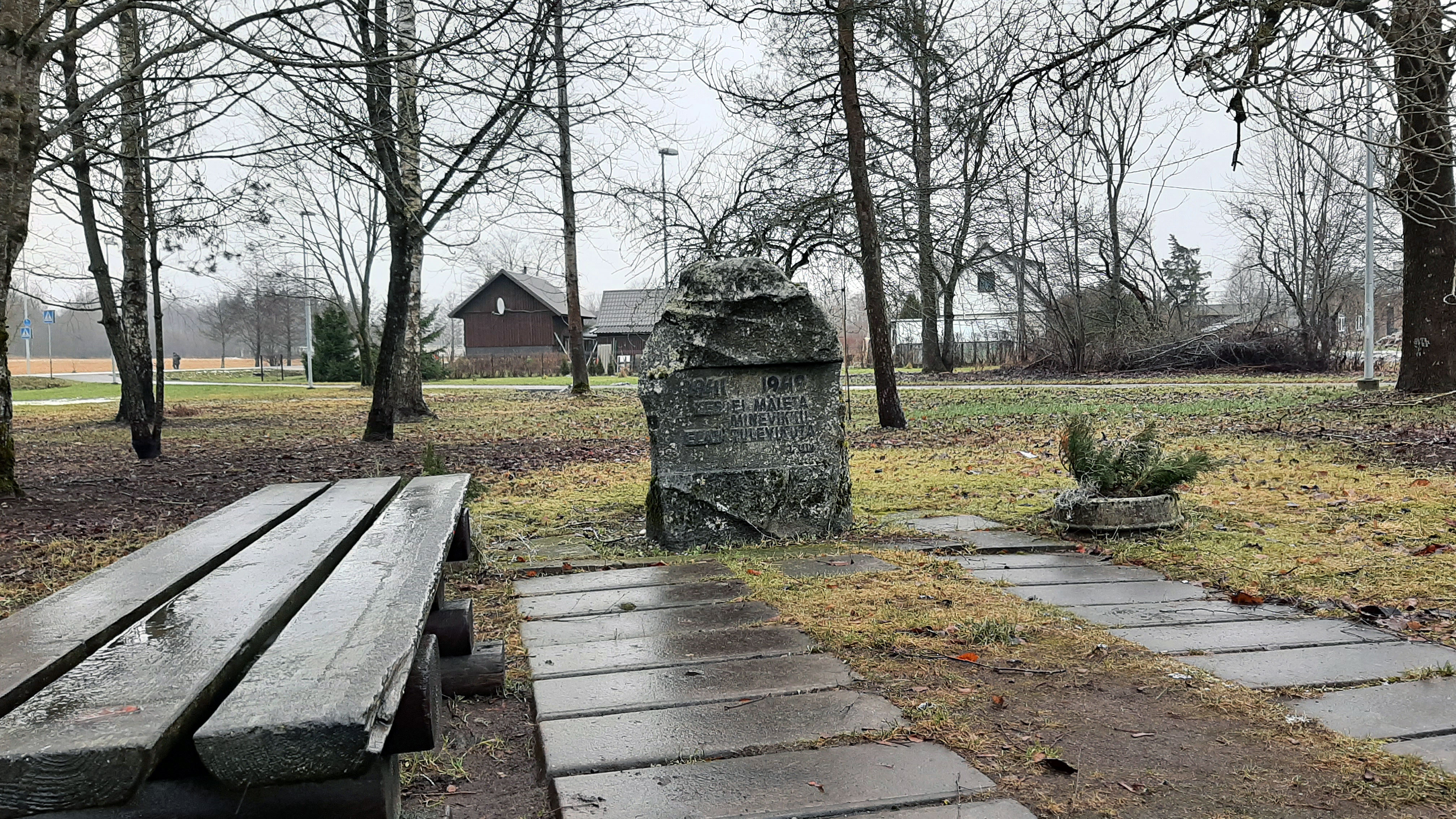
Memorial to the deported in Kehra, dedicated to those deported from Estonia in 1941 and 1949. The stone bears Juhan Liiv's words: “Who does not remember the past lives without a future.”
The June 1941 deportation
On the night of 14 June 1941 Estonia's first mass deportation began — a crime against humanity by the Soviet security organs (the NKVD). The order came from Moscow on 13 June; in the Estonian SSR the operation was led by the people's commissar for state security, Boris Kumm. In a single day and night about 10,000 people were carried out of Estonia.
The men — roughly 3,000 — were separated from their families and sent to prison camps in Russia, where most perished as early as 1941–1942. The women, children and the elderly — roughly 7,000 — were sent into exile in Siberian villages. The June deportation is estimated to have cost about 6,000 lives. People were deported from Latvia and Lithuania in the same night's wave.
The March 1949 deportation (Operation Priboi)
On 25–28 March 1949 the largest deportation in the Baltic states' history was carried out, code-named Operation Priboi. From Estonia about 7,500 families — over 20,000 people (estimates range 20,700–22,500) — were sent to Siberia. Across the three Baltic states some 90,000 people were deported. Unlike in 1941 the families were not separated; the overwhelming majority of the deportees were women, children and the elderly — over 70% were women or children under 16.
Officially the deportation was presented as the liquidation of the kulaks. Its real aim was to break the backbone of rural society, so as to force through collectivisation and cut off support to the forest brothers (metsavennad). By the end of the year about 80% of Estonia's farms had been collectivised. The European Court of Human Rights has classed the March deportation as a crime against humanity.
Whole nations were deported
Mass deportation did not strike the Baltic states alone. Between 1930 and 1952 forced resettlement in the Soviet Union affected at least six million people, and during the Second World War entire nations were deported wholesale: the Volga Germans (1941), the Crimean Tatars (18 May 1944, over 191,000 people), the Chechens and Ingush (1944), and also the Kalmyks, Karachays, Balkars and Meskhetian Turks. Deportation was the collective punishment of a whole people.
By the official Soviet (occupation) account, about 20% of the Crimean Tatar deportees died in the first year and a half after the deportation; the Crimean Tatar community itself has put the share of the dead at roughly 46% — more than double.
Remembrance
In Estonia 14 June (a day of mourning) and 25 March are days of remembrance for the victims of the deportations. The deportations were aimed at the whole of society, children included, and are internationally recognised as crimes against humanity. The official Soviet account spoke of removing kulaks and enemies of the state; the communities' lived memory is of families torn apart, many of them women, children and the elderly.
See also: Sürgün — the deportation of the Crimean Tatars · Communist crimes against Estonia's minorities · No one escaped the Soviet Union.
Sources: Juuniküüditamine Eestis — Vikipeedia; Märtsiküüditamine — Vikipeedia; Operation Priboi — Wikipedia; Soviet deportations from Estonia — Wikipedia; Population transfer in the Soviet Union — Wikipedia; Terroriaktsioon, mis muutis Eesti: 1949. aasta märtsiküüditamine — communistcrimes.org.