Sürgün — the deportation of the Crimean Tatars
The Sürgün (Crimean Tatar Sürgünlik, “the Exile”) is the Crimean Tatars' name for the 1944 deportation, when the Soviet occupation authorities removed an entire people from Crimea to Central Asia and Siberia in three days. It was one of the gravest cases of the Stalinist punished-peoples policy and is recognised as genocide. The Crimean Tatars are one of the Turkic-Tatar peoples — see the Crimean Tatars.
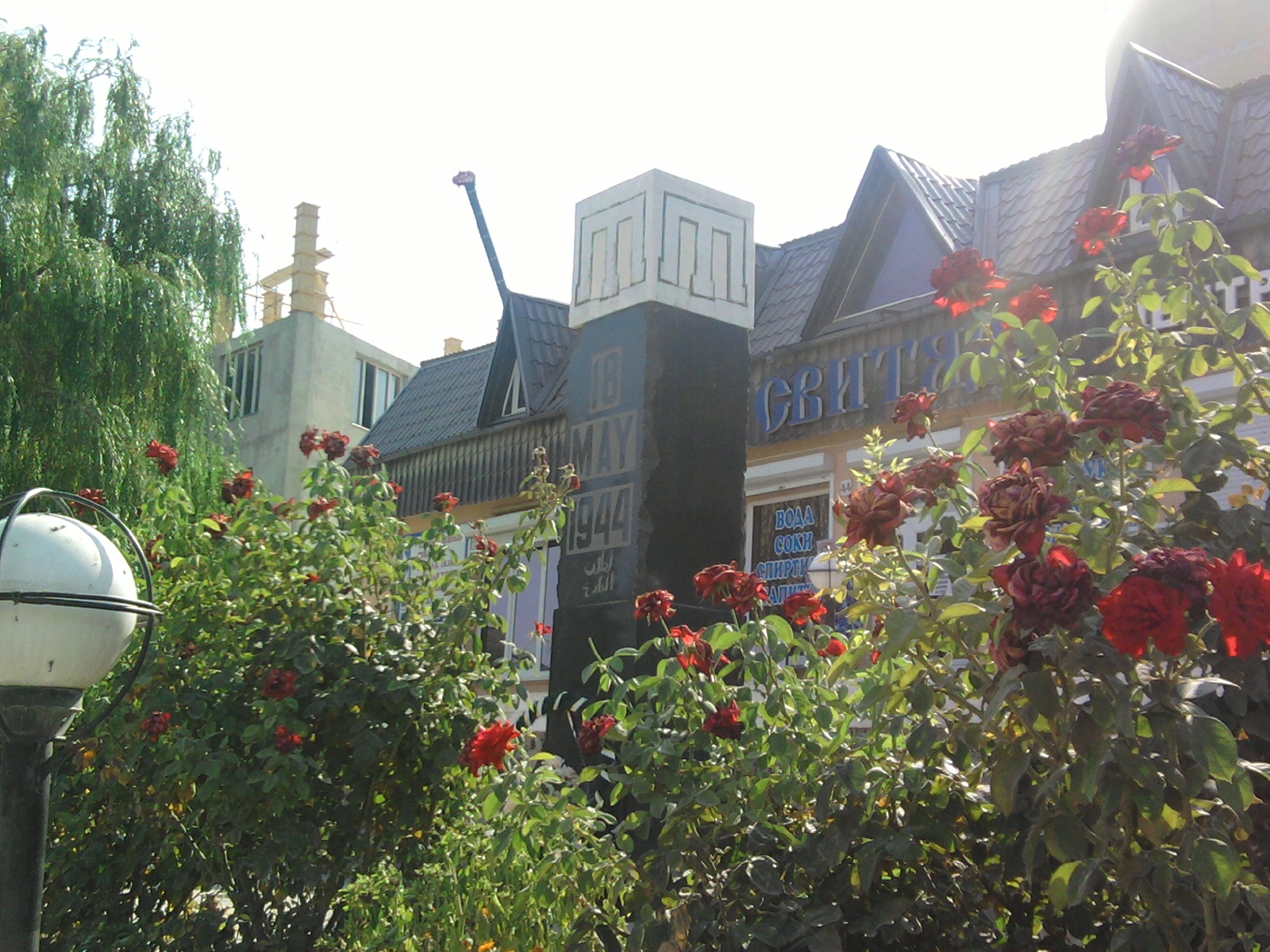
Memorial to the deportation of the Crimean Tatars, which began on 18 May 1944, in Sudak, Crimea (Lystopad; CC BY-SA 3.0; Wikimedia Commons)
The name
The word sürgün comes from the Turkic verb sürmek — “to drive away, to banish”. Already in Ottoman times it named the state practice of forcibly resettling whole communities to frontier regions, at once punishment and control. In naming Stalin's operation the “Sürgün”, Crimean Tatars place it within a long memory of forced displacement.
The operation
On 10 May 1944 Lavrentiy Beria recommended to Stalin the deportation of the Crimean Tatars for alleged “treasonous actions”; Stalin issued order no. 5859ss on 11 May. The operation was carried out by some 20,000 NKVD internal troops and up to 5,000 NKVD–NKGB operatives plus thousands of soldiers, going house to house at gunpoint. It ran 18–20 May 1944 — three days. People were given about 15 minutes to pack. They were carried in sealed cattle wagons (nominally 50, in practice up to 133 per car) some 3,200 km; the journey took weeks. At least 191,044 Crimean Tatars from about 47,000 families were removed; with other groups (Armenians, Bulgarians, Greeks in a second wave on 27–28 June) 228,392 people. Destinations: about 151,000 to the Uzbek SSR, the rest to the Mari and Kazakh SSRs and to the Urals and Siberia.
The special-settlement regime and mortality
The deportees became “special settlers” — second-class citizens who had to register with a commandant and could not leave the settlement. They were put to forced labour in mines, forestry and collective farms for 11–12-hour days on 200–400 g of bread; a 1948 decree set 20 years of hard labour for leaving without permission. Malaria, typhoid and hunger killed thousands — by July 1944 about 40% of the Crimean Tatars in Namangan Oblast had malaria or yellow fever. NKVD records count more than 26,000 deaths in the first 18 months (May 1944–1945, about 18% in Uzbekistan), nearly half of them children under 16; at least 7,889 died in transit alone. The Crimean Tatar national movement estimates that up to 46% of the people died in the first years — considerably more than the official Soviet count records.
The de-Tatarisation of Crimea
The deportation was followed by the erasure of Crimean Tatar traces from Crimea. The Crimean ASSR was abolished on 30 June 1945. Over 1,300 settlements (about 90% of all) were renamed from Crimean Tatar and German names to Russian ones. About 2,400 cemeteries were destroyed, mosques and shrines razed or turned into warehouses and clubs; a 1945 decree ordered over 1,500 libraries destroyed and 861 Crimean Tatar schools closed. The term “Crimean Tatar” was expunged — in the 1959, 1970 and 1979 censuses one could register only as “Tatar”. From July 1944 about 51,000 new inhabitants, mostly Russians, were settled into the roughly 80,000 emptied houses and onto the land.
The return movement
The Crimean Tatars did not acquiesce. From the 1950s–60s a large nonviolent petition movement grew — the 1966 campaign gathered over 100,000 signatures, with the Soviet dissident Petro Grigorenko as an ally. A decree of 5 September 1967 lifted the collective treason charge but claimed the Tatars had “taken root” in Uzbekistan and offered no way to return — only a few families got residence permits and thousands who tried were expelled. The movement's symbol was Mustafa Cemilev (Cemiloğlu; Russian: Dzhemilev), deported at six months old, imprisoned six times in 1966–1986 for about 15 years in total, who held a 303-day hunger strike. Mass return began only as the Soviet occupation collapsed: the declaration of 14 November 1989 condemned the deportation, and by the end of 1991 about 166,000 had reached Crimea; by the 2001 census Crimean Tatars again made up about 12% of Crimea's population.
Recognition as genocide
Ukraine's Verkhovna Rada recognised the deportation as genocide on 12 November 2015 and designated 18 May as the day of remembrance for the victims of the genocide of the Crimean Tatar people. Estonia, Latvia (2019), Lithuania (2019), Canada (2019), Poland, Czechia and the Netherlands have also recognised it as genocide. As early as 26 April 1991 the Russian SFSR rehabilitation law called the mass deportations “Stalin's policy of defamation and genocide”.
After the 2014 annexation
After Russia's annexation of Crimea in March 2014, the UN reported that over 10,000 people left the peninsula, most of them Crimean Tatars. The Crimean Tatars' representative body, the Mejlis, was branded “extremist” and banned in 2016; the International Court of Justice ordered the ban lifted in 2017, but Russia has not complied. Mustafa Cemilev himself was barred from entering Crimea in 2014. Arrests of Crimean Tatar activists, raids on homes and mosques and politically motivated prosecutions are documented.
The wider pattern
The Sürgün was one link in the Stalinist punished-peoples policy: in 1941–1944 whole nations judged “unreliable” were deported — Volga Germans and Finns, Karachays, Kalmyks, Chechens, Ingush, Balkars, Crimean Tatars and Meskhetian Turks. The Turkic-Muslim groups were feared as a possible “Turkish fifth column”. The Crimean Tatars shared the charge but not the reprieve: the Chechens, Ingush and others were allowed home in the late 1950s, but the Crimean Tatars only in 1989 — making their case the longest unresolved of the punished peoples. See also communist crimes against Estonia's minorities.
See also
Sources: Deportation of the Crimean Tatars (Wikipedia); J. O. Pohl, The Deportation and Fate of the Crimean Tatars; Sürgün (Wikipedia); Mustafa Cemilev; Renaming of Crimean toponyms; Crimean Tatar repatriation; Mejlis (Wikipedia); Euromaidan Press — Sürgünlik.