The Codex Cumanicus and the Kipchak-Cuman language
The Kipchaks and the Cumans
The Kipchaks (Cumans) were a Turkic steppe people who, from the 11th to the 13th century, dominated the grasslands between the northern Black Sea coast and the Caspian — a region known as the Dasht-i Kipchak, the Kipchak steppe. After the Mongol conquest the Kipchaks formed the bulk of the Golden Horde's population, and their language became the common tongue of the steppe.
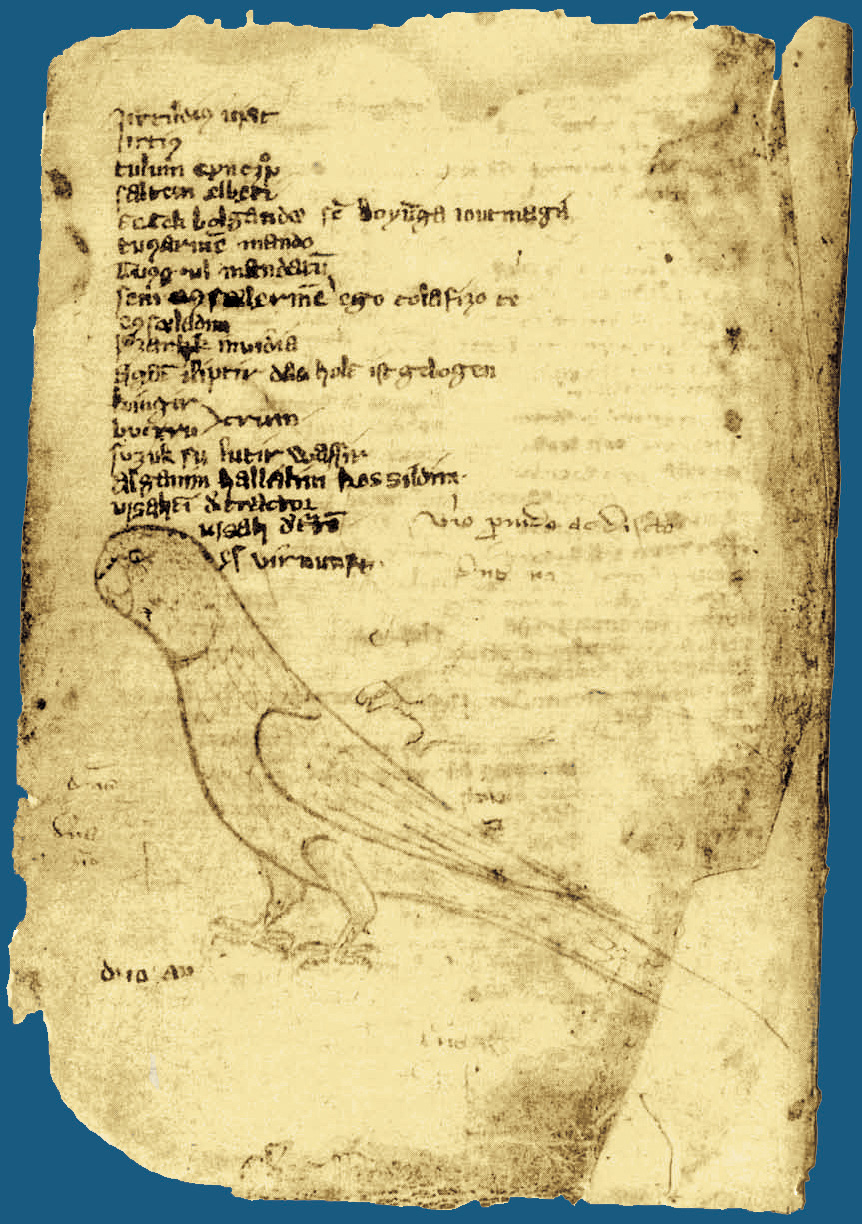
A page of the medieval Codex Cumanicus manuscript showing a drawing of a parrot; this 14th-century handbook of the Kipchak language is kept in the Marciana Library in Venice. (Unknown author (14th-century manuscript, Biblioteca Nazionale Marciana, Venice); Public domain; Wikimedia Commons)
Linguistically, Cuman (Kipchak) belongs to the western (Kipchak-Cuman) group of the Kipchak branch of Turkic. Its modern relatives in the same group are Crimean Tatar, Karachay-Balkar, Kumyk and Karaim. Remarkably, the Cumans (Kipchaks) themselves called their language “tatar til” in the Codex Cumanicus — the very name this community still uses (Tatar tel).
Cuman (Kipchak) survived longest in the Kunság region of Hungary, where some Cumans (Kipchaks) had fled from the Mongols in the 13th century. Its last speaker is considered to be István Varró, who recited the Cuman (Kipchak) Lord's Prayer at the court of Empress Maria Theresa in 1744 and died in 1770 — with him Cuman (Kipchak) ceased to be a living language.
The Codex Cumanicus
The Codex Cumanicus is a medieval manuscript kept in the Biblioteca Marciana in Venice (shelfmark Lat. Z. 549). It consists of 82 paper leaves of roughly 20 × 14 cm. The surviving copy bears the date 11 July 1303 on its first leaf; the copy itself was probably made in Crimea in the first half of the 14th century, and the oldest layers of the collection date to the late 13th century. It is one of the oldest written monuments of any Kipchak language.
The manuscript falls into two distinct parts. The so-called Italian part is a practical glossary in Latin, Persian and Cuman (Kipchak) — a tool for Italian merchants trading in the lands of the Golden Horde, complete with verb conjugation tables and everyday vocabulary. The so-called German part contains a Cuman-German dictionary, grammar notes and Christian texts in Cuman (Kipchak) — a handbook for Catholic missionaries.
By tradition the manuscript reached Venice through the library of the poet Francesco Petrarca, donated to the Republic in 1362. Modern scholars consider that link uncertain — what is certain is only the manuscript's presence in the Marciana collection.
Printed editions and our copy
The first complete printed edition was published in Budapest in 1880 by the orientalist Count Géza Kuun, under the auspices of the Hungarian Academy of Sciences. The Latin-language volume of over 500 pages contains a long introduction (prolegomena), the full text of the codex with notes, and Cuman (Kipchak) and Persian glossaries. Systematic study of the codex begins with Kuun's edition. It was later followed by Kaare Grønbech's facsimile edition (Copenhagen 1936) and Vladimir Drimba's diplomatic edition (Bucharest 2000), which refine some of Kuun's readings.
The primary source behind this article is a digitised copy of Kuun's 1880 edition (an Internet Archive scan). A selection of the codex's texts based on the same edition can also be read in this site's library.
What the manuscript actually says
The first leaf of the codex opens with a date and dedication (abbreviations expanded):
MCCCIII die XI Iuly. In nomine domini nostri Iesu Christi et Beate Virginis Marie matris eius et omnium sanctorum et sanctarum dei. Amen. Ad honorem dei et beati Iohannis euangeliste. In hoc libro continentur persicum et comanicum per alfabetum.
“1303, on the 11th day of July. In the name of our Lord Jesus Christ, of the Blessed Virgin Mary his mother, and of all the saints of God. Amen. To the honour of God and of Saint John the Evangelist. In this book are contained Persian and Cuman (Kipchak), in alphabetical order.”
The first entry is a full conjugation table of the Latin verb audio (“I hear”) with Persian and Cuman (Kipchak) equivalents: audio — mesnoem — eziturmen. The Cuman (Kipchak) stem ešitür- is the same one found in the Mišär word išetergä (to hear).
The glossary is arranged by topic. Under “Nomina rerum que pertinent Deo” (names of things pertaining to God) stands deus — ghoda — tengri; under “Hec sunt elementa” (the elements) and “Hec sunt tempora” (the times) we find words a Mišär speaker recognises to this day. Cuman (Kipchak) form (c. 1330–40) → Mišär form in this site's dictionary:
caelum (sky): kök → kük
sol (sun): cuyas → kojaš
luna (moon): ay → aj
stella (star): juldus → joldõz
aqua (water): su → su
terra (earth): yer → jer
ignis (fire): ot → ut
aer (air): hawa (a second hand added salkon) → hava; Mišär salkõn today means “cold”
sanguis (blood): kan → kan
annus (year): gil → jõl
dies (day): cun → kön
nox (night): tun → tön
hora (hour): sagat → sägät
matutinum (morning): tank ärtä → irtä
elemosina (alms): sadaga → sadaka
The Cuman (Kipchak) forms are given here as printed in Kuun's edition (pages 1–3 and 77–79 of the print); the Mišär forms come from this project's dictionary, in the Estonian Tatar alphabet.
The riddles — the oldest Turkic folklore
Pages 119–120 of the German part preserve about fifty Cuman (Kipchak) riddles — the oldest recorded collection of Turkic folklore. The Turkologist Andreas Tietze called them the earliest variants of riddle types shared by the Turkic peoples. The manuscript gives the answer to most riddles in the form ol … dir (“it is …”). Below are the best-known riddles with their English translation, answer and Mišär equivalent:
Cuman riddle | English translation | Answer | Mišär equivalent |
|---|---|---|---|
Jazda javli tokmak jatir | In the steppe lies a greasy club | kirpi — hedgehog | kerpe |
Jazda javli hays jatir | In the steppe lies a greasy strap | ylan — snake | jõlan |
Ičer, jer, jnina kirer | It drinks, eats and slips into its den | bičak — knife | põtsak |
Bu bardi, izi joh | It went away and left no trace | kema — boat | köjmä |
Aq küymengin avuzı yoq | The little white yurt has no mouth | yumurtqa — egg | jomõrka |
Kökçä ulahım kögende semirir | My bluish kid fattens on the tether | huvun — melon | kavõn |
Oturğanım oba yer basqanım baqır canaq | Where I sit is a mound, where I step is a copper bowl | zengi — stirrup | — |
The first four riddles are in Kuun's 1880 spelling, the other three in the normalised transcription of modern editions. “Answer” gives the manuscript's answer — the Cuman word and its meaning (given in the manuscript as ol … dir, “it is …”); “Mišär equivalent” shows the same word in Mišär. The stirrup (Cuman zengi) has no Mišär equivalent in the dictionary yet. The complete list of all 50 riddles: “The riddles of the Codex Cumanicus — all 50”.
The prayers in the manuscript's own spelling
The German part contains sermon fragments, hymns, retellings of the Gospel and prayers. The best-known text is the Lord's Prayer in Cuman (Kipchak). In the manuscript itself (p. 171 of Kuun's edition) it reads as follows (with the abbreviation marks expanded):
Atamis kim köctä sen. Algiszle bulsun senig hanlechin. Bulsun senig tilemegin nezik kim kocta alley ierda. Kundegi ötmackimisni bisga bugun bergil. Dage iazuclarmisne bisgä bozzatkil. Nečik bis bozzatirbis bisgä iaman etchenlergä. Dage iecnik sinamakina bisni kuurmagil. Bassa barče iamandan bisni kuthargil. Amen.
In the normalised transcription of modern editions the same prayer appears as Atamız kim köktesiñ… — the difference shows well how much the spelling of medieval scribes varied. The scribes were Italians and Germans who wrote down Cuman (Kipchak) sounds by the habits of their own mother tongues; scholarly editions later normalise this.
In the manuscript the Lord's Prayer is followed by the Ave Maria: Sounčlu bolgil, Maria, söwrgamachbile tolu sen; bey tengri senig bile; barče katunlar arassinda algizlä sen… — “Rejoice, Mary, full of grace; the Lord God is with you; blessed are you among all women.”
Mišär and Cuman
In the conventional classification, Tatar (including the Mišär dialect) belongs to the Volga group of the Kipchak branch (the Kipchak-Bulgar group), while Cuman (Kipchak) belongs to the western group (the Kipchak-Cuman group). But for Mišär specifically the classification is disputed: the noted Turkologists Vasily Radlov and Aleksandr Samoylovich placed Mišär instead in the Kipchak-Cuman group — thus as a close relative of Cuman (Kipchak), closer than Kazan Tatar.
The support for this view is the archaic character of Mišär. Mišär has preserved features that Kazan Tatar has changed: hard k and g (not the back q/ğ), an open a without lip-rounding, and clear affricates. The Sergach subdialect of the Nizhny Novgorod region — the very ts-dialect also spoken by the Estonian and Finnish Tatars — has been described as the modern speech form standing closest to the old Kipchak language.
The vocabulary of the Lord's Prayer and the riddles lives on almost unchanged in Mišär:
Cuman | Mišär | Meaning |
|---|---|---|
atamis | ata | father |
kim | kem | who |
köctä | kük | sky |
sen | sin | you |
nezik | nitsek | how |
ierda | jer | earth |
kundegi | kön | day |
ötmac | ikmäk | bread |
bugun | bügen | today |
bergil | birergä | to give |
iaman | jaman | bad |
ak | ak | white |
avuz | avõz | mouth |
yoq | jok | there is none |
yumurtqa | jomõrka | egg |
huvun | kavõn | melon |
semirir | simez | fat, fattened |
oturğan | utõrõrga | to sit |
The old initial letter y- is a direct link: Cuman (Kipchak) preserved it (yer “earth”, yeti “seven”), and by the community's decision (3 July 2026) the Mišär dictionary also writes j- — jer (earth), jide (seven), jõr (song), jul (road). Kazan literary Tatar changed the same sound into an affricate; earlier dz spellings remained in the dictionary as variant forms. The core vocabulary, however, is often almost identical: su (water), kön (day), ber (one), ike (two).
In fairness it should be added: measuring “closeness” across seven centuries and on the basis of few sources is inevitably scholarly interpretation, not exact science. The quotations here are in the form of Kuun's 1880 printing; later editions (Grønbech, Drimba) have corrected some of his readings. What is certain is that Mišär is a Kipchak language whose sound and core vocabulary stand remarkably close to the language of the 1303 codex — and that the words this community still keeps alive in Estonia today are a heritage carrying on that same old steppe language.
See also
Sources: Géza Kuun, “Codex Cumanicus” (Budapest 1880; Internet Archive digitisation, also in this site's library); the Wikipedia articles “Codex Cumanicus”, “Cuman language” and “Mishar Tatar dialect” (en.wikipedia.org); Encyclopaedia Britannica “Kipchak”; K. Grønbech, facsimile (Copenhagen 1936); V. Drimba, “Codex Comanicus. Édition diplomatique” (Bucharest 2000) — cited via secondary sources.