Tallinn's old Jewish cemetery
Tallinn's old Jewish cemetery stood at Magasini Street 27 in the city centre, beside the Inner City (Alexander Nevsky) cemetery — in the same quarter as the Tatars' Muslim cemetery. Its fate is almost identical to that of the Tatar cemetery: both were founded by Tallinn's minority communities, both were destroyed by the Soviet occupation authorities, and on both a motor depot was built.
Founding and heyday
The cemetery opened in the late 18th century (c. 1790), when Jews who had served in the Russian army began to be buried there; in 1845 the community received a permit to lay out its own cemetery beside the Inner City cemetery. In the 1870s–1880s the ground was enclosed with a limestone wall and gates, a watchman's house and a chapel were built. A burial chapel followed at the century's end, and in 1908–1910 the Shaje Levinovitsch mausoleum designed by the architect Jacques Rosenbaum. The cemetery covered 0.36 hectares.
Closure and Rahumäe
As the groundwater rose, burials were halted in 1910. A new Jewish cemetery opened in 1911 as a separate area east of the Rahumäe cemetery; the last burial at the Magasini cemetery took place in 1936.
Destruction under the occupation
In 1963, under the Soviet occupation, the entire cemetery was destroyed by a decision of the occupation authorities. In 1967 Motor Transport Base No. 1 was built on it; the site later became a car park. The demolition rubble — including headstones — was used to build coastal reinforcements between the Russalka memorial and the Old City Harbour; some of those headstones came to light in 2017 during the construction of Reidi Road. Rosenbaum's mausoleum perished together with the cemetery.
Restoration
In 2021–2023 the city of Tallinn restored the area as a memorial: a new gate, wall repairs and planting. The Magasini Street Cemetery Park was opened on 12 October 2023.
The link to the Estonian Tatars
The two cemeteries' stories are entwined. By family tradition the Tatar merchant Sibgadulla Mähdejev helped the Jewish community obtain cemetery land from the governor; in gratitude the Jewish community gave the money with which the Tatar cemetery's stone wall and crescent-topped iron gate were built. The occupation authorities treated both minorities the same way: the Tatar cemetery was let to decay and closed (a motor depot on top, the wrought-iron gate taken to Crimea); the Jewish cemetery was destroyed in 1963 (a motor depot on top, the headstones into coastal reinforcements). Two communities, one occupation, one method — see also communist crimes against Estonia's minorities.
Note: the founding date (c. 1790) and some early dates vary between sources; the reuse of headstones in coastal reinforcements is documented by the 2017 Reidi Road finds.
Photographs
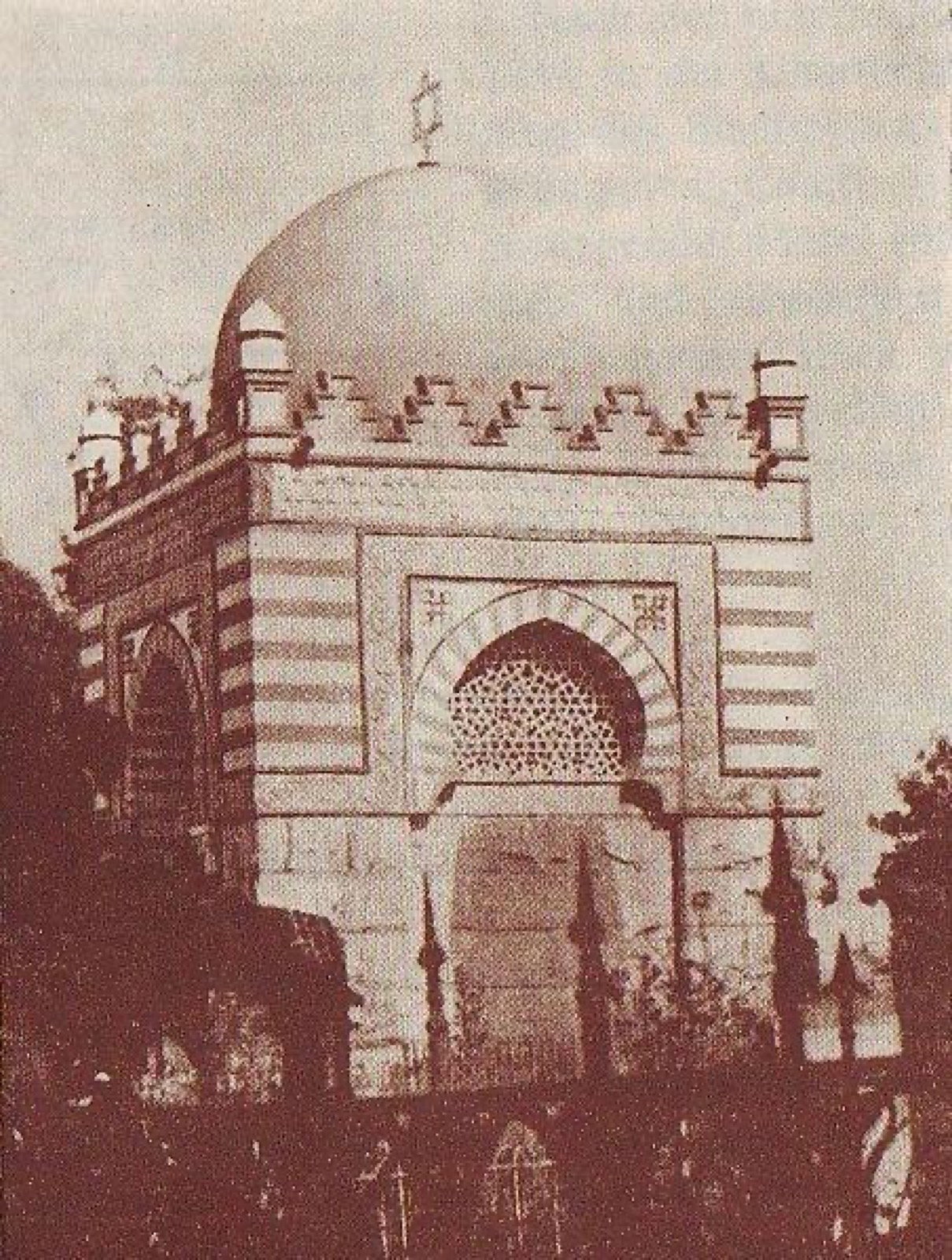
The Schaje Levinovitsch chapel-mausoleum (architect Jacques Rosenbaum, 1908; demolished 1963). Photo before 1944 (public domain).
See also
Sources: Wikipedia (et) “Tallinna vana juudi kalmistu”; Estonian Jewish Museum; Jewish Heritage Europe (2023); ERR; City of Tallinn (tallinn.ee).