Sibgadulla Mähdejev
Sibgadulla Mähdejev (b. 1863 in Nizhny Novgorod province – d. 1939 in Tallinn) was, before the First World War, the most honoured and richest Estonian Tatar, whom the Estonian press called “the king of the Tatars”. He founded the Tatar cemetery in Tallinn and was a central supporter of the pre-war Tatar community.
Life and business
Mähdejev arrived in Tallinn in 1885 and opened his first shop in 1892. His wealth came from trade in fur, rugs and jewels; he had business partners in Saint Petersburg and Pskov, and dukes and grand dukes among his customers. He made regular business trips to Saint Petersburg and to Haapsalu, a resort favoured by the Russian elite. During the Russian Civil War he traded with White émigrés who had fled to Estonia and made notable profits. Mähdejev married twice and had thirteen children, of whom six reached adulthood; his son Hairulla was born in 1892 and his son Ibrahim in 1904.
“The king of the Tatars”
Mähdejev was a generous supporter of the community: he cared for its poorer members and donated money for wells and bridges in his home village. His house at Raua Street 57 held the Tatar Sunday school and was home to the community's mulla.
Founder of the cemetery
In the early 20th century Mähdejev founded the Tatar cemetery beside the Siselinna cemetery in Tallinn, enclosing it with a stone wall and a crescent-topped iron gate. By tradition, the wall and gate were built with money the Jewish community gave him in thanks for helping them obtain land from the governor for their own cemetery. The cemetery was the backbone of the community for decades; it was destroyed under the Soviet occupation. By family tradition, the founding was an act of gratitude to God: his first daughters had died as newborns, while his sons survived.
Death, 1939
When Mähdejev died in 1939, the newspaper Uudisleht wrote on 14 April: “The king of the Tatars is dead!” Almost all of Tallinn's Tatars attended the funeral, led by the spiritual head of Finnish Muslims, Väliahmäd Hakim. Mähdejev's relatives gave away a thousand crowns so that people could buy something in his memory.
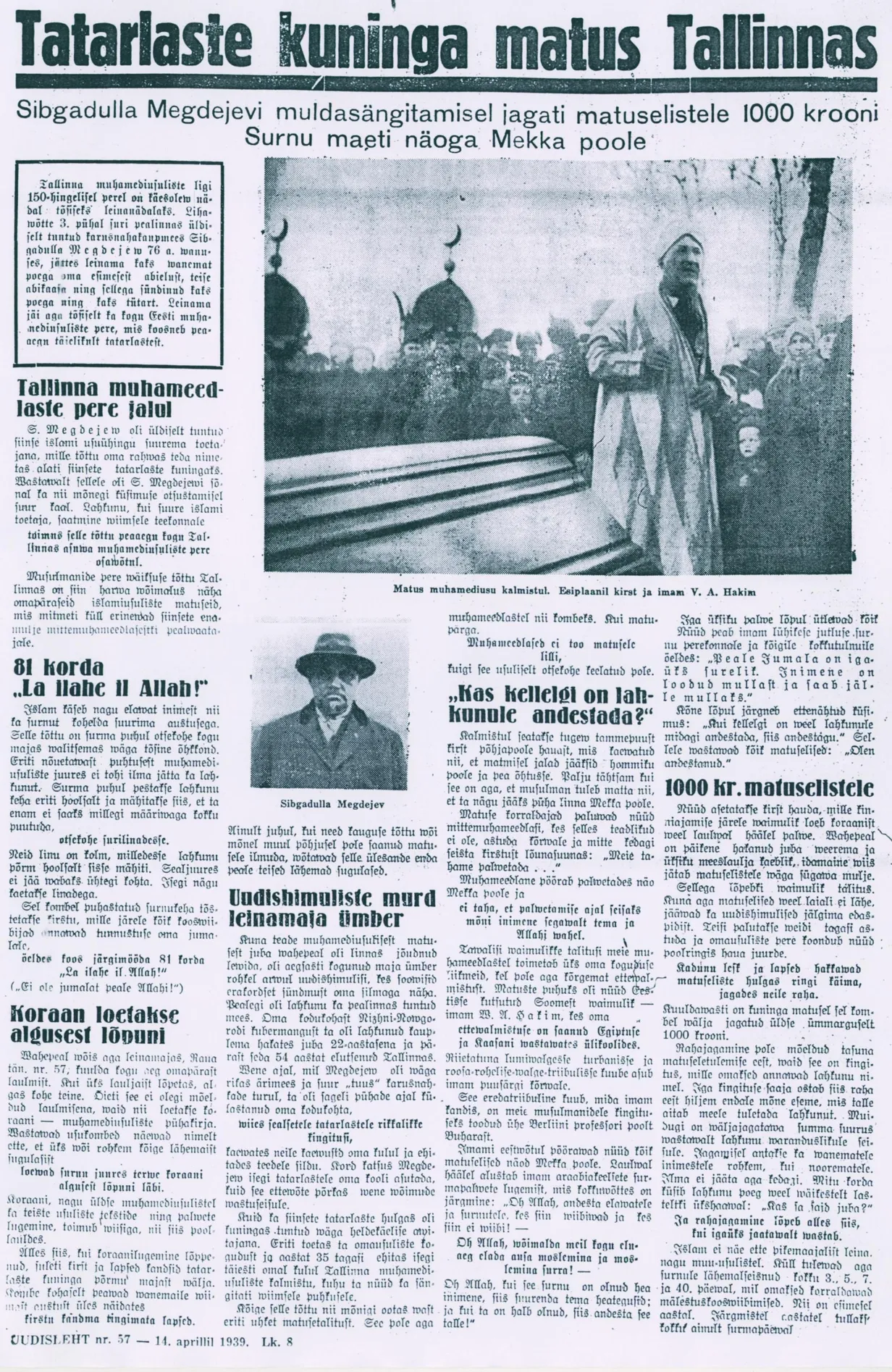
The funeral of Sibgadulla Mähdejev, 1939. Photo: Tallinn City Museum.
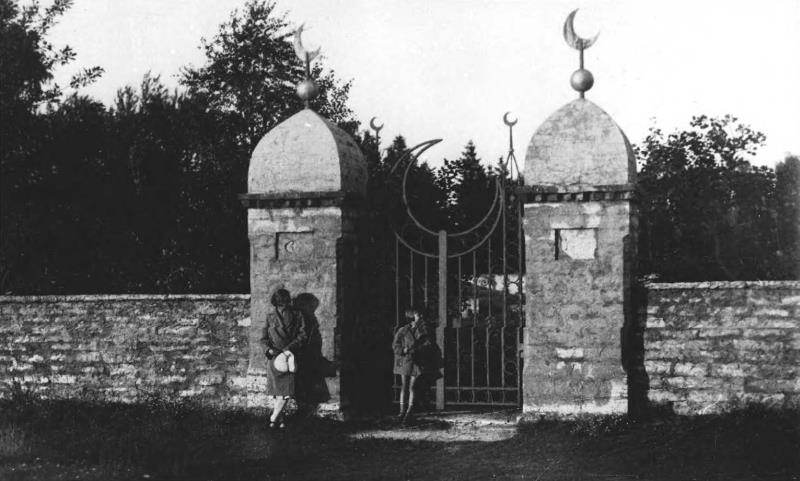
The Muslim cemetery gate founded by Mähdejev.
See also
Sources: Toomas Abiline and Ringo Ringvee, 'Estonia', in Muslim Tatar Minorities in the Baltic Sea Region (Brill, 2016), pp. 105–127; Uudisleht, 14 April 1939. Name-forms vary between sources (Mähdejev ~ Megdejev).