The history of Narva
Narva is Estonia's easternmost city, on the Narva River at the Russian border. For centuries it was a prosperous trading town and a jewel of Swedish-era Baroque — and also a second home of the Estonian Tatars: up to half of the historical Estonian Tatar community lived in Narva. The Second World War and the Soviet occupation changed the city beyond recognition.
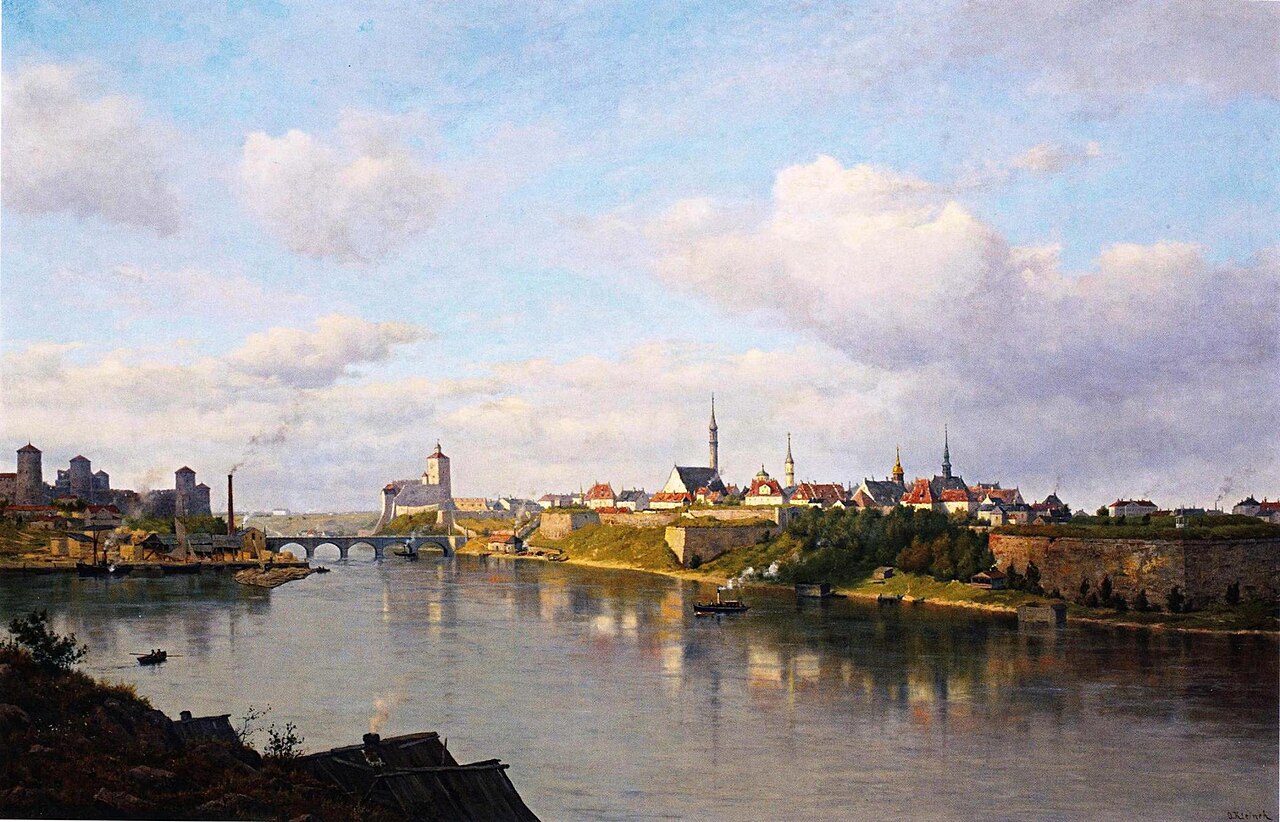
View of the historic town of Narva across the Narva River, oil painting from around 1894 (Oscar Kleineh (1846–1919); Public domain; Wikimedia Commons)
The Middle Ages and Hanseatic trade
The castle was founded under Danish rule of northern Estonia in the 13th century (first recorded 1277). In 1345 Narva received Lübeck city rights, and in 1346 the Danish king sold his northern Estonian lands to the Livonian Order. Throughout the Middle Ages the town lived on Hanseatic long-distance trade, though Tallinn's opposition kept Narva out of the Hanseatic League and small. In 1492 Grand Prince Ivan III of Moscow built the fortress of Ivangorod on the opposite bank — the two fortresses face each other to this day.
Swedish rule and the Baroque town
In the Livonian War Russian forces took Narva in 1558; in 1581 Sweden conquered it and Narva became part of the Swedish realm. Under Swedish rule the famous Baroque Old Town was built, and from the 1680s a powerful system of bastions designed by the renowned military engineer Erik Dahlbergh. Narva flourished as a trading town; there was even a passing idea that it might become Sweden's second capital.
The Great Northern War
During the Great Northern War, in November 1700, the first great battle between King Charles XII of Sweden and Tsar Peter I of Russia was fought at Narva — the young Swedish king won. In 1704 Peter I finally took the city, and Narva remained in the Russian Empire. After that war, as discharged soldiers stayed on, the first lasting Tatar community in the Estonian lands also formed.
An industrial town
In 1857 the Kreenholm Manufacturing Company was founded, growing into one of the largest cotton mills in Europe — about 10,000 workers by the turn of the century; in 1872 the first strike in Estonia took place there. By the century's end 41% of all Estonia's industrial workers laboured in Narva. The pull of industry also brought Mišär merchants, whose customers were both workers and other Muslims.
Narva and the Estonian Tatars
During the Republic of Estonia (1918–1940) Narva was, alongside Tallinn, the main centre of the Estonian Tatars — by the community's own estimate about half of them lived here. The Narva Muhammadan Congregation was registered on 18 May 1928 and the former North Estonian Bank building was adapted as its religious centre; on 28 September 1928 the Narva Tatar Cultural Society was founded (founder Veliulla Fetkullin); on 29 July 1935 Estonia's first mosque opened on Kiriku Street. Tatars often spent summers at Narva-Jõesuu, where children's summer schools were held and the last great gathering took place in 1939.
Destruction (1944)
On 6 and 7 March 1944 the Soviet Air Force destroyed Narva's Baroque old town by bombing; by the end of July 1944, 98% of the city lay in ruins. After the war much could have been restored — the walls still stood — but in the early 1950s the Soviet occupation authorities decided to demolish the ruins and put up apartment blocks in their place. The former residents were not allowed to return; among them were Narva's Tatars, who moved mostly to Tallinn and Rakvere — after which the Narva Tatar community ceased to exist.
The occupation-era population replacement
In place of the locals, Russian-speaking workers were brought in en masse from outside Estonia. By the 1934 census Narva was still 65% Estonian; by 2011, 87.7% of its residents were Russians and only 5.2% Estonians. Thus a new, Soviet-style city with a new population was built over old Narva — one of the clearest examples in Estonia of the occupation's reshaping of settlement and historical memory.
See also
Sources: the Wikipedia article 'Narva'; Toomas Abiline and Ringo Ringvee, 'Estonia' (Brill, 2016) on the Narva Tatar community. Population figures and percentages are from censuses and the sources.