How the Mišär Tatars came to Tallinn
A community tradition of origins
The community has passed down the following oral tradition about its origins:
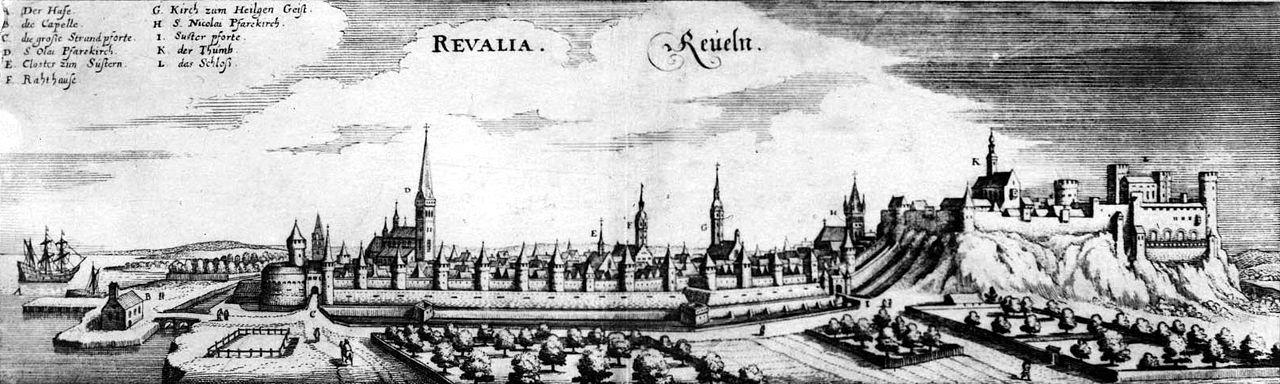
Seventeenth-century view of Tallinn, an engraving by Adam Olearius showing the harbour, city walls, churches and Toompea Castle (Adam Olearius (1603–1671); Public domain; Wikimedia Commons)
About 600 years ago the Tatars came to the Volga and Bulgar region, having come from further away — the tradition names Iran. They built beautiful houses and made robes of horse-hide. When the Russians wanted to attack them, the Arabs came to help — on condition that the Tatars adopt the teachings of the Quran. The Arabs saved them and marvelled at how well the Tatars lived: fine houses, clothing and military equipment.
The historical background of the tradition
The tradition reflects the history of Volga Bulgaria. The Bulgars were an Oghuric Turkic people who settled the middle Volga and Kama region in the 8th–9th centuries and were at first under the dominance of the Khazar Khaganate.
In 921 the Bulgar ruler Almış sent an envoy to Caliph al-Muqtadir in Baghdad, requesting religious instruction as well as military and financial support against the Khazars and help building fortifications. In response, an embassy reached Bulgaria in 922 with Ahmad ibn Fadlan as its secretary; he arrived at the city of Bolgar on 12 May 922, and Bulgaria formally adopted Islam — 66 years before the Christianization of Kievan Rus'.
Ibn Fadlan's travel account (the Risala) describes the life of the Bulgars and the peoples of the Volga. Bolgar and Bilär were thriving trade cities that rivalled the greatest centres of the Islamic world in wealth, commanding the Volga trade route between Europe and Asia. This is exactly what the tradition's image of “the Arabs came and marvelled at how well the Tatars lived” recalls.
Tradition and history. The tradition is not a precise chronicle, but it captures the core. Some details are folklore's own: the adoption of Islam happened more than a thousand (not 600) years ago; help was sought against the Khazars, not the Russians (Kievan Rus' and later Moscow only threatened Bulgaria centuries later); and the Tatars' roots are Turkic, not Iranian — though Persian trade and cultural influence on the Volga was strong. Volga Bulgaria gained full independence after the fall of Khazaria (late 10th century) and was conquered by the Mongols in 1236, becoming part of the Golden Horde.
Sources: Volga Bulgaria (Wikipedia); Ahmad ibn Fadlan (Wikipedia). On the origin of the merchant wave: the Wikipedia articles 'Finnish Tatars' and 'Mishar Tatars'; the City of Helsinki history portal ('Tatars in Helsinki'). General data on the Mišär people: the Wikipedia article 'Mishar Tatars'. This account also rests on this knowledge base's pages: the Mišär dialect, the Kipchak steppe, the Golden Horde, the Qasim Khanate and the Finnish Tatars.
The Mišärs in numbers and territory
The Mišärs are the second large subgroup of the Volga Tatars (after the Kazan Tatars), numbering about 2.3 million — roughly a third of all Volga Tatars; the 1897 census counted 622,600. They live in the middle and western Volga regions — Mordovia, Tatarstan, Bashkortostan and the Ryazan, Penza, Ulyanovsk, Orenburg, Nizhny Novgorod and Samara oblasts — and many have moved to Moscow. Mišärs living apart from the Kazan Tatars often simply call themselves Tatars.
The name 'Mišär'
The name comes from the historical Meshchera region (Mišär Mišär yortı) between the Oka and the Sura. Several explanations exist: the linguist J. J. Mikkola derived it from a Mordvin word meaning 'beekeeper'; another links it to the medieval name-forms Madjar ~ Mazhar ~ Mišär, suggesting a possible connection with the Hungarians (Magyars).
Theories of origin
Among the Mišärs' ancestors have been counted the Burtas, Bulgars, Khazars, Kipchak-Cumans and Ugric Magyars. The Finno-Ugric substrate theory (Velyaminov-Zernov, Radlov) holds that the Mišärs descend from a 'Tatarised' Finno-Ugric Meshchera tribe; this is contested by Zekiyev, Akhmarov and Orlov, who see the Meshchera as originally a Turkic (Kipchak) tribe. Most researchers agree the ancestors belonged to the Golden Horde, and that Kipchaks built strongholds in the region (Temnikov, Narovchat, Shatsky, Kadom). The Hungarian link is supported by Friar Julian's report of 1235, who found in Bashkiria 'Eastern Hungarians' who spoke a Hungarian mutually intelligible with his own.
The western dialect — closest to Kipchak
Mišär is the western dialect of Tatar, considered the closest to the archaic Kipchak language. It lacks the labialised [ɒ] and the back [q], [ʁ] of Central Tatar; some local dialects have the affricate [tʃ], others [ts]. Radlov and Samoylovich classify Mišär as Kipchak-Cuman rather than Kipchak-Bulgar. The Sergach dialect is considered especially archaic.
Sergach — the 'real Mišärs'
The historian Alimzhan Orlov considers the Mišärs of the Sergach country in Nizhny Novgorod the 'real' or purest Mišärs, who have preserved the Kipchak language, culture and customs. It is from this country that the ancestors of both the Finnish and the Estonian Tatars come; the Finnish Tatars are nicknamed 'Nizhgar' (Nizhgarlar). By Orlov, the Nizhny Novgorod Tatars are one of the most original Tatar groups, keeping the continuity of the Kipchak-Turkic language and heritage.
Difference from the Kazan Tatars
The Mišärs and the Kazan Tatars share the same language and Sunni Islam, but their formation differs: the Kipchak share was greater in the Mišärs, and they had a longer association with the Russian state. In 1885 the missionary Malov compared them, describing the Mišärs as having bushier beards, not showing off their clothes and speaking loudly. Anthropologically the Mišärs are more Europoid and less Mongoloid than the Kazan Tatars (Trofimova's data). Through migration and convergence the differences have decreased over time.
Notable Mišärs
From among the Mišärs have risen the leader of the Tatar national movement Ayaz İshaki (1878–1954), the imam of Saint Petersburg's first Muslim congregation Muhammed-Zarif Yunusov (1850–1914), the first imam of the Moscow mosque Bedretdin Alimov (imam 1904–1913) and the historian-philologist Husain Faizkhanov (1823–1866); today, for instance, the tennis player Marat Safin (b. 1980) and the tennis head coach Shamil Tarpishchev (b. 1948).
First contacts
Tallinn's first encounters with Tatars long predate any settled community. Already during the Livonian War, at the 1570 siege of Tallinn, Tatars made up a notable share of the Russian forces. The lasting connection, however, began a century and a half later in a far more peaceful way.
Soldiers who stayed
The first Tatar settlement in Tallinn formed after the Great Northern War, when Estonia passed to the Russian Empire in 1721 and Tallinn became a Russian naval base. Discharged sailors and soldiers, many of them Sunni Tatars, stayed in the city and bought land. In the community's own memory this grew into the “Tatari agul” — the quarter of Sakala, Tatari, Liivalaia, Ravi, Veerenni and Uus-Tatari streets, whose names survive to this day — with a second settlement, “Kompasna”, by the Härjapea stream in Kadriorg.
A prayer hall operated in Tallinn by the early 19th century, and by mid-century the city had a congregation with an imam.
The merchant wave from the Nizhny Novgorod villages
The roots of today's Estonian Tatar community, though, lie in a second, later wave. When serfdom was abolished in Russia in 1861, the villages gained freedom of movement, and from the 1860s–1870s onward merchants and pedlars arrived from the Mišär villages of the Nizhny Novgorod governorate, above all the Sergach district — the same region the Finnish Tatars come from. The community's memory has kept the names: around 1870 Zakir Zakerov reached Tallinn, whose shop near the Russian market trained 6–12 village apprentices a year in trade and Russian; the fur merchants Sibgadulla Mähdejev and Fateh Zakerov; and the lace merchant Umiar Zarip. Narva became the community's centre, with families settling in Tallinn and Tartu as well.
Why trade, of all things? The twenty-odd Mišär villages of the Sergach country sat on poor land: by the 19th century arable and pasture land had grown ever scarcer, and farming no longer fed the families. Short of income, the village men turned to trade — at first as seasonal itinerant peddling, travelling in winter and returning home for the summer field work.
The itinerant merchants sold fabrics, furs, ready-made clothes and soap — easily portable goods bought in the towns and resold in the villages. The trading journeys first reached Saint Petersburg; the railway opened up north-western Russia, and from Saint Petersburg they moved on to Finland (from the late 1860s) and to Estonia. Men of the same village network travelled together: a village's merchants sent for relatives and fellow villagers and took boys along as apprentices — and so whole village lines (Aktuk and Kuy-Su among them) carried over to the Baltic coast.
That origin is precisely why the Estonian Tatars' language is the Mišär ts-dialect: the speech of the Sergach country.
The villages of origin
The twenty-odd Mišär villages of the Sergach country, from which the merchant wave moved west, lie southeast of Nizhny Novgorod — in today's Krasnooktyabrsky district (centre Urazovka) and its surroundings. For the Finnish Tatars the villages are documented precisely, and since the Estonian Tatars are a branch of the same migration, these are our villages of origin too:
Village (Mišär name) | Russian name | Notes |
|---|---|---|
Aktuk (also Yañapar “new Par”) | Aktukovo | The principal village: over half of the Finnish Tatars came from this one village, the rest from its surroundings. Founded in the 1640s from the Par/Para settlement of Temnikov service Tatars; named after the elder Aktök. |
Suksu (Suıksu “cold water”) | — | On the village list of the Finnish Tatar community literature. |
Kuysue (Kuy Suwı “sheep water”) | Ovechy Ovrag (“sheep ravine”, a Russian calque) | Estonian sources name this village (spelled Kuj-Su, also Kuj-Sud) as one of the main places the merchants who came to Estonia set out from (Ahmetov and Nisamedtinov 1999; Abiline and Ringvee 2016). Home of the noted ishan family Alimov, who gave the Moscow Cathedral Mosque its first imam. |
Mädänä | Medyana | On the same list; in today's Krasnooktyabrsky district. |
Tšümbäli (Çümbäli) | — | On the same list. |
Other Mišär villages of the same cluster: Urazovka (Urazawıl — grown from the same Par/Para settlement as Aktuk), Öçkül (“three lakes”), Kadımawıl (“old village”), Andrejevka (Möterawıl) and the large village of Petryaksy in the neighbouring district.
In independent Estonia
Estimates of the community's size before the First World War vary widely — some sources speak of a handful of families, others of up to two thousand people, many of whom left after 1918. In the 1920s a couple of hundred Tatars lived in Tallinn, Narva, Jõhvi and Rakvere; the 1934 census counted 170 Muslims in Estonia, 166 of them Tatars.
The Estonian Republic gave the community a legal home: the Narva Mohammedan Congregation was registered on 18 May 1928 (renamed in 1937), and the Tallinn Mohammedan Religious Society — in 1940 by the community's own history (Wikipedia gives 1939). Prayer halls operated on Raua and Sube streets under imam Adiatulla Minahztetin; the Tatar Cultural Society organised gatherings, music and excursions to the kindred community in Finland, and Sunday schools taught children the Tatar language, history and the basics of the faith. The wealthiest merchant, Sibgadulla Mähdejev (1863–1939), called the “King of the Tatars”, financed the founding of a Tatar cemetery in Tallinn. When Imam Alimdžan Idris visited Estonia in 1934, he praised the republic's constitution for granting minority peoples rights equal to Estonians. In the community's own memory, the first republic remained the era when they could live in peace, work, and honour their customs.
Alongside the congregations, cultural societies arose. On 28 September 1928 the Narva Tatar Cultural Society was founded (founder Veliulla Fetkullin); in Tallinn a Tatar Cultural Society was active, its board made up of the community's respected men. The societies organised choral singing (both an older men's and a youth choir), plays, musical evenings and trips to the Finnish Tatars, and ran summer schools at Narva-Jõesuu — the last great gathering was held there in the summer of 1939.
War and the Soviet occupation
The occupation authorities dissolved both congregations in 1940, and the fighting of 1944 destroyed Narva together with the community's centre there. After the war the centre of gravity shifted to Tallinn. During the Soviet occupation the number of Tatars in Estonia grew through in-migration.
Today
Today the historical Estonian Tatars celebrate Estonian holidays — each according to how far their family's religious customs have been kept or have changed.
According to the 2011 census, 1,993 Tatars lived in Estonia, 1,012 of them in Tallinn — the city where the community's Estonian story once began. The Tatar Culture Society, the Narva Tatar Culture Society and the Estonian Tatar Society Altõn are active; Tatars were also among the founders of Estonia's Islamic congregation. These societies and other Tatar unions, however, represent rather the interests of Kazan Tatars; the Union of Estonian Tatars, by contrast, focuses solely on the historical Estonian Tatars and their Mišär heritage, making exceptions only by decision of the board. The Union regards as a historical Estonian Tatar a person whose Tatar family reached Estonia before the Soviet occupation, and takes as its task the preservation of this community's history, language and customs. The Union's tasks also include representing and commemorating the historical Estonian Tatars in connection with the old Muslim cemetery, and cooperating with the Estonian History Museum to archive this history.
Among Tatars, those of Mišär descent are still not distinguished, so an exact number of Mišär Tatars cannot be given — censuses do not separate the different Tatar groups. Only a few speakers of the Mišär Tatar language are known to remain in Estonia. They work to save Mišär: enriching it with neologisms and with older Turkic, Kipchak and Cuman languages. This is the work of the Union of Estonian Tatars, which represents the descendants of the historical Estonian Tatars.
Figures and details rest on the sources listed below; estimates for earlier periods vary between sources and are presented here with caution.
See also
The Estonian Tatar community in the Republic of Estonia (1918–1940)
We are the Estonian Mišär Tatars
Sources: Wikipedia “Islam in Estonia” and “Eesti tatarlased” (et.wikipedia.org); research by R. Ringvee and others on Estonian Tatars; Springer, “Horsemeat in the culinary traditions of the Mishär Tatar diaspora” (2020). Villages of origin: Suomen tataarit (fi.wikipedia.org); Finnish Tatars, Aktuk, Krasnooktyabrsky District (en.wikipedia.org); Medyana (Wikidata). D. Ahmetov and R. Nisamedtinov, “Tatarlased” — Eesti rahvaste raamat (Tallinn, 1999), 449–452; T. Abiline and R. Ringvee, “Estonia” — Muslim Tatar Minorities in the Baltic Sea Region (Brill, 2016), 105–127.
See also: Tatar life in the Russian Empire.