Reburials under the Soviet occupation
When the occupation authorities closed and razed Estonia's cemeteries, the dead often had to be reburied elsewhere. This page gathers what is known about the reburials — chiefly through the closure of Tallinn's Inner City (Siselinna) necropolis and the F-quarter of the Liiva cemetery, documented in Carl-Dag Lige's 2022 expert assessment and the archival acts.
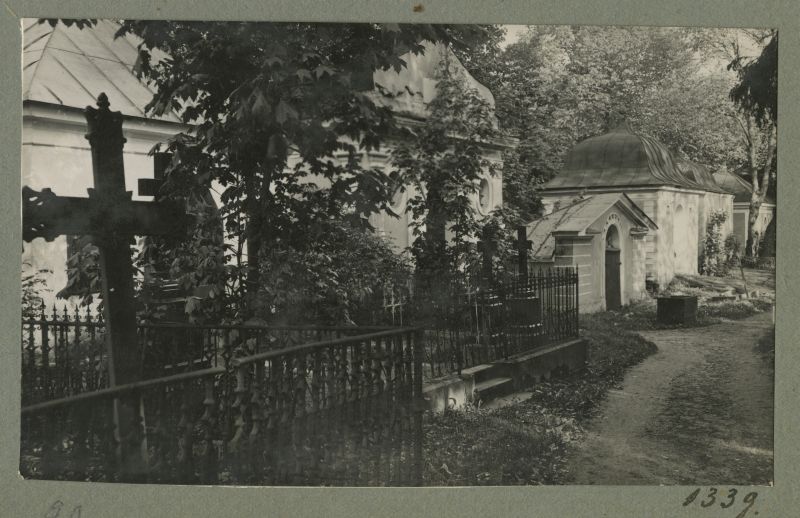
Kopli cemetery in Tallinn in the 1920s, before the occupation authorities razed it in the early 1950s and turned it into parkland (Karl Akel (1878–1942); Public domain; Wikimedia Commons)
1955: the closure of the Inner City necropolis
Tallinn City Executive Committee decision No. 83 (29 March 1955) ordered the closure for burial of the whole Inner City cemetery — the Alexander Nevsky (Russian Orthodox), Vana-Kaarli, Catholic and Muslim (Tatar) cemeteries. For the Apostolic-Orthodox, the Catholics and the Muslims, new burial districts were to be allocated from 1 April 1955 in the F-quarter of Tallinn's Liiva cemetery. In December 1955 (Estonian SSR Council of Ministers protocol No. 63) and January 1956 burials in family plots were still allowed in the Russian Orthodox and Vana-Kaarli parts where there was room — but the Catholic and Muslim cemeteries stayed closed.
The reburial of the Tatars
Although Islamic custom does not practise reburial, several remains were reburied from the Muslim cemetery to the Liiva cemetery (the F-quarter) in the late 1950s. For the community it was a double pain: they had to rebury their own relatives' remains, against their religious custom. See The cemetery as the community's backbone.
Catholics and Baltic Germans
From the Catholic cemetery it was deemed reasonable to rebury graves younger than 25 years (Estonian Heritage Yearbook 2007) — the rest were left under the tennis stadium and the park.
From the Kopli Baltic-German cemetery only a few notable figures were reburied — the writer Eduard Bornhöhe, the actress Netty Pinna, the composer Konstantin Türnpu and Erika Tetzky; the tens of thousands of others were leveled.
The pattern
Reburial was selective and often partial: families were allowed plots at the main (Russian Orthodox) cemeteries, the minority congregations were given a narrow F-quarter at Liiva, and for those whose religious custom forbids reburial (Muslims, Jews) forced reburial was an added desecration. See also Orthodoxy under the Soviet occupation and communist crimes against Estonia's minorities.
See also
Sources: Carl-Dag Lige, „The Tallinn Muslim cemetery, Tehnika St 171 — expert assessment” (Tallinn 2022; heritage department of the Tallinn Urban Planning Department), citing acts of the Tallinn City Archives (TLA.R411.1.14; TLA.1148.1.16); Carl-Dag Lige and Oliver Orro, Muinsuskaitse aastaraamat 2007; Toomas Abiline and Ringo Ringvee (Brill, 2016).