The Soviet Union needed help to fight its former friend
This page is a summary of what kind of country the Soviet Union was — and what that meant for the occupied. It was not enough for Stalin to pressure Estonia into giving away its freedom at gunpoint and then to deport innocent people — and to do so while he himself was cooperating with the Nazis. When the Nazis betrayed him on 22 June 1941 with Operation Barbarossa and the first heavy defeats came, he suddenly needed help from the West — supplies and a second military front to relieve the pressure on his troops. In my view this paints a picture of what the Soviet Union was — and gives a sense of what life may have become for the occupied thereafter.
Taking freedom away — in cooperation with the Nazis
On 23 August 1939 the USSR and Nazi Germany divided Europe by the Molotov–Ribbentrop Pact; Estonia was assigned to the Soviet sphere. On 28 September 1939 the USSR forced the bases treaty on Estonia at gunpoint — and on that very same day, in the same Kremlin, the USSR and Nazi Germany signed the Boundary and Friendship Treaty. Estonia's last free moments passed between two devils. Read: 28 September 1939 — A dance of death between two devils.
Deporting the innocent
On 14 June 1941 the occupation authorities deported over 10,000 innocent people from Estonia to Siberia in cattle cars — still during the era of Soviet-Nazi cooperation, just a week before Barbarossa. Read: Communist crimes against Estonia's minorities.
Supplies from the West
This same Soviet Union, which had occupied Estonia and deported the innocent, needed Western aid to survive. Through Lend-Lease the USSR received from the United States and Great Britain vast quantities of trucks, food, aircraft, fuel and raw materials — without which the Red Army could not have advanced or held out. Read: Lend-Lease and the Soviet Union.
Despite being overlooked in many circles, American “Lend-Lease” support sent to the USSR not only tipped the scales in Eastern Europe but enabled the victory on the Russian Front.
— Lend-Lease and the Eastern Front, The National WWII Museum.
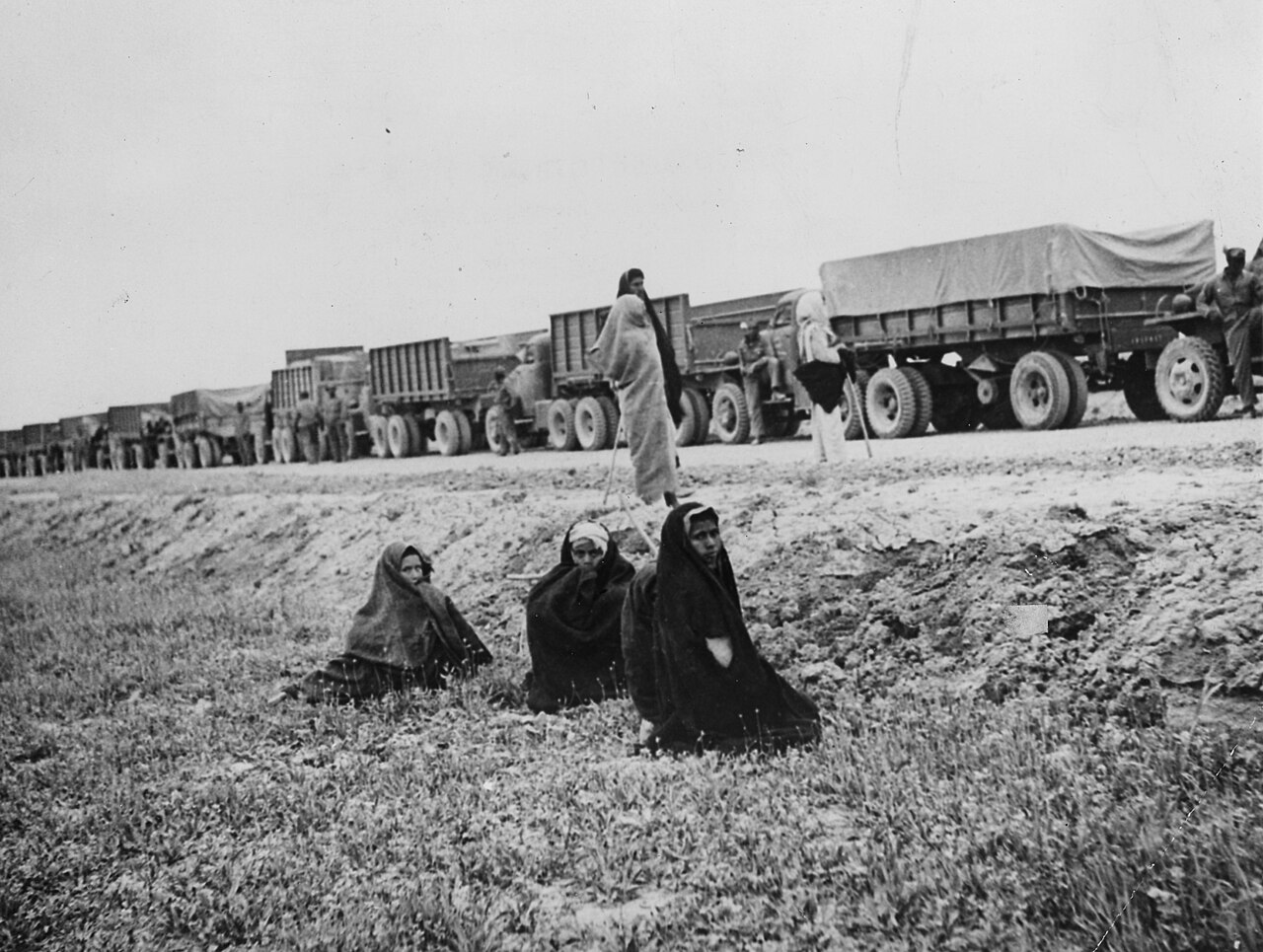
A convoy of American Lend-Lease trucks bound for the Soviet Union via the Persian Corridor (Iran, 1943). Photo: U.S. National Archives (NARA), public domain.
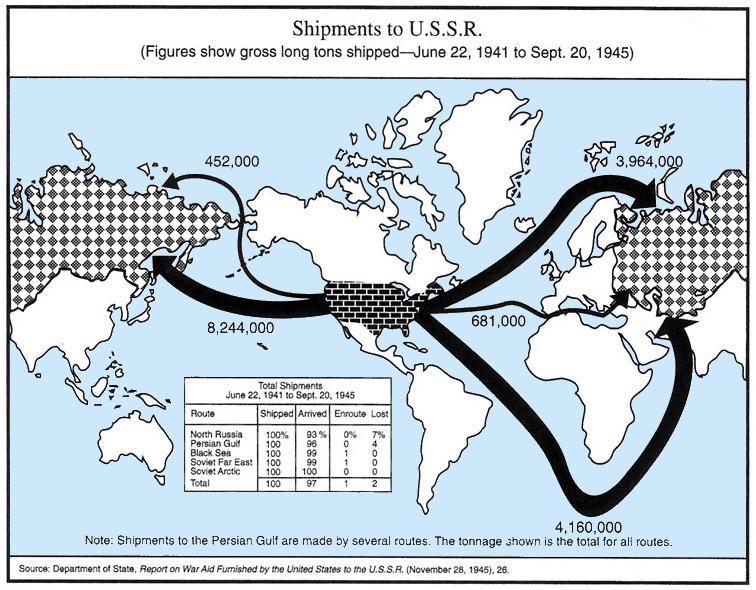
The routes of Lend-Lease shipments to the Soviet Union: the Arctic convoys, the Persian Corridor and the Pacific route. Map: U.S. Department of State, Report on War Aid Furnished by the United States to the U.S.S.R. (1945) — public domain (U.S. government work).
A second front
At the same time Stalin relentlessly demanded that Churchill and Roosevelt open a second front in the west, to relieve the pressure on his troops — already in his very first letter in 1941, and for years after. Read: The Kremlin Letters — the psychology of the Big Three's correspondence.
And what life was like for the occupied afterwards
For the Estonian Tatars the occupation meant the dissolution of the congregations and the destruction of the old cemetery, the pressure of Russification and Estonianisation, and the shadow language of the occupation. The community became an invisible part of society, often with only a name left. Read the whole picture: the cultural genocide.
See also
Sources: see the pages “Lend-Lease and the Soviet Union” and “The Kremlin Letters” (and the sources cited there).