Russification
Russification is a form of cultural assimilation in which non-Russians adopt Russian culture and the Russian language as a result of state policy. It was pursued by both the Russian Empire and the Soviet Union, either as a goal in itself or as a side-effect of policies of centralization.
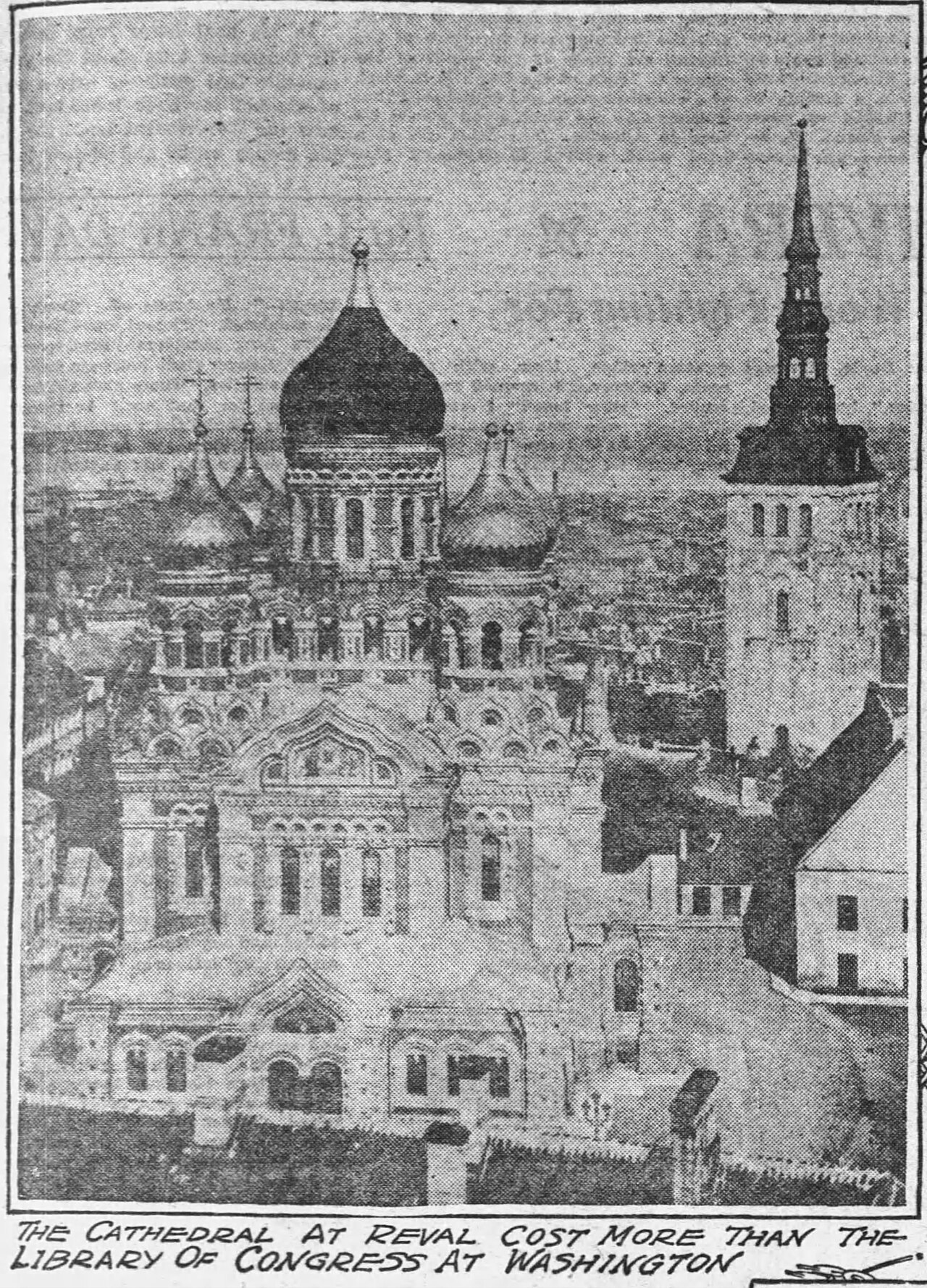
The Alexander Nevsky Orthodox Cathedral on Toompea hill in Tallinn, built around 1900 as a symbol of Tsarist-era Russification; historical photograph from 1923. (Frank G. Carpenter; Public domain; Wikimedia Commons)
Impact on the Estonian Tatars
The Russian ending -ov was added to the Estonian Tatars' surnames on several occasions; the author's grandfather had it removed as soon as Estonia was free again. During the occupation Estonian-language street signs were changed to Russian and the main language of communication became Russian.
The author stresses that disliking Russification does not mean disliking Russians as people — the blame lies with the regime and its policies, not with ordinary people.
The literary language and the reforms of the Soviet occupation era
The Tatar literary language shows the effects of russification with particular clarity. One of the earliest works of Tatar literature is the narrative poem Qissa-i Yusuf (The Story of Yusuf) by the Volga-Bulgar poet Qol Gali (Qul Ghali, c. 1183–1236), completed around 1233 (learntatar.com dates its composition to c. 1212–1233). From then on the Tatar literary language used the Arabic script for centuries.
Under the Soviet occupation the literary language was moved to a new script twice: the Latin alphabet was adopted in 1927 and used until 1939; at the end of the 1930s the language was forced over to Cyrillic.
The russification measures included making Russian compulsory and replacing the Arabic-Persian loanwords with Russian terms.
Tatar was declared a state language of Tatarstan (alongside Russian) only in 1992.
The same pattern — take away a people's script, replace its vocabulary with Russian — is the core of russification: the language is left standing, but its backbone is swapped out. This project's Estonian Tatar alphabet is written in Latin script partly to turn that current back.
See also
See also: What an ordinary Russian is taught about history.
Sources: Russification. Literary language: Wikipedia “Tatar language”, “Qol Ghali”; learntatar.com.
See also: Minority peoples in present-day Russia.