Tatar traditions and customs
Note. The customs and holidays described here (Sabantuy, Narduğan, Cıyın, etc.) are rather Kazan Tatar traditions and holidays, not those of the Estonian (Mišär) Tatars. Mišär-specific features are few; most of what is described below is pan-Volga-Tatar (Kazan) heritage. The Estonian Tatars, however, have their own living, present-day customs — see below.

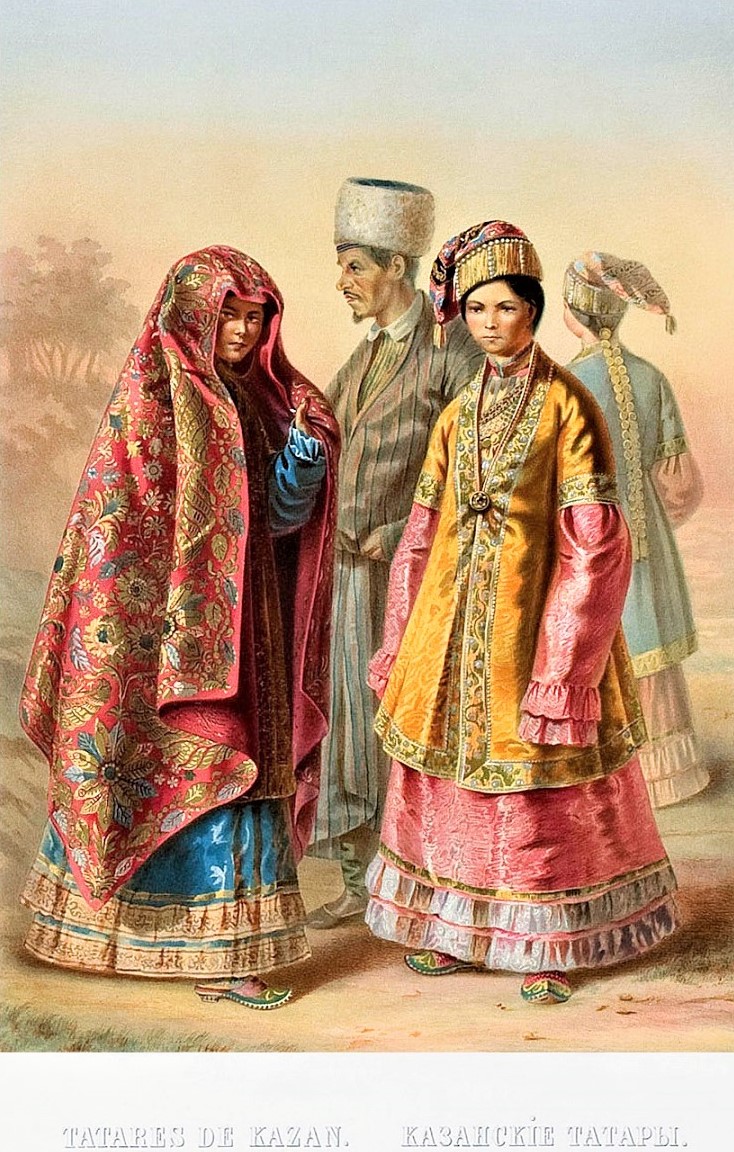
Kazan Tatars in traditional folk costume, a hand-coloured lithograph from 1862 (Gustav-Theodor Pauli (Gustav-Fyodor Khristianovich Pauli); Public domain; Wikimedia Commons)
Tatar traditions and customs encompass the folk traditions of the Volga Tatars (including the Kazan and Mišär Tatars) — seasonal festivals, family and wedding customs, and tea culture. The main source for this overview is Aygul Ahmetcan's website learntatar.com, which gathers sub-articles on spring and summer festivals (Saban tuyı, i.e. Sabantuy, and Cıyın), the winter-solstice rite Narduğan, courtship, funeral customs, and tea culture. The core traditions are largely of pan-Volga-Tatar origin, though some carry documented Mišär-specific variants.
Relation to the Mišär Tatars: this topic is mixed. The core customs — Sabantuy, Cıyın, Narduğan, tea culture, and the chak-chak wedding custom — are in origin pan-Volga-Tatar (Kazan-Tatar) practices shared with Bashkirs and others, and are therefore not Mišär-specific in origin; this is the honest starting point. However, there are genuinely sourced Mišär angles: learntatar.com notes that among Mišärs the winter rite Narduğan is called "Raštuwa," that Mišärs made a sweet called "bawırsak" and practised marriage and fortune divination (including ring divination with water drawn from an ice hole), and that in Mišär regions the egg-dyeing custom was called "olı kön." Independent sources confirm that the Estonian (and Finnish) Tatars are Mišärs originating from the Sergachsky District of Nizhny Novgorod Governorate (many families from the village of Aktuk) whose general traditions are the Estonian Tatars' own heritage as Mišärs. An important qualification: people of historical Estonian Tatar background do not celebrate Sabantuy to any great extent — the Sabantuy events held in Estonia are organized mainly by later Russian-speaking Tatar immigrants (and the Bashkir cultural association), not by the historical community. Most of the festival details described are therefore general Volga-Tatar rather than uniquely Mišär. Any claim that, for example, the wrestling rules or the tea-road history are distinctively Mišär is an educated guess unsupported by the sources.
A summary classification — what is general Tatar, what Kazan, what Mišär:
Custom / holiday | Whose is it? |
|---|---|
Sabantuy (spring festival) | Kazan Tatar — the historical Estonian Tatars do not really celebrate it |
Cıyın (summer gathering) | Kazan / pan-Volga |
Narduğan (winter solstice) | Kazan / Volga-Bulgar |
Tea culture | general Tatar |
Wedding and family customs | general Tatar, described from Kazan sources |
Uraza bäiräm (Eid al-Fitr) | general Tatar — an attested holiday of the Estonian Tatars themselves (Narva 1936) |
Communal cooking, remembering the old cemetery, attending the Song Festival | living customs of the Estonian Mišär Tatars |
The Estonian Tatars' own living customs
Unlike the pan-Volga-Tatar (Kazan) festivals described above, the historical Estonian Tatars have their own living, present-day customs, centred on holding the community together, keeping their language and food culture alive, and representing their heritage honestly. These include:
Communal gatherings where food is prepared and eaten together — cooking as a community keeps Estonian Tatar food culture alive.
Taking part in fairs and events, representing their minority-nationality organization and the heritage of the historical Estonian Tatars, i.e. their own historical kin.
Preserving and shaping the cultural identity of the historical Estonian Tatars.
The community union's aims and activities
These customs are carried by a union that brings the community together, whose aims include:
Promoting and introducing the Mišär Tatar language, culture and traditions of the historical Estonian Tatars.
Uniting the historical Estonian Tatars and representing their interests.
Recording, analysing and systematizing the Estonian Mišär Tatar language.
Organizing language teaching for the Estonian Tatars.
Keeping Estonian Tatar food culture alive.
Researching and documenting the history of the Estonian Mišär Tatars, including their connection with the Kipchaks.
Representing and commemorating the historical Estonian Tatars in connection with the old Muslim cemetery.
Cooperation with the Estonian History Museum so that Estonian Tatar history is archived correctly and honestly, without the influence of russification.
Respecting freedom of religion and people's personal choices in that regard.
The union's fields of activity include representing the interests of the historical Estonian Tatars, strengthening communal cohesion, continuously introducing Estonian Tatar culture and history, and recording the Estonian Mišär Tatar language and enabling its teaching.
Sabantuy — the spring festival
Sabantuy (Tatar Saban tuyı) means "plough's feast/festival" in Turkic languages, from saban (plough) + tuy (feast/festival), and is an agricultural celebration marking the end of spring field work. It traces to pre-Islamic times and was documented by the Arab traveller ibn Fadlan in 921; originally celebrated before the sowing season, it became a secular holiday as Islam and Christianity spread among the peoples who kept it.
Sabantuy is celebrated by Tatars, Bashkirs, Kazakhs and Chuvash; the Bashkirs call it Habantuy and the Chuvash call it Akatuy.
In its modern form it is held roughly from 15 June to 1 July on Sundays, beginning in villages and culminating in major cities such as Kazan.
It is celebrated internationally by the Tatar diaspora, including in Tallinn, alongside Moscow, Saint Petersburg, Prague, Istanbul, Kyiv and Tashkent; in China it is recognized as intangible cultural heritage.
Sabantuy contests
The central Sabantuy competition is köräš (kurash), a traditional wrestling in which opponents grip each other with towels or sashes. The champion becomes the batır ("hero") and wins prizes ranging from a ram to a car. Other contests include horse racing, sack races, pole climbing, egg-and-spoon races and pot-smashing.
In the pole-climbing contest, participants climb a slippery pole roughly 15–25 metres tall to retrieve a rooster or an embroidered towel.
The sack race covers about 75–100 metres.
learntatar.com lists Sabantuy egg games such as kükäyle uyın / yomırqalı uyın and the gift-collecting custom büllek cıyu, in which embroidered items and towels were gathered from households.
Cıyın — the summer gathering and Soviet suppression
Cıyın was a summer folk gathering held between spring fieldwork and haymaking, timed by phenological signs (for example, "when the rye is in bloom"). Until the 1920s it was more significant than Sabantuy; it was eradicated by the Bolsheviks and forgotten within two to three generations.
In 1925 the Tatar Communist Party Committee recommended merging the spring festival Sabantuy with the summer gathering Cıyın and moving Sabantuy to the post-sowing period.
The aim was to suppress Cıyın, which served as a platform for discussing local affairs and was seen as a source of dissent against Soviet authority.
Narduğan — the winter-solstice rite
Narduğan is an ancient winter-solstice rite among Tatars and other Volga-region peoples, observed on 21–22 December (for Christianized Keräšen Tatars, 25 December – 5 January). Its name derives from the Mongolian nar ("sun") and the Tatar tuğan ("born"), reflecting reverence for the sun and the sky-deity Tengri.
Narduğan featured costumed house-to-house processions in which participants portrayed bears and goats, cross-dressed, disguised their voices and concealed their faces.
Muslim clergy opposed it as a pagan practice; the ethnographer H. Gatina documented its survival into the early 20th century.
According to learntatar.com, among Mišär Tatars the rite is called "Raštuwa"; Mišärs made a sweet called "bawırsak" and practised marriage and fate divination, including ring divination with water drawn from an ice hole.
In Mišär regions the festive egg-dyeing custom was called "olı kön."
Tea culture
Tea reached the Tatars via the Great Tea Road through Kazan in the 17th–18th centuries, introduced by Tatar merchants from East Turkestan and Bukhara who obtained it from China and India. It was first an elite drink, while common people used taqta çäy (brick tea) diluted with milk, and the quality of the tea served came to symbolize a hostess's hospitality.
Wedding and family customs
The culmination of a traditional Tatar wedding is serving tea with the sweet pastry chak-chak, presented as a treat from the bride; sweets, pies and tea are set out on the table.
The Estonian Tatars and these festivals
The Estonian (and Finnish) Tatar community descends from Mišär Tatars who came, from the 1860s–1870s onward as merchants, from the Sergachsky District of Nizhny Novgorod Governorate — with many families from the village of Aktuk — selling fabrics, furs, clothes and soap. The Estonian Tatars are the country's largest historically Muslim community.
The Sabantuy held in Estonia is organized mainly by later Russian-speaking Tatar immigrants and the Bashkir cultural association, not by the historical Estonian Tatars — for example through the Tallinn Bashkir Cultural Association "Agizel" and a Maardu Sabantuy; for the Finnish Tatar community, a summer youth camp traditionally ends with the Sabantuy festival.
The congregation Narva Muhamedi Kogudus was registered in 1928 and Tallinna Muhamedi Usuühing in 1939; the 1934 census counted 170 Muslims (166 of them Tatars).
The Finnish Tatar community keeps a spring celebration for the Tatar poet Abdulla Tukay (Balalar Bäyräme, “Children’s celebration”); it is not a custom of the historical Estonian Tatar community.
See also
Sources: learntatar.com (Aygul Ahmetcan): Traditions, Saban tuyı, Winter rites — Narduğan, Cıyın, The Tatar tea culture; Wikipedia: Sabantuy (en), Sabantui (et), Islam in Estonia, Finnish Tatars, Mishar Tatars, Volga Tatars; tatarstan.eu (Sabantuy); articlewedding.com (Tatar wedding traditions).