Tatar cultural heritage
Tatar cultural heritage covers the material and spiritual tradition of the Volga Tatars: sacred architecture and mosques, the construction and furnishing of the traditional village house, crafts, folk dress, music, literature, and tea and food culture. This overview draws mainly on learntatar.com, whose Cultural Heritage section is authored by the Kazan-born architect Aygul Ahmetcan, together with supplementary sources. The heritage covered centres largely on Kazan's mosques, the Kazan-Tatar house, Kazan leather-mosaic boots, the kalfak headdress, and Kazan-Tatar cuisine and tea — all Kazan-Tatar reference points.
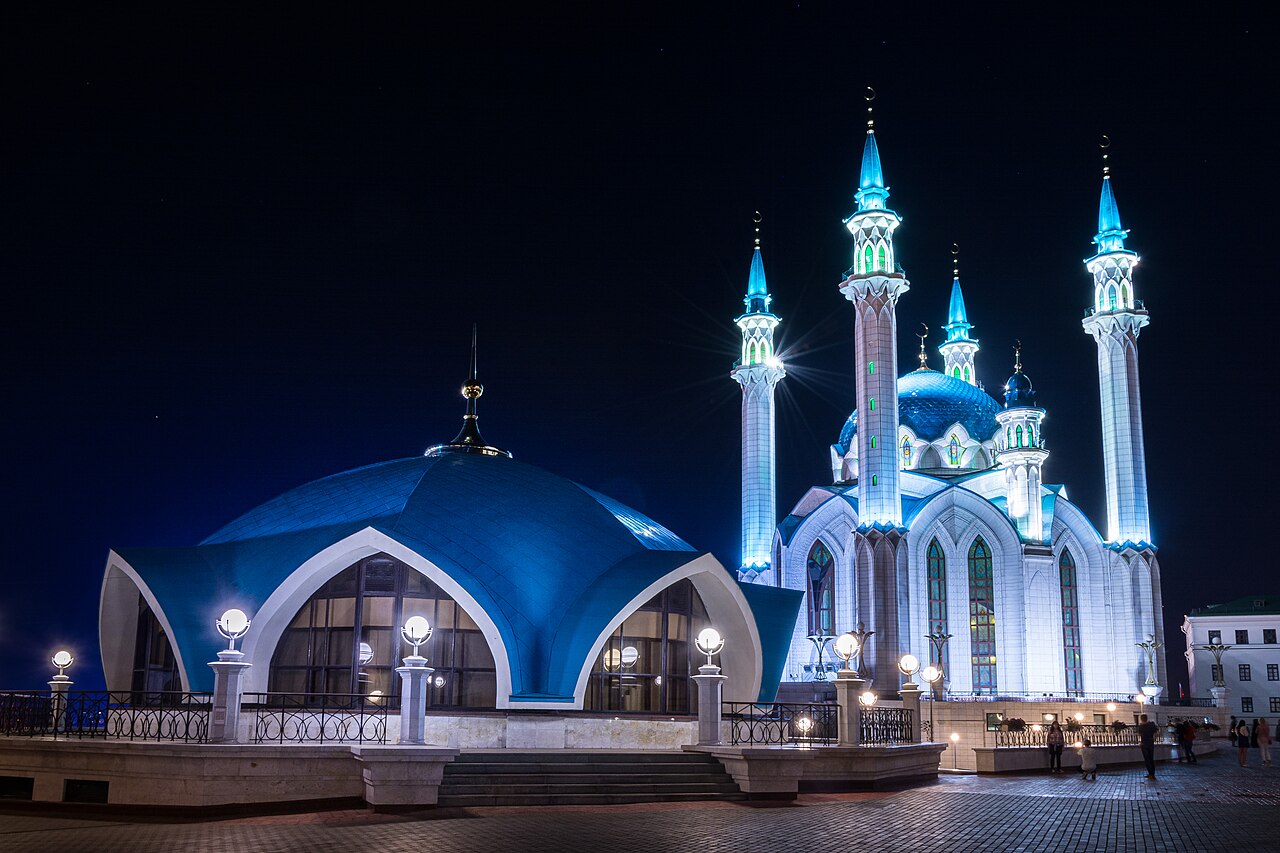
Kul Sharif Mosque in the Kazan Kremlin, a landmark of Tatar architecture (Michael Kuhn (kuhnmi); CC BY 2.0; Wikimedia Commons)
Relation to the Mišär Tatars: the heritage described here is overwhelmingly general Volga/Kazan-Tatar culture, not specifically Mišär. The Estonian and Finnish Tatars are Mišärs from the Sergach area of Nizhny Novgorod Governorate who speak the western Tatar dialect, close to Kipchak — but this link is chiefly genealogical, not artefactual. Sources note that the Mišärs once differed from the Kazan Tatars in dress, speech and customs, though these differences have largely eroded through contact; so which of the crafts, dress or music described above the Estonian community's Sergach-Mišär ancestors actually practised is not established by these sources. An educated guess (not sourced): pentatonic melody, tea-with-milk culture, the tübätäy skull-cap and floral embroidery are broadly pan-Volga-Tatar and were most likely shared by the Mišärs, whereas the elaborate Kazan urban mosque architecture and high-end leather-mosaic boot workshops were Kazan-centred and should not be presented as Estonian-Tatar heritage without direct evidence.
A summary classification — what is general Tatar, what Kazan, what Mišär:
Heritage | Whose is it? |
|---|---|
Mosque architecture (roof minaret) | Kazan Tatar |
The traditional log house and painted fences | Volga/Kazan village culture |
Tea culture and the samovar | general Tatar, spread via Kazan |
Chak-chak and other sweets | rather Kazan |
Horse-meat dishes (kazõ) | general Tatar — alive in Mišär cooking too |
Crafts, leather mosaic, folk dress | rather Kazan |
Music and literature (Tukay etc.) | Kazan-centred literary culture |
Architecture and mosques
According to learntatar.com, Kazan preserves 13 historical mosques exhibiting a distinctive Tatar style with roof-minaret structures aligned along the qibla. The most important is the Märcani (Al-Marjani) Mosque in Kazan's Old Tatar Settlement (İske Tatar Bistäse) by Lake Qaban.
The Märcani (Al-Marjani) Mosque was built 1766–1770 (construction began 1767) — the first stone mosque built in Kazan after the 1552 conquest, permitted under Catherine the Great's policy of religious tolerance, and the sole Kazan mosque that stayed open throughout the Soviet occupation.
The Nurulla Mosque (1849) at Peçän Bazarı; its minaret was dismantled in 1930 and restored in 1990.
The Äcem Mosque (1887–1890), whose 51-metre minaret is said to resemble old Istanbul minarets.
The traditional house
learntatar.com describes the traditional Tatar house as built on a raised foundation (nigez), with a cellar (idän astı) and a gabled or flat roof (tübä). Wooden decorative elements were painted in polychrome colours — white, yellow, brown, blue and green — with darker shades on walls and lighter tones on architectural details.
The interior centred on a large wooden platform (säke) used for work, rest and meals. The space was completed by shelves (kiştä), a curtain dividing male and female areas (çarşaw/bülem), and the honour zone opposite the door (tür). Textiles included handwoven towels (sölge, bistär), tablecloths (aşyawlıq) and prayer rugs (namazlıq). (These are Tatar terms as given in the source; they are not presented as the Estonian community's own word forms.)
Tea and food culture
learntatar.com links Tatar tea to the Great Tea Road established in the 17th–18th centuries, which passed through Kazan, making the city a gateway of tea to Russia and Europe. Loose-leaf tea was an elite luxury while common people drank diluted pressed brick tea (taqta çäy). The quality of the tea served came to symbolise a hostess's hospitality.
Tea was served hot and strong, with warmed milk added last (to avoid cooling the cup), and blended with herbs such as oregano-type mätrüşkä, currant leaves, lemon balm, mint, sage and lavender; learntatar.com cites ethnographer Ruslan Bushkov's work 'A Bouquet of Beverages from Tatarstan'.
Tea was served in small, low cups with rounded bottoms alongside a samovar.
Accompanying pastries included çäkçäk (honey-drenched dough balls), öçpoçmaq (triangular meat-and-onion, later potato, pie), pärämäç (round fried meat pie) and göbädiä (a tall layered festive pie with rice, dried fruit and dried salty curd, qort).
Crafts and folk dress
Tatar leather mosaic — used for the decorated boots called çitek (ichigi, or Kazan boots) — was developed by the Volga Bulgars in the Middle Ages. Decorated Tatar boots gained international fame after being shown at World Fairs in London (1851), Philadelphia (1876), Chicago (1893) and Paris (1925).
The tulip is a favourite motif in Tatar ornament, treated as a symbol of rebirth; Tatar embroidery is predominantly floral and plant-based, drawn from surrounding nature.
The kalfak is the emblematic Tatar women's headdress, richly embroidered with chenille yarn or appliquéd with curled silk petals and adorned with sequins, beads, pearls and metal wire; men and boys wear the skull-cap tübätäy.
A woman's costume comprised a shirt (külmäk), wide trousers (ıştan) and outerwear.
Music and literature
Tatar folk music is defined by the pentatonic (five-note) scale. Characteristic folk instruments include the kubyz (jaw harp), talyanka (two-row accordion), kurai (flute), dumbra (2–3-string plucked lute) and a Tatar gusli-type instrument.
Ghabdulla Tuqay (1886–1913, died aged 26) is regarded as the founder of the modern Tatar literary language and modern Tatar literature; his poem 'Tuğan tel' (Mother Tongue) became an unofficial anthem of the Tatar language, and 'Şüräle' was his first major poem.
20th-century Tatar art music was shaped by composers Salix Säydäş and Näcip Cihanov.
The harvest festival Sabantuy, featuring belt-wrestling (küräş), remains central to Tatar cultural identity.
Link to the Estonian Tatars
The Estonian and Finnish Tatars are predominantly Mišär Tatars originating from villages in Nizhny Novgorod Oblast; the Sergach area is described as home of the 'real Mišärs'. They speak the western Tatar dialect, which the linguist Vasily Radlov noted as among the closest to the Kipchak language. Mišärs historically differed from Kazan Tatars in dress, speech and customs, but these differences have decreased through migration and contact; their ethnogenesis is generally linked to the Golden Horde's Kipchak population, with formation around the 1400s–1500s in the Qasim Khanate.
See also
Sources: learntatar.com (by Aygul Ahmetcan; articles on cultural heritage, architecture, the home and tea culture); Wikipedia (Volga Tatars, Mishar Tatars, Märcani Mosque, Ghabdulla Tuqay, Tatar cuisine, Music in Tatarstan); uniqueleathermosaic.com (art of leather mosaic); folkcostume.blogspot.com (kalfak); tatarstan.eu (traditional Tatar clothes); advantour.com (Märcani Mosque); Lithuanian historical studies journal (journals.vu.lt).