Tatar mythology
Tatar mythology is a layered system of belief that overlays a pre-Islamic Tengrist and shamanist cosmology with later Islam. At its centre stand the supreme sky-god Tengri (Tatar Täñre), the fertility goddess Umay, and the earth-water deity Yer-Su (Cir-Su). Upon this foundation sits a rich world of nature spirits — the "masters" (iyä / iyäse) of water, house, yard and forest — together with malevolent beings such as Albasty, Ubyr and the dragon Ajdaha. Most of this inheritance is general Volga (Kazan) Tatar and often pan-Turkic folklore.
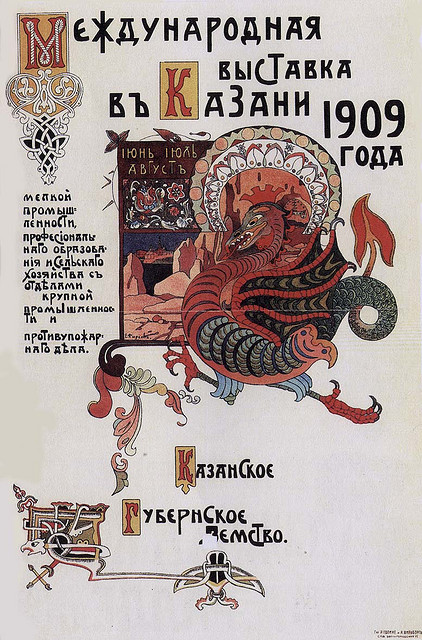
The Zilant, the mythological dragon of Kazan, depicted on a 1909 Kazan exhibition poster (E. Firsov (1909); Public domain; Wikimedia Commons)
Relation to the Mišär Tatars: this body of mythology is general Volga-Tatar and largely pan-Turkic (Şüräle, Bichura, Albasty and Ubyr recur among Tatars, Bashkirs and other Turkic peoples from the Altai to the Volga); neither learntatar.com nor the cross-checked sources flags any of it as specifically Mišär. The Estonian (and Finnish) Tatars are Mišärs who emigrated from the 1870s as merchants from Mišär villages of Nizhny Novgorod Oblast, especially the Sergach district (e.g. Aktuk and Sergach). As Volga Tatars they share this general mythological inheritance, but no source attests a distinctly Mišär or Estonian-Tatar version of these creatures. That the Sergach Mišär community carried the same iyä-spirit and Şüräle/Ubyr folklore is an educated guess — the exact forms, names and any local variants remain unattested in the sources checked and should not be presented as Mišär-specific.
A summary classification — what is general Tatar, what Kazan, what Mišär:
Belief / being | Whose is it? |
|---|---|
Tengrism (sky god Tängri) | common Turkic heritage — Tängri lives in the Mišär dictionary to this day |
Nature spirits (iyä) | pan-Volga Tatar |
House spirit Bichura | pan-Volga folklore |
Forest spirit Šüräle | pan-Volga folklore, made famous by Kazan literature (Tukay) |
Evil beings (Albastõ etc.) | common Turkic heritage |
Pre-Islamic worldview: Tengrism
The pre-Islamic layer of Tatar cosmology is Tengrist and shamanist. It is centred on the supreme sky-god Tengri (Tatar Täñre), venerated among Turkic peoples including the Volga Tatars and Bulgars; the earliest written evidence comes from the 8th-century Orkhon inscriptions. After the Tatars' conversion the worldview became intertwined with Islamic belief.
Umay — goddess of femininity and fertility, the Earth-Mother principle.
Yer-Su / Cir-Su (Jer-Su) — the earth-water deity, patron of homeland and nature.
Ancient totemic legends reference animal-origin ancestors such as Aq Büre (White Wolf) and Aq Yılan (White Serpent), reflecting a totemic bond between humans and animals.
Nature spirits: iyä and water spirits
Tatar mythology uses the general term iyä / iyäse for the spirit-masters of the elements — a system of tutelary nature spirits. The circle of water spirits is especially rich.
Su iyäse — master of water; Su anasy — mother of water; Su qyzy — daughter of water; Yort iyäse — master of the house; Abzar iyäse — yard/barn spirit.
Su anasy ("Mother of Water") is the most famous Tatar water spirit: with long hair, big black eyes and no eyebrows, living underwater in rivers, lakes and springs and emerging to the shore to comb her hair. Offerings of food, coins and prayers were made to her for water purity and crop success.
Su babasy — the water father (an old man) — and his tragic daughter Su qyzy, who lives in an underwater palace.
Abzar iyäse — a barn/yard spirit that protects domestic animals (especially horses) and can take human or animal form.
Öräk — the spirit of the violently deceased.
The house spirit Bichura
Bichura is a house spirit of Turkic (Tatar) mythology that behaves like a poltergeist: pulling hair as a warning, moaning, harassing horses, rattling and breaking small objects, and leaving muddy little footprints. It lives behind the stove or in the cellar. Per learntatar it is a short woman in an örpäk head-cloth, and in folklore it is often equated with the Russian kikimora.
The forest spirit Şüräle
Şüräle is a forest spirit of Turkic mythology, especially in Tatar and Bashkir lore. It has long fingers, a horn on its forehead and a woolly, hairy body; when appearing as a human it looks like a peasant with glowing eyes and shoes on backwards.
Şüräle lures victims into the thickets and tickles them to death, leads people astray and hides woodcutters' axes.
It can be escaped by turning one's clothes inside out and wearing shoes on the opposite feet, by jumping over a stream (it fears water), or by trapping its long fingers with a pinch; in one Tatar tale it is caught by smearing resin on a horse's back that it likes to ride.
Farit Yarullin composed the first Tatar ballet, "Şüräle", based on Tuqay's poem; Soyuzmultfilm released an animated "Shurale" in 1987 and Tatarmultfilm a Tatar-language version in 2014.
Evil and supernatural beings
The malevolent beings include the vampiric Ubyr, the female demon Albasty, and the dragon Ajdaha that becomes the maiden Yuxa-qyz.
Ubyr is a vampiric / undead being of Tatar (and broader Turkic) folklore that penetrates a human body and takes the place of the soul, appearing notably as the bloodthirsty old-woman figure Ubyrly karchyk; the term is linked to Turkic "obur" ("glutton") and Proto-Turkic "ōp-" ("to suck"). A scholarly study distinguishes the Ubyrly karchyk image in four roles: hero's assistant, fire-holder, sorceress/witch, and werewolf.
Albasty is a female demon widespread among Turkic peoples from the Altai Mountains via the Caucasus up to the Volga, associated with attacking women in childbirth and sleeping victims (sitting on the chest); iron knives or scissors placed near a sleeper are a traditional defence.
Ajdaha (Azhdaha): in Tatar lore a snake that reaches 100 years old transforms into a dragon that lives for a thousand years; ajdaha are said not to be found in the Tatar region but carried off by clouds to a sea island, and can be seen in the clouds beating their tails.
Yuxa-qyz (dragon-woman): after a thousand years on the island the dragon becomes a beautiful girl who marries and ultimately devours her Tatar husband; she is recognised by bad breath, a strong need for water and the absence of a navel, and even the invocation "Bismillahi" has no effect on her.
Mythology in literature
The Tatar poet Ğabdulla Tuqay (1886–1913), founder of modern Tatar literature, drew on this folklore. He is credited with the children's poem "Su anasy" (Water Mother, 1908) about a boy who steals the water-spirit's golden comb, and the early poem "Şüräle" about the forest spirit (written 1906–1907, inspired by Pushkin's "Ruslan and Lyudmila").
See also
Sources: learntatar.com (by Aygul Ahmetcan) — Tatar mythology, Tatar mythological creatures, Forest spirits, Ajdaha and Yuxa-qız, The evil spirit of Albastı; Wikipedia articles Şüräle, Bichura (folklore), Tengri, Ğabdulla Tuqay, Upiór, Mishar Tatars, Mishar Tatar dialect; gramota.net; real.mtak.hu; khansden.substack.com; gabrielececconi.com.