History of the Tatars
The history of the Tatars covers the long development of the Volga Tatars and their ancestors along the middle Volga and in the Volga-Kama region: from the early Turkic peoples and Great Bulgaria, through Volga Bulgaria, the Golden Horde and the Khanate of Kazan, to the 1552 Russian conquest and later language reforms. The learning site learntatar.com (by Aygul Ahmetcan) treats this mainly as the shared history of the Volga and Kazan Tatars, and the opening article of its series focuses on Volga Bulgaria.
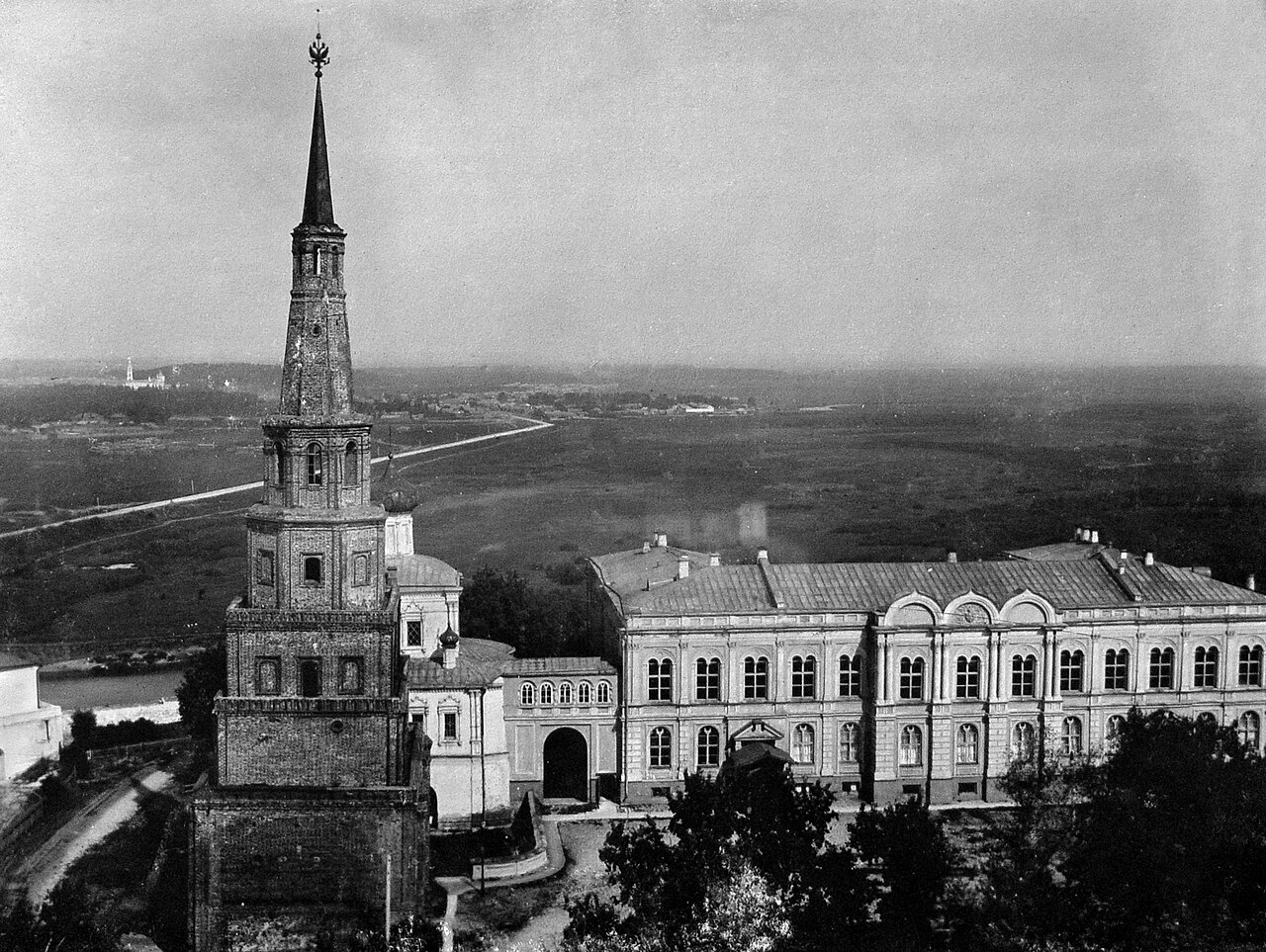
The Söyembikä Tower in the Kazan Kremlin, a historical photograph from the Imperial period (Unknown author (public domain); Public domain; Wikimedia Commons)
Relation to the Mišär Tatars: this topic is about the general history of the Volga and Kazan Tatars, not specifically about the Mišär (Estonian) Tatars. The Volga Bulgaria, Golden Horde and Khanate of Kazan narrative is the shared deep history of all Volga Tatars — including the Estonian Mišärs — but it is not a distinctively Mišär story, and learntatar.com does not mention the Mišärs, Sergach or the Estonian community in its history pages. The Mišär thread is real but comes from outside sources: the Estonian (and Finnish) Tatars are Mišärs, whom most researchers connect to Kipchaks of the Golden Horde who settled west of the Volga, with the Sergach area of Nizhny Novgorod Oblast as the recognized homeland. It is an educated guess (though a reasonable one) that the Estonian Tatars would regard Volga Bulgaria and the Khanate of Kazan as ancestral heritage in the general Volga-Tatar sense — but their more specific lineage runs through the western-Volga Kipchak/Mišär line and the Qasim Khanate rather than directly through the city of Kazan.
Volga Bulgaria and the adoption of Islam
The earliest state predecessor of the Volga Tatars was Volga Bulgaria, which emerged in the Volga-Kama region. Its roots reach back to Great Bulgaria, founded near the Black Sea (traditionally 632/635) under Khan Kubrat; after it broke up, Kubrat's son Kotrag led a group north to the Middle Volga, while another son, Asparukh, founded the First Bulgarian Empire in the Balkans. By the end of the 9th century the Bulgars had become the dominant population of the region.
Its main cities were Bolghar (Bulgar), Bilyar (Bilär) and Suvar.
Volga Bulgaria adopted Islam as its state religion in 922 under the ruler Almish (Almish Iltäbär), who in 921 had requested religious instruction from the Abbasid Caliph.
The returning embassy included Ibn Fadlan, whose account describes the Bulgars.
In 1236 the Mongols invaded Volga Bulgaria and destroyed its cities, especially Bilyar; within a few years the whole country was subjugated and its territory became part of the Golden Horde.
The Golden Horde and its successor states
The Golden Horde was a Mongol-founded, later Turkicized khanate in the northwestern part of the Mongol Empire, established in the 13th century and greatly expanded under Batu Khan (r. c. 1242–1256). Its population was largely non-Mongol Turkic (Kipchak) peoples, and its languages were Middle Mongol and Kipchak Turkic. Under Öz Beg (Uzbeg) Khan the Horde adopted Islam as its state religion in 1313 and was largely Islamized by about 1315.
As the Golden Horde fragmented it produced successor states: the Khanate of Kazan, the Crimean Khanate, the Astrakhan Khanate, the Qasim Khanate, the Nogai Horde and the Khanate of Sibir.
The Golden Horde itself effectively ended in 1502.
The Khanate of Kazan and the Russian conquest
The Khanate of Kazan was founded in 1437–1438 by Ulugh Muhammad as a successor state of the Golden Horde, occupying the territory of the former Volga Bulgaria. learntatar.com dates the khanate period 1436–1552 and notes that a common Bolgar-Kipchak literary language and the epic 'Idegey' developed then.
In August 1552 Ivan the Terrible's forces besieged Kazan; the city fell after roughly a two-month siege on 2/3 October 1552, ending the Khanate of Kazan and annexing it to the Tsardom of Russia.
Armed resistance continued after 1552 (rebel governments at Chalym and Mishatamaq) and was suppressed by 1556, when the leaders were executed.
Literary language and reforms under the Soviet occupation
One of the earliest known works of Tatar literature is the narrative poem 'Qissa-i Yusuf' (Tale of Yusuf) by the Volga-Bulgar poet Qol Gali (Qul Ghali, c. 1183–1236), completed around 1233 (learntatar.com dates its creation to roughly 1212–1233). Under the Soviet occupation, the Tatar written language was changed.
A Latin alphabet was adopted in 1927 and used until 1939; in the late 1930s it was switched to the Cyrillic alphabet.
Russification measures included making Russian obligatory and replacing Arabic/Persian loanwords with Russian terms.
Tatar was declared a state language of Tatarstan (alongside Russian) in 1992.
The Mišärs and the Estonian Tatar lineage
The Mišär Tatars are the second-largest subgroup of the Volga Tatars (after the Kazan Tatars). Most researchers connect their ancestors to Kipchaks of the Golden Horde who settled on the west side of the Volga, and their ethnic character was largely formed in the 15th–16th centuries in the Qasim Khanate and the Temnikov principality.
The Mišär dialect, especially in the Sergach area of Nizhny Novgorod Oblast, is described as very close to ancient Kipchak languages.
Mišärs form the majority of the Estonian and Finnish Tatars, whose ancestors came from villages of Nizhny Novgorod Oblast.
Mišärs originally from Nizhny Novgorod province (notably the Sergach area and villages such as Aktuk) migrated to the eastern Baltic Sea region in the late 19th and early 20th centuries, forming communities in Estonia (mainly Tallinn), Latvia (Riga) and Finland.
See also
Sources: learntatar.com (by Aygul Ahmetcan) — culture/history, 'The History of Tatars I: the Volga Bulgaria', 'A Short Outline of the Tatar Language Development' I and II; Wikipedia articles Volga Bulgaria, Golden Horde, Khanate of Kazan, Qul Ghali and Mishar Tatars; Springer, Journal of Ethnic Foods (2020), link.springer.com/article/10.1186/s42779-020-00072-2.