Tatarstan today
The Republic of Tatarstan is the homeland of the Volga Tatars within the Russian Federation, with Kazan as its capital and the heart of Tatar culture. The story of Tatarstan today is two-sided: a living, rich culture on one hand, and the gradual narrowing of its language and self-rule on the other. For the Estonian Tatars — the Mišär — Kazan is a kindred reference point, though not the community's own tradition.
Overview
The Republic of Tatarstan lies in the middle Volga basin, around the confluence of the Volga and the Kama. Its capital and largest city is Kazan, a major industrial and cultural centre. The 2021 census counted about four million inhabitants. The core people are the Volga Tatars, a Turkic people: roughly 53% of the population are Tatars and about 40% Russians. The republic's two official languages are Tatar and Russian.
Language: status and the 2017 turning point
Tatar is co-official with Russian in Tatarstan, and its official script is Cyrillic. It has an estimated four million first-language speakers, but bilingualism with Russian is nearly universal and the language's use contracted across the 20th century.
2017 brought a decisive change. For roughly a quarter-century, Tatar had been compulsory for every pupil in Tatarstan — regardless of mother tongue, up to six hours a week. In July 2017 the Russian president declared that no one should be forced to learn a language that is not their mother tongue and ordered prosecutors to investigate. Under pressure, on 29 November 2017 Tatarstan's State Council adopted Moscow's curriculum, under which Tatar became an optional subject — about two hours a week and only with a parent's written consent. Around half of the republic's Tatar-language teachers were left without work, and critics warned the change further endangered the language.
Tatar in public space
In present-day Tatarstan, Russian is the dominant, high-status language of the city, administration, higher education and careers, while Tatar is associated more with the home, rural life and older generations. This prestige gap is well documented in sociolinguistics: non-Russian languages were left with low social status and a narrow sphere of use, with Russian the language of social advancement. The urban-rural divide is the sharpest: in rural families Tatar is the home language, in the big cities Russian dominates, and migration from village to city shrinks Tatar use. In a 2015 survey 83% of young people wanted to learn English, 62% Russian and only 38% Tatar; many judged Tatar of little use for a career or university, since the state exam and university language is Russian.
Tatar has thus retreated from the high-status public sphere (administration, higher education, official media) toward the home and the countryside. Some activists describe the public use of Tatar being treated increasingly as “unethical” — because not everyone understands it — or even as suspect; the writer and activist Marsel Ganeyev has said that speaking one's own language in public has become a protest. Such reports should be read as the testimony of individual activists rather than systematically measured fact. The broader trend, however, is clear: the number of Tatar speakers fell by more than a million between the 2010 and 2021 censuses.
Yet the picture is not only decline. Tatar remains present in public through Tatar-language broadcasting (the public broadcaster TNV and the children's channel Shayan TV), theatre, a contemporary music scene, and a youth urban culture that deliberately uses Tatar in Russophone settings as a kind of reclaiming of public space. Some activists note that interest in Tatar has actually grown since 2022, as people seek to identify less as “Russian-speakers”.
Script: the Latin vs. Cyrillic struggle
The writing system of Tatar has been a political struggle in its own right — one that touches our community closely, since the Estonian Tatar alphabet is Latin-based. In 1999 Tatarstan passed a law establishing an official Latin alphabet for Tatar, Zamanälif, drawing on the 1930s Yañalif. Some schools began teaching it from 2000.
On 15 November 2002 Russia amended federal law to require that all state languages of its republics use Cyrillic. On 16 November 2004 the Russian Constitutional Court upheld that law and rejected Tatarstan's appeal. Tatarstan had to rescind its decree restoring the Latin alphabet on 22 January 2005.
To this day official Tatar remains in Cyrillic, while the Latin script survives informally and in the diaspora. For the Estonian Tatars this is no distant question: our own Estonian Tatar alphabet is Latin-based, and the very choice Moscow suppressed in Tatarstan is our everyday practice.
Cultural autonomy
Tatarstan's arc of self-rule shows how broad autonomy was gradually narrowed:
30 August 1990 — Tatarstan adopted a Declaration of State Sovereignty.
1992 — a referendum backed Tatarstan's status as a sovereign state.
15 February 1994 — a power-sharing treaty with Moscow granted the republic wide self-rule and special status while keeping it within Russia.
24 July 2017 — that treaty expired and was not renewed; Tatarstan was the last Russian republic to lose its special status.
2022–2024 — the republic's “President” title was abolished (under a 2021 federal law barring regional presidencies); the head of the republic became the Rais (Arabic for “leader”).
The World Congress of Tatars (Bötendönya Tatar Kongressı) is a Kazan-based organization uniting Tatars worldwide and working closely with the Tatarstan government. It operates alongside the federal national-cultural autonomy of Russia's Tatars — the mechanism through which Tatars living outside Tatarstan organize their cultural and linguistic life. How substantive that autonomy is in practice remains debated.
Culture: Kazan as the heart
The Kazan Kremlin was inscribed on the UNESCO World Heritage List in 2000. Ivan the Terrible built the citadel over the former castle of the Kazan khans after taking the city in 1552 — the event that ended the independent Khanate of Kazan. Within it, the Kul Sharif (Qolşärif) mosque, reopened in 2005, was rebuilt on the site of the khanate's principal mosque destroyed in 1552 and is one of Europe's largest. The Kremlin's signature landmark is the leaning Söyembikä tower, named for Söyembikä, wife of three Kazan khans and regent for her son.
Sabantuy is the Tatar summer festival whose name means “the plough's feast” (saban ‘plough’ + tuy ‘feast’), marking the end of the spring sowing. Its roots reach into the pre-Islamic era. It features köräş (belt wrestling, whose champion is crowned batır), horse racing and climbing games. Tatarstan has sought UNESCO recognition for Sabantuy.
The flagship of Tatar theatre is the Ğälicämal (Galiaskar) Kamal Tatar Academic Theatre in Kazan, founded in 1906. The national poet is Ğabdulla Tuqay (1886–1913), regarded as the founder of modern Tatar literature and its literary language. National dishes include çäkçäk (fried dough balls soaked in honey, a ceremonial wedding sweet) and öçpoçmaq (a triangular pie of meat, potato and onion).
It is important to remember that all of the above is Kazan (Volga) Tatar culture, built on the Central or Kazan dialect. It is kindred to the Mišär tradition, but distinct from it.
Connection and diaspora
Kazan and Tatarstan are the cultural heart of the wider Tatar world and the source of the literary standard. The Estonian Tatars, however, are Mišär — an ethnographic group speaking the Western Mišär dialect and making up about a third of the Volga Tatars. They are related to the Kazan Tatars but a separate branch, not Kazan Tatars themselves. Kazan's institutions and literary language are therefore a kindred reference point for us, not the community's own heritage — as is true of the wider diaspora, including the Crimean Tatars and other kindred communities.
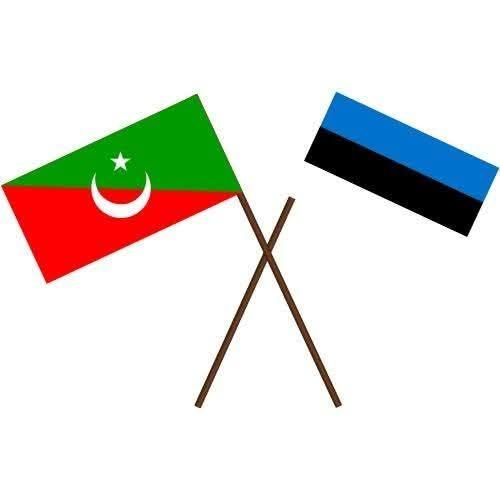
The Estonian flag crossed with the Tatar flag — a symbol of the Estonian Tatars' bond between Estonia and the Tatar world.
Sources
Britannica (Tatarstan); Wikipedia (Tatarstan, Tatar language, Tatar alphabet, Kazan Kremlin, Sabantuy, Ğabdulla Tuqay, Galiaskar Kamal Theatre, Tatar cuisine, Shayan TV); RFE/RL, openDemocracy, Diggit Magazine and Frontiers in Language Sciences (the 2017 language decision and language attitudes); The Moscow Times (abolition of the presidency title, decline in speakers, public-space reports); sociolinguistic studies of Tatar language attitudes and the urban-rural divide; the official site of the World Congress of Tatars.