The Tatar language
The Tatar language
Tatar is a Turkic language belonging to the Volga group of the Kipchak branch (the Kipchak-Bulgar subgroup). It has an estimated four to six million native speakers — Wikipedia gives about 4 million first-language speakers (2020) and nearly 810,000 second-language speakers, while learntatar.com cites about six million. Its homeland is the Volga–Ural region of Russia; UNESCO classifies Tatar as vulnerable.
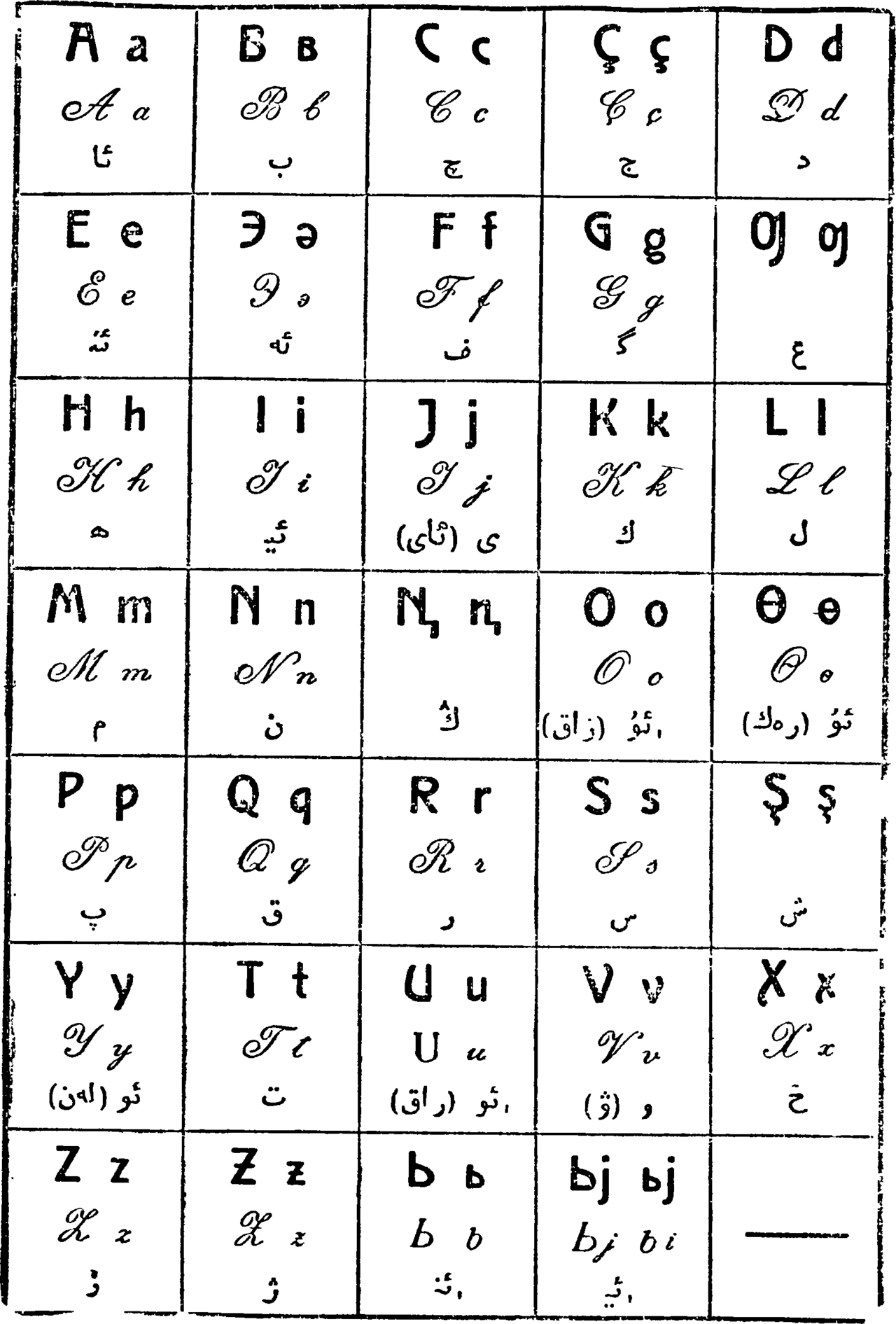
The first Tatar Latin alphabet (Jañalif) compared with the Tatar Arabic script, from the magazine Jañalif, 1928 (Unknown (from the magazine "Jañalif", 1928); CC BY-SA 3.0; Wikimedia Commons)
The Tatars are a Turkic people of Kipchak-Bulgar roots. Their language is a close relative of Bashkir and belongs to the wider Kipchak branch alongside Kumyk, Karachay-Balkar and Crimean Tatar.
Dialects
Three main dialects of Tatar are distinguished:
the Central or Kazan dialect — the majority dialect and the basis of literary Tatar;
the Western or Mišär dialect — hard k and g instead of uvular q/ğ, and different affricates; this is the dialect the Estonian Tatars speak;
the Siberian Tatar dialect — renders the affricate as ts and c as j; some scholars treat it as a separate language.
This community’s language is the western (Mišär) dialect, treated in the separate article “The Mišär Tatar dialect”.
Vowel and consonant harmony
As in other Turkic languages, the core rules of Tatar are vowel harmony and consonant harmony. Vowel harmony means the vowels of a word are all front or all back, and suffixes adapt to the stem (a front or a back form). Consonant harmony ties the initial sound of a suffix to the last sound of the stem. These rules govern much of Tatar declension and conjugation.
Writing
Tatar has been written in three alphabets (learntatar.com; Wikipedia, “Tatar language”):
the Arabic script — until 1928 (old orthography until 1920, new orthography 1920–1928); some diaspora communities still use it;
the Latin alphabet (Jaꞑalif) — 1928–1939;
Cyrillic — from 1939 to the present, imposed across the Soviet Union under Soviet rule. In 1999 Tatarstan passed a law to switch to a Latin alphabet, which Russian federal law overrode in 2002.
learntatar.com describes the Latin alphabet as an alternative to the Cyrillic script “forcefully implemented by the Soviet Union”, and notes that the Latin script has been revived by the diaspora, including in Finland. This aligns with the Estonian Tatars’ practice: the community writes its language in Latin letters (this project’s Estonian Tatar alphabet) and uses neither Cyrillic nor Russian.
Relation to the Estonian Tatars
The mother tongue of the Estonian Tatars is the western (Mišär) dialect of Tatar. The literary language taught in Tatarstan is based on the Kazan dialect and Cyrillic; the Estonian community, however, keeps its Mišär dialect in the Latin script. The community’s language is thus part of the larger Tatar language, yet distinct in dialect and script — Latin-written, ts-pronounced, and carrying the old vocabulary of the Volga–Ural steppe.
See also
Sources: learntatar.com (“The alphabet and spelling rules”, home page; by Aygul Ahmetcan); Wikipedia “Tatar language” (en.wikipedia.org); community usage from this project’s LANGUAGE.md.