The fall of Kazan and Tatarstan
The history of the Tatars in Russia reaches back to the conquest of the Khanate of Kazan by Ivan IV in 1552. Despite centuries of subjugation, the Tatars have managed to preserve their language and culture, though with many losses.
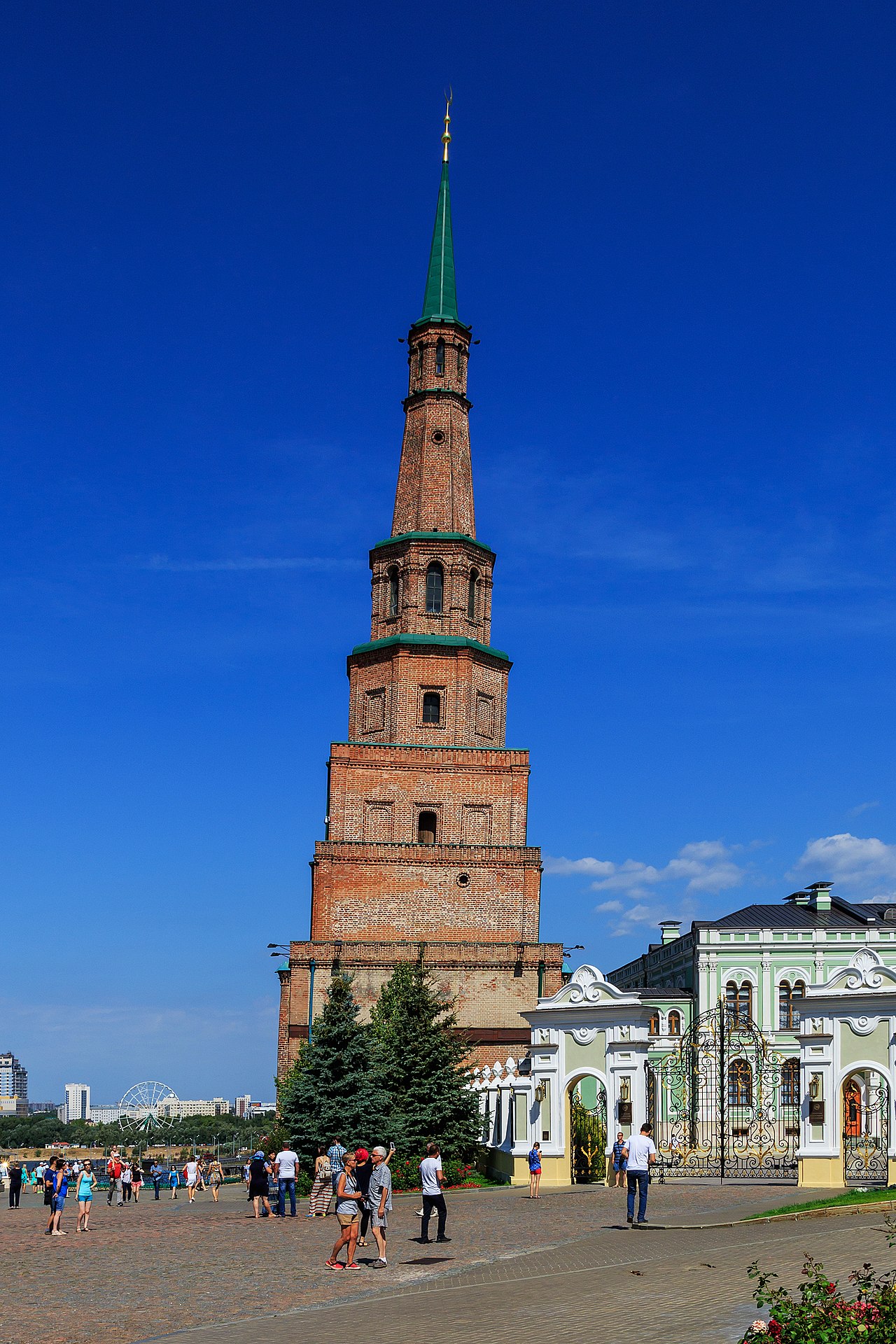
The Söyembikä Tower in the Kazan Kremlin, a landmark of Tatarstan named after the last regent of the Khanate of Kazan (A.Savin; Free Art License 1.3; Wikimedia Commons)
The Khanate of Kazan
The Khanate of Kazan arose in 1438, when Ulugh Muhammad took the title of khan as a successor of the Golden Horde. The state covered today's Tatarstan, Mari El, Chuvashia, Mordovia and parts of Udmurtia and Bashkortostan; its capital was Kazan. Its population was multi-ethnic — Kazan Tatars, Chuvash, Mari (Cheremis), Mordvins, Udmurts and Bashkirs.
It was politically turbulent: the khan changed 19 times in 115 years. Moscow's pressure grew steadily — in 1487 Ivan III took Kazan and installed a puppet ruler, but in 1521 the khanate broke free of Moscow and allied with the Crimean Khanate. Its last years were ruled by Safa Giray; after his death in 1549 his widow, Queen Söyembike, became regent alongside their young son Ütämeš-Giray.
The Siege of Kazan (1552)
In the summer and autumn of 1552 Ivan IV (the Terrible) besieged Kazan with an army of about 150,000. Gunpowder was decisive: Russian and foreign military engineers dug mines under the walls and blew them up by the Nogai Gate, and destroyed the city's underground water source. On 2 October 1552 Kazan fell. A great massacre followed — Kazan sources speak of up to 65,000 dead and missing (civilians included) — and almost all Tatar buildings, the mosques among them, were destroyed.
The aftermath
The khanate was annexed into the Tsardom of Russia. The authorities forbade Tatars, Chuvash and Mari from living by rivers and in the cities and from working as smiths and jewellers. Forced Christianisation began, out of which the Kräshens — the baptised Tatars arose. For the Kazan Tatars this was a catastrophe: centuries of subjugation through which the language and culture nonetheless survived, at great cost.
The Mišärs and the fall of Kazan
An honest distinction is due here. The fall of Kazan is above all the catastrophe of the Kazan Tatars. The Mišärs were by 1552 already long subjects of the Russian state: in Meshchera and the Qasim Khanate they were in Moscow's orbit and served as serving Tatars — some even took part in the Kazan campaign on Moscow's side. The Mišärs and the Kazan Tatars are both Volga Tatars, but their historical paths parted exactly here: the Kazan Tatars lost their state, while the Mišärs were by then already in the empire's service. The Estonian Tatars' direct line runs through the Mišärs, not the Kazan Tatars (see The Mišärs' road to Tallinn).
The road to modern Tatarstan
In 1920 the Tatar ASSR was created, though its borders left out most of the Volga Tatars. As the Soviet occupation collapsed, Tatarstan declared sovereignty on 30 August 1990 and held a 1992 referendum backed by about 62% (more among Tatars than Russians), even though Russia's Constitutional Court declared it unconstitutional. On 15 February 1994 a power-sharing treaty was signed between Moscow and Kazan (renewed in 2007 with reduced powers).
On 24 July 2017 the 1994 treaty lapsed and Tatarstan became the last of Russia's republics to lose its special status; the same year, mandatory Tatar-language teaching in schools was ended. In 2022 a federal law changed the republic head's title from “president” to “rais” (Arabic for “leader”). These steps lead straight into the next section.
Tatarstan today
Russia is a federation, and Tatarstan was a republic within it with its own president. In recent years — especially after Russia's war against Ukraine — the teaching of the Tatar language in Tatarstan's schools has declined, Tatar speakers have been insulted in the street, and the language is fading among the young. The title of Tatarstan's president was reduced to governor, and movements for cultural preservation and autonomy are treated as anti-state.
These developments can be seen with concern — a parallel with the way the occupation authorities earlier caused the fading of Estonian Tatar culture.
See also
Sources: Khanate of Kazan, Siege of Kazan (1552), Tatarstan (English Wikipedia). See also: the Golden Horde, the Qasim Khanate, the serving Tatars, the Kräshens.
See also: The Siege and Fall of Kazan (1552).