The Mišär Tatar dialect
The Mišär Tatar dialect
The Mišär dialect (also the western dialect) is one of the main dialects of the Tatar language, spoken mostly outside Tatarstan. The learning site learntatar.com stresses that Mišär is not a “corrupted” Kazan Tatar but an independently developed dialect, shaped by ancient Kipchak tribes and Oghuz and Finno-Ugric elements. It is this dialect that the Estonian Tatars speak.
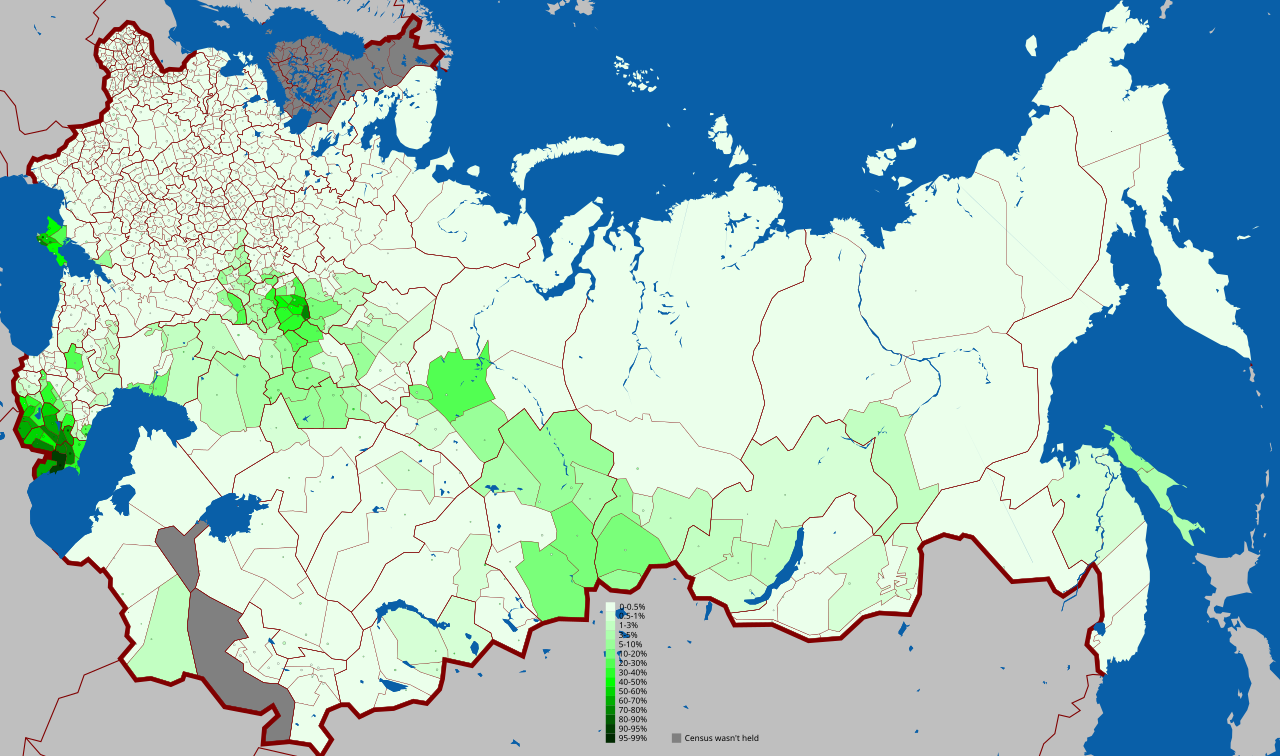
Map of the share of Tatar-language speakers across the Russian Empire based on the 1897 census, with the densest distribution in the Volga-Ural region. (Altes (Wikimedia Commons); CC BY-SA 4.0; Wikimedia Commons)
Its speakers live mainly in Mordovia, Chuvashia and Bashkortostan and in the Penza, Saratov, Volgograd, Ulyanovsk, Nizhny Novgorod and Orenburg regions. Kazan Tatar is the basis of the literary standard; Mišär remained largely a spoken home and community language.
Classification: ch- and ts-subdialects
Mišär splits into two large groups by how the affricate (the standard language’s “ç”) is pronounced:
ch-subdialects (Southern or Lämbrä Mišär): the affricate is [tʃ]. These include the Temnikov, Lämbrä, Kuznetsk and Bashkortostan subdialects.
ts-subdialects (Northern or Nizhgar Mišär): the affricate is [ts]. These include the Sergach, Chüpräle and Bayqıbash subdialects.
The Sergach subdialect of Nizhny Novgorod oblast is regarded as the modern variety standing closest to the old Kipchak language. This ts-subdialect is precisely the speech of the Estonian and Finnish Tatars: the community pronounces and writes the affricate as “ts” (e.g. tsäj “tea”, atsõk “open”), not “ch”. That is why this project’s Estonian Tatar alphabet uses the letter ts.
Pronunciation
learntatar.com and linguistic sources (Wikipedia, “Mishar Tatar dialect”) list these Mišär sound features against literary Kazan Tatar:
hard k and g instead of the uvular q and ğ;
an open, unrounded a;
word-initial j- for old ʒ- (the standard c-): learntatar gives yəy “summer” (standard cəy), yiñ “sleeve” (ciñ);
v for j in some words: sevü “love” (söyü), sevək “bone” (söyək);
monophthongisation of diphthongs: kü “tune” (köy), kurik “tail” (qoyrıq);
in ts-subdialects, ts and dz where the standard has affricates: pıtsak “knife”, endze “pearl” (standard pıçaq, ençe).
Several of these live on in the Estonian Tatars’ speech. Word-initial j- is fixed by community decision (e.g. jer “earth”, jul “road”, jide “seven”), as is the ts pronunciation. The word for knife in this project’s dictionary is põtsak — exactly the ts-form of learntatar’s “pıtsak”.
Grammar and vocabulary
Mišär also has its own grammatical and lexical traits. learntatar.com notes, among others:
desire expressed with the action noun + -gı/-ge keli or -ma keli: bargım keli “I want to go” (standard barasım kilə);
a frequentative suffix -gakla/-gäklä: kilgäklä “to come now and then”;
an old 3rd-person present ending -dır: ul kiläder “he/she comes” (standard ul kilə);
vocabulary: alaşa “horse” (standard at), kıçık/koçok “dog” (et), əpəy “bread” (ipi), yəy/yaz “summer” (cəy), tanaw “nose” (borın), baryam “holiday” (bəyrəm).
These learntatar examples are given in the site’s own spelling and describe Mišär broadly (mainly the Russian-homeland varieties). Some coincide with the Estonian community’s own attested words — see below.
Relation to the Estonian Tatars
The Estonian (and Finnish) Tatars are ts-subdialect Mišärs who emigrated from villages of the Sergach district of Nizhny Novgorod Governorate (especially the village of Aktuk) from the 1860s–1870s onward. Their language is therefore the very Mišär dialect this article describes (source: Wikipedia “Finnish Tatars”, “Mishar Tatars”; City of Helsinki history portal).
This project’s own dictionary confirms several of the features above in the community’s speech: horse is alaša (not at), dog is kotšok, summer is jaz — the same words learntatar cites as Mišär markers. The ts affricate and word-initial j- are rules of the community’s language (see LANGUAGE.md and the grammar overview). Thus the site’s scholarly description of Mišär matches the community’s own living speech.
Honesty requires marking what is certain and what is a guess. Certain and sourced: the Estonian Tatars descend from the Sergach Mišär community, and the community dictionary shares learntatar’s listed features (ts, j-, alaša, kotšok, jaz). A guess would be equating every single learntatar word with a community form — some learntatar forms (e.g. əpəy, tanaw) are not yet in this project’s dictionary in an attested shape, and should not be presented as the community’s language without a native speaker’s confirmation.
See also
Sources: learntatar.com (“Mişər Tatar”, by Aygul Ahmetcan); Wikipedia “Mishar Tatar dialect”, “Mishar Tatars”, “Finnish Tatars” (en.wikipedia.org); the City of Helsinki history portal (historia.hel.fi); community forms from this project’s dictionary and LANGUAGE.md.