Tatar soldiers in Estonia
Tatar soldiers are the starting point of the Estonian Tatars' story: the first Tatars reached the Estonian lands precisely as soldiers — in the 16th century in the armies of the Livonian War, and in the 18th century in the garrisons of the Russian Empire. Tallinn's first Tatar community grew from discharged soldiers.
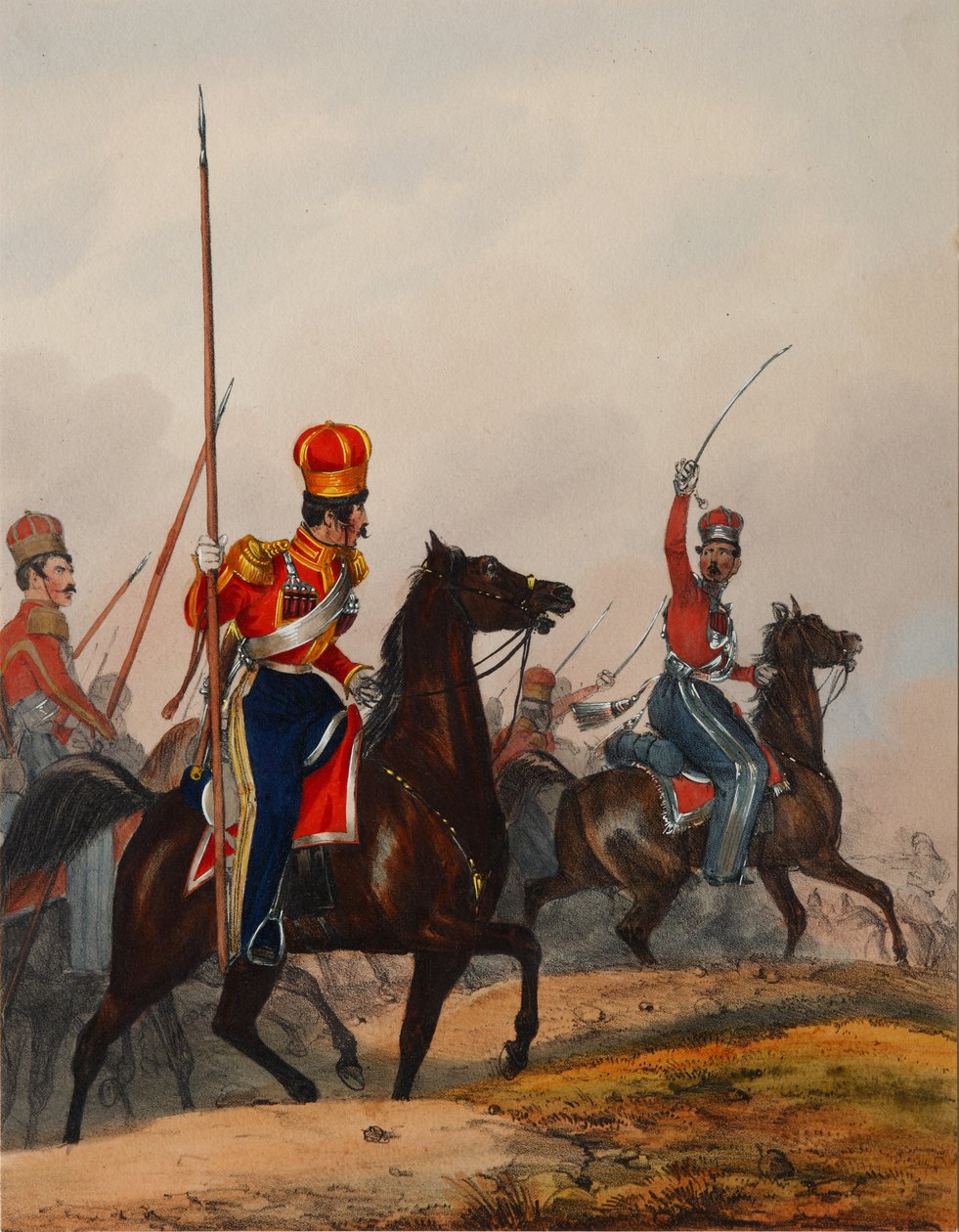
Mounted troopers of the Crimean Tatar Life Guard Squadron in the Imperial Russian army, 1840s — Muslim Tatar soldiers in imperial guard uniform. (Heinrich Ambros Eckert; Public domain; Wikimedia Commons)
The Livonian War (1558–1583)
The first Tatars came to Estonia in 1558, when the Russian campaign into Livonia was led by the former khan of Kazan, the ruler of Qasim, Shah Ali — his 40,000-strong army also included Maris and Bashkirs. In 1570 a Russian force besieged Tallinn with 40,000 men, of whom some 10,000 were Tatars and other peoples of Kazan and Astrakhan. Some soldiers went over to the Swedish king and stayed; the best known was the Tatar boyar Bulaat Murssov, who joined Tallinn's defenders in 1577. From the Tatar defectors of the Livonian War also descends the Baltics' best-known noble family of Tatar origin — the Baranovs.
Garrison soldiers and the Tatar quarter (1721→)
A lasting community formed after the Great Northern War in 1721, when Estonia was joined to the Russian Empire. Its founders were soldiers who stayed after 25-year military service; imperial policy encouraged marriages between discharged soldiers and Estonian women — the 1794 registers of Tallinn's Holy Spirit congregation record Tatar marines marrying Estonian women simultaneously 'according to the government's order'. The veterans bought land and built houses: the Tatar settlement (Tatar Sloboda) arose, its main street still Tatari Street today; Kadriorg was nicknamed the 'Tatar Nest'. Between 1834 and 1862 about 50 Muslims lived in Tallinn, with their own mosque and imam.
Convicts at Paldiski
Alongside soldiers, the empire also sent Muslim convicts to Estonia to build coastal fortresses. The most famous was the Bashkir peasant leader and bard Salavat Yulayev, sent to Paldiski for life after Pugachev's rebellion (1775); he died there in 1800 — Paldiski was called 'another Siberia'.
Soldiers for the Republic of Estonia and Finland
In free Estonia, Tatars served in the Estonian defence forces — Ämer Arslanov, who died as a serviceman, received the first Tatar grave with a concrete border, and gun salutes. In the Second World War three Estonian Tatars volunteered for the Finnish forces and are known as the Finnish Boys: Ibrahim Zarip, Ahmed Haerdinov and Raffik Moksanov.
See also
Sources: Toomas Abiline and Ringo Ringvee, 'Estonia', in Muslim Tatar Minorities in the Baltic Sea Region (Brill, 2016), pp. 105–127.