The Qasim Khanate
The Qasim Khanate (1452–1681) was a Tatar khanate on the middle Oka in the Meshchera region, with its capital at Kasimov. As a vassal of Moscow it lasted over two centuries — and it was here, in the Tatar milieu of the Meshchera forest belt, that the ethnic character of the Mišär Tatars was finally shaped around 1400–1500.
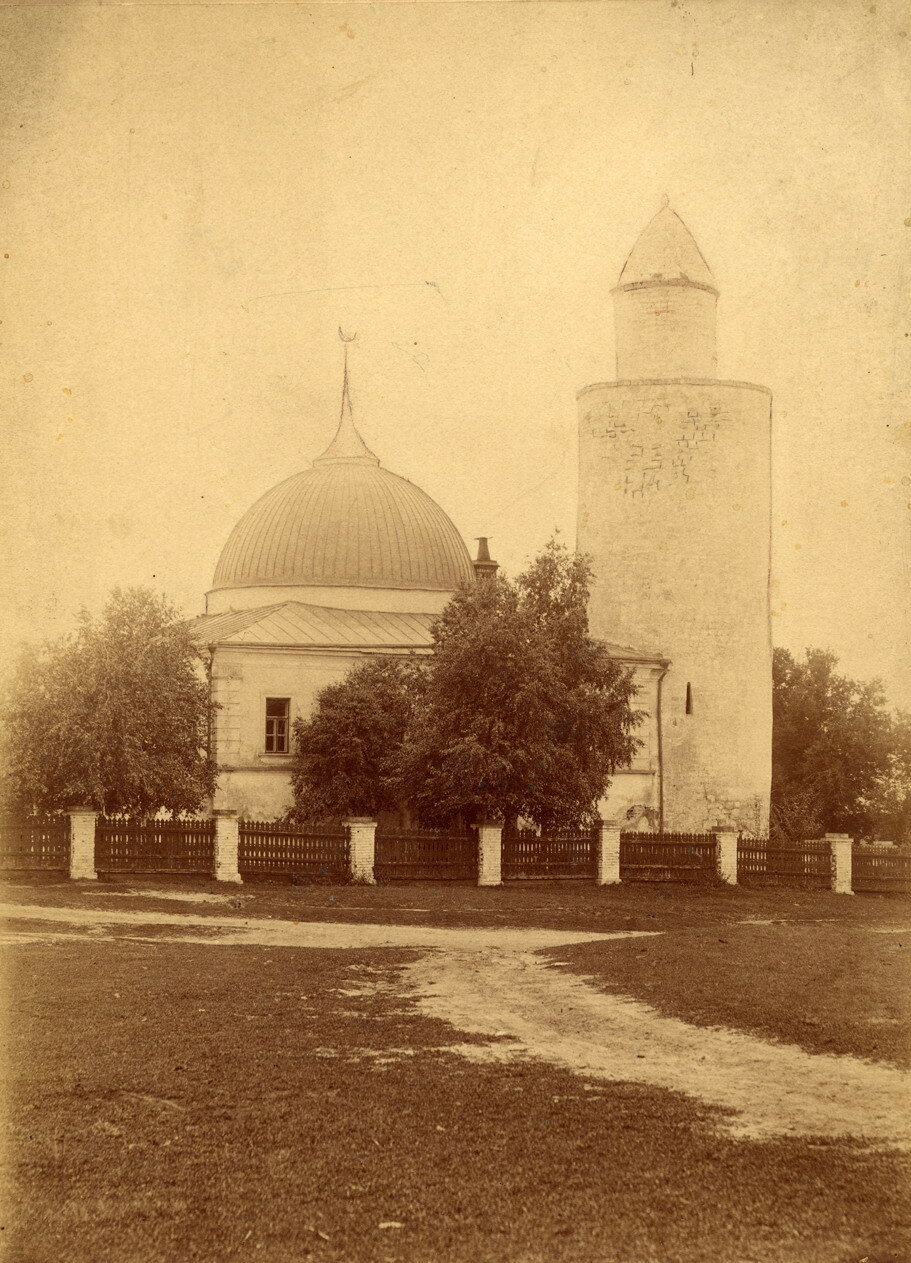
The khan's mosque with its stone minaret in Kasimov, seat of the Qasim Khanate, in an early 20th-century photograph (Public domain; Wikimedia Commons)
Foundation (1452)
Qasim, a son of the Kazan khan Ulugh Muhammad, sought refuge with Moscow after succession strife. In 1452 Grand Prince Vasily II granted him the Meshchera lands and the town of Gorodets-Meshchersky as a hereditary domain; the town took its new ruler's name, Kasimov. For Moscow it was a calculated move: the khanate served as a buffer against the more hostile Kazan and Crimean khanates and supplied Tatar cavalry for Moscow's campaigns.
A state between two worlds
The Qasim khans were Genghisids — often members of the Kazan, Crimean, Siberian or Kazakh ruling houses — and the state lived under an Islamic order: mosques, madrasas and Tatar settlements in the Meshchera villages. At the same time it was in Moscow's sphere from the start; from the 1530s Moscow interfered ever more directly in its affairs. Qasim's forces took part in all of Moscow's campaigns against Kazan (1467–1469, 1487, 1552).
Shah Ali — a Qasim khan in Estonian history
The most famous Qasim ruler was Shah Ali (Shahghali, 1505–1567), who governed Qasim for most of his life and thrice sat on the throne of Kazan. One of his wives was Söyembikä, Kazan's famed queen. For Estonian history Shah Ali is special: at the start of the Livonian War in 1558 it was he who led the Russian campaign into Livonia — the army in which the first Tatars to reach Estonia served.
The cradle of the Mišärs
The Meshchera region — the forest-steppe between the Oka and the Sura — was the meeting ground of Finno-Ugric peoples and the Kipchak settlements of the Golden Horde era. In the Tatar milieu of the Qasim Khanate these layers fused: here, around 1400–1500, the ethnic character of the Mišär Tatars and their western dialect, preserving archaic Kipchak features, took final shape. From Qasim's service Tatars also grew the Mišärs' later role on the borderlands of the Russian state — including the villages of the Nizhny Novgorod region from which the ancestors of the Estonian Mišärs emigrated in the 19th century.
The end (1681)
Over time the khan's power grew ever more nominal; the last ruler was the khaness Fatima-Soltan. On her death in 1681 Moscow abolished the khanate and annexed its lands directly to the Russian state. A Qasim Tatar community lives in the town to this day.
What became of the Mišärs after the khanate
After the fall of Kazan (1552) and the fading of the Qasim Khanate, the Mišärs west of the Volga were gradually integrated into Russian state service: they became service Tatars (sluzhilye tatary), guarding the defensive lines of the south-eastern frontier. Service scattered the Mišärs across a wide area — Penza, Simbirsk (Ulyanovsk), Samara and Orenburg, and Bashkiria, where they were known as 'Meshcheryaks'; from 1798 to 1865 they served alongside the Bashkirs in the Bashkir-Meshcheryak Host. In the 18th century the service Tatars were reclassified as state peasants.
The Mišärs who stayed in the home districts — including the Sergach area of Nizhny Novgorod province — held stubbornly to Islam and their dialect under christianisation pressure. When serfdom was abolished in 1861, a wave of Mišär itinerant merchants grew out of those villages, reaching Saint Petersburg, Finland and Estonia — the ancestors of the Estonian Mišär Tatars are children of precisely this Sergach-country emigration.
See also
Sources: the Wikipedia articles 'Qasim Khanate' and 'Shahghali'; Abiline and Ringvee (Brill, 2016) on the formation of the Mišärs and Shah Ali's 1558 campaign. On the service Tatars and Meshcheryaks: the Wikipedia articles 'Serving Tatars' and 'Mishar Tatars'.