The Serving Tatars
The Serving Tatars (Tatar: yomyshly tatarlar) were a class of ethnic Tatar state servants who served Muscovy (and Poland-Lithuania) in the 14th–18th centuries as soldiers, border guards, translators and diplomats. The Mišärs formed one of the core groups of this class — and the history of the serving Tatars explains how the Mišärs spread across the Volga-Ural region and how their descendants eventually reached Estonia.
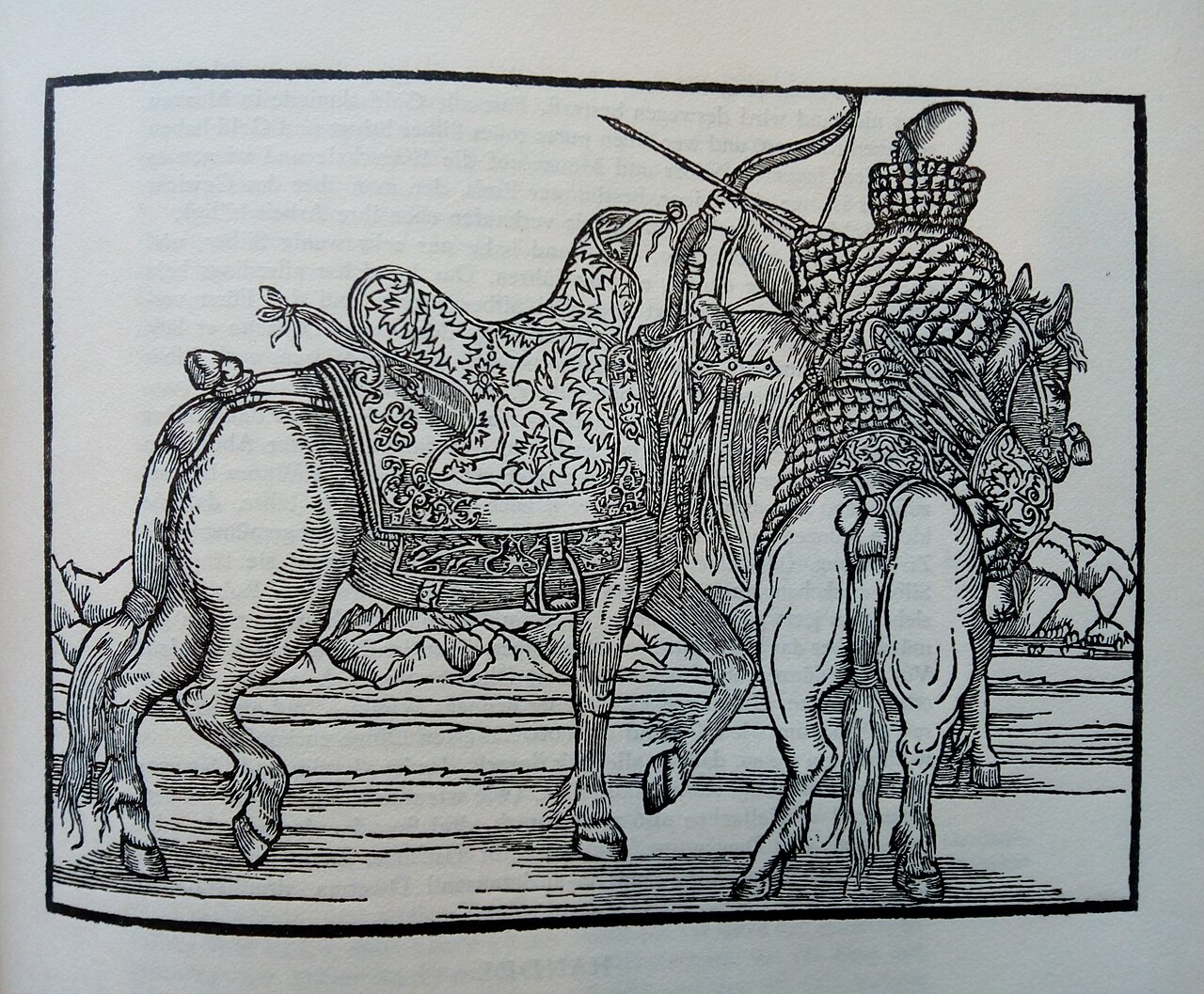
Sixteenth-century woodcut of a Muscovite mounted archer, the kind of cavalry in which Service Tatars served (Sigismund von Herberstein (1486–1566); Public domain; Wikimedia Commons)
Who they were
The class first grew from the Tatar nobility of the Golden Horde and the khanates who entered Moscow's service; after the fall of Kazan in 1552, peasants of the fallen khanate also gained serving status, receiving land alongside Russian and Qasim nobles. A 17th-century register recorded 156 Tatar noble families; by some estimates up to a third of the Russian nobility has Turkic roots.
Service and reward
The elite served as translators, scribes and envoys to Central Asia; the majority in the cavalry and border defence. Serving Tatars guarded the state's eastern frontier (especially around Orenburg) alongside the Cossacks and were among the few Tatars permitted firearms; some became officers of the Russian army. In return they received land, tax privileges, pay and trading rights — and the possibility of remaining Muslim. Serving Tatars also fought in the Livonian War (1558–1583): the very forces that brought the first Tatars to the Estonian lands.
Mišärs and Meshcheryaks
A large share of the western serving Tatars were Mišärs. Service carried them to the defensive lines of the south-eastern frontier — to Penza, Simbirsk, Samara and Orenburg, and to Bashkiria, where they were known as Meshcheryaks; from 1798 to 1865 they served with the Bashkirs in the Bashkir-Meshcheryak Host. Thus arose the wide Mišär settlement area stretching from Mordovia to Bashkortostan.
The end of the class, and its legacy
In the 18th century the serving Tatars were reclassified as state peasants — the special military status vanished, but the villages, the dialect and Islam remained. It was from those villages, including the Sergach country of Nizhny Novgorod province, that the merchant emigration to Saint Petersburg, Finland and Estonia grew after the abolition of serfdom in 1861.
See also
Sources: the Wikipedia articles 'Serving Tatars' and 'Mishar Tatars'; Abiline and Ringvee (Brill, 2016). The counts of noble families and the share of Turkic roots are the sources' estimates.
See also: Tatar life in the Russian Empire.