The Treaty of Tartu
The Treaty of Tartu (Tartu rahu, 2 February 1920) was the peace treaty between the Republic of Estonia and Soviet Russia (Nõukogude Venemaa) that ended the Estonian War of Independence (1918–1920) and gave Estonia its first de jure international recognition. In it Soviet Russia renounced “in perpetuity” all rights over the Estonian people and territory. The treaty is the “birth certificate” of the Estonian state and the legal cornerstone of its continuity. It was also the first treaty in which any state recognised the Soviet government at all.
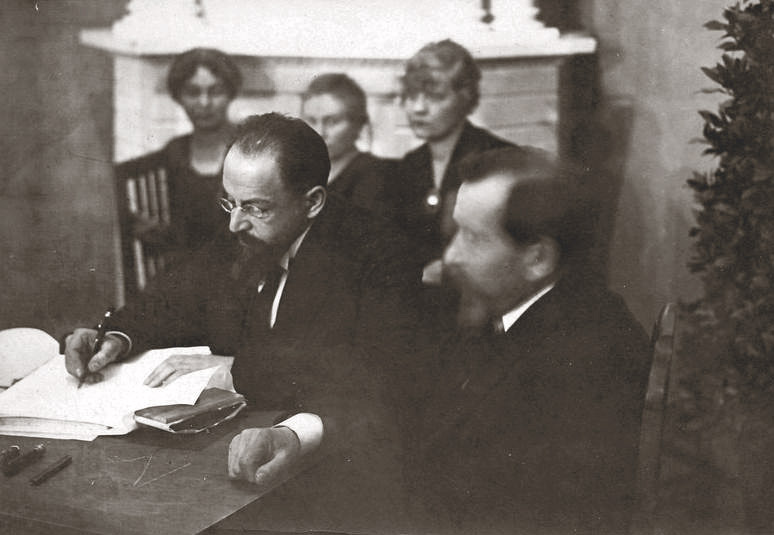
The signing of the Tartu Peace Treaty on 2 February 1920, with the head of the Soviet Russian delegation Adolf Joffe seated at the table signing the document (Armin Lomp (1883–1936); Public domain; Wikimedia Commons)
Background: the War of Independence
Estonia declared independence on 24 February 1918. The war began on 28 November 1918 when the Red Army attacked the border town of Narva; by year's end the offensive reached within about 34 km of Tallinn. In early January 1919 the tide turned: the Estonian army halted the Reds and counter-attacked on 7 January, retaking Tapa, Narva and Tartu with effective use of armoured trains. Foreign aid was decisive — Finland sent arms and about 3,500 volunteers, and the British Royal Navy delivered weapons and gave naval-gun support. A separate threat from the Baltic-German Landeswehr was broken at the Battle of Cēsis (Võnnu), 19–23 June 1919 — commemorated in Estonia as Victory Day. A grinding final phase around Narva drove both sides to negotiate; an armistice took effect on 3 January 1920.
The negotiations
Talks opened in Tartu on 5 December 1919. The Estonian delegation was led by Foreign Minister Jaan Poska (members included Ants Piip, Julius Seljamaa, Jaan Soots). The Soviet Russian delegation was chaired at first by Leonid Krasin, but after he left the head and principal signatory became Adolph Joffe. The main sticking point was the border: the Russians initially demanded half of Virumaa and all of Petserimaa, and the talks nearly collapsed. The gold sum was fixed by the Kremlin, framed as recognition of Estonia rather than an economic calculation.
Signing and terms
The 20-article treaty was signed on 2 February 1920 in Tartu and entered into force with the exchange of ratifications in Moscow on 30 March 1920. The central article: “Russia unreservedly recognises the independence and sovereignty of the State of Estonia, and renounces voluntarily and forever all sovereign rights over the Estonian people and territory”. It was the world's first de jure recognition of Estonia — and also the first treaty in which any state recognised the Soviet government.
Gold: 15 million gold roubles (about 11.4 tonnes of gold) paid to Estonia.
Optation: about 38,000 ethnic Estonians chose to move from Soviet Russia to Estonia.
Exchange of prisoners of war and return of property.
Why Soviet Russia needed the treaty
In 1920 Soviet Russia was diplomatically isolated and under the Entente economic blockade. The Treaty of Tartu was strategically vital to it, for several reasons:
Breaking its isolation. Moscow saw the peace as an important factor in overcoming its diplomatic isolation — it was the first treaty in which any state recognised the Soviet government at all.
A window to the West. On 16 January 1920 the Entente decided to lift the full blockade; this changed the tone of the Tartu talks, as Estonia became Soviet Russia’s economic “window to Europe” — a conduit for selling gold and trading with the West around the blockade.
Military freedom. The peace let it eliminate the White North-Western Army and free Red Army forces for other Civil War fronts (against Denikin and Poland).
“An incomparable victory over Western imperialism.” — Lenin on the Treaty of Tartu (per Georg von Rauch).
The border
The treaty left two areas east and south-east of the ethnic Estonian core on the Estonian side (the border stood until 1944):
Narva-taguse (the Estonian Ingria strip east of the Narva river, about 375 km²), including the Ivangorod (Jaanilinn) fortress — a trophy of the war and a buffer zone; the population was largely Russian-speaking.
Petserimaa (south-west of Lake Peipus, about 1,251 km²), including the town and monastery of Petseri — the historic homeland of the Seto people.
Significance: the birth certificate
The Treaty of Tartu is the “birth certificate” of the Estonian state, as the first de jure recognition of its independence. Because the recognition was “forever”, Estonia treats the 1920–1940 Republic and the post-1991 Republic as the same continuous state, merely interrupted illegally by occupation. The treaty is the cornerstone of that continuity doctrine.
Peace on paper, subversion in practice
The later Foreign Minister Karl Selter, who worked with the military court and the Ministry of War in 1920–1927, testified that Moscow's subversion began the moment the front fell silent and Soviet Russia's first official representatives arrived in Estonia. Under the protection of diplomatic mail and passports, propaganda, Communist Party instructions, arms and organisers of shock troops were brought into Estonia; the Soviet trade representation in Estonia's ports — where Estonia had granted concessions in the spirit of the peace treaty — grew, in Selter's words, into “a center of agitators and a nest of militant bolsheviks”. The police uncovered underground cells one after another, but new and larger ones replaced those destroyed.
In 1924 a shock-troop group was caught whose 149 members were put before a military court. Some of the organisers operated under diplomatic passports as staff of the legation or the trade representation; to others Moscow had issued guarantees that they would be exchanged if need be. For that purpose the Kremlin permanently kept in prison a certain number of Estonians living in or travelling to Russia — an exchange fund, through which even Bogdanov, a shock-troop organiser sentenced to death for fatally wounding a policeman, went free.
The test of strength came on 1 December 1924: by Selter's testimony, the night before, some 500 street-fighting specialists sent from Russia had summoned about a thousand fellow travellers to secret meetings, from which no one was allowed to go home. At 5.15 in the morning they moved, under pre-issued battle orders, to seize government offices and railway stations. The coup attempt was crushed within hours. Thus Moscow kept peace on paper and war underground — the same handwriting that led to the treaty's open violation in 1939–1940 (see A dance of death between two devils). (Source: Karl Selter's testimony, published in Lituanus 2/1968.)
Violation and the border question
The Soviet occupation from 1940 violated the treaty: Estonia's forcible incorporation into the USSR defied the “in perpetuity” recognition. The occupation authorities severed the borderlands from Estonia — on 23 August 1944 Petserimaa and Narva-taguse were assigned to the Russian SFSR (Petserimaa to Pskov Oblast; in January 1945 Narva-taguse to Leningrad Oblast). After the Soviet occupation collapsed, Estonia at first sought the Tartu-treaty border, but Russia refused any reference to the treaty and treated the Soviet-era administrative line as the border. In 2005 the Estonian parliament ratified a border treaty with a preamble referencing Tartu rahu; Moscow read this as a door to territorial claims and withdrew its signature. A new treaty without the reference was signed in 2014 and remains unratified.
Memory
Tartu rahu is a national symbol of statehood and of victory in the War of Independence; its anniversary, 2 February, is a day of commemoration. Jaan Poska died only weeks after the treaty (7 March 1920) and received the first state funeral in Estonian history, attended by about 20,000 people. The treaty was signed in a building on today's Vanemuise Street in Tartu.
Connection to our story
The Estonian Tatar community between the world wars lived in the Republic founded by the Treaty of Tartu — the flourishing of the congregation, the mosque and the merchants belongs precisely to that independence era. The same occupation that violated the treaty in 1940 later struck Estonia's minorities too (see communist crimes against Estonia's minorities). The treaty's continuity doctrine is why 1940–1991 is occupation and 1991 the restoration of the state, not its creation.
See also
See also: The Estonian Socialist Party's Foreign Association (ESPVK), The Kersten Committee.
Sources: Tartu rahu (Estonian Wikipedia); Treaty of Tartu (Wikipedia); Tartu Peace — Estonian MFA; The Tartu Peace Treaty and Estonia's Eastern Border — ICDS; Estonian War of Independence (Wikipedia); Jaan Poska (Wikipedia); Estonia–Russia border (Wikipedia); Georg von Rauch, The Baltic States: The Years of Independence 1917–1940; How Was the Tartu Peace Treaty Reached? — ICDS.