Soviet policy toward minority cultures
The Soviet Union's policy toward minority cultures moved from the indigenisation of the 1920s to Stalinist russification. For a Turkic-Muslim people like the Tatars and for occupied Estonia it meant the same machine that promised a “friendship of peoples” while hollowing out national cultures through language, religion, deportation and demography. This page gives the Union-wide frame around the cultural genocide of the Estonian Tatars and russification.
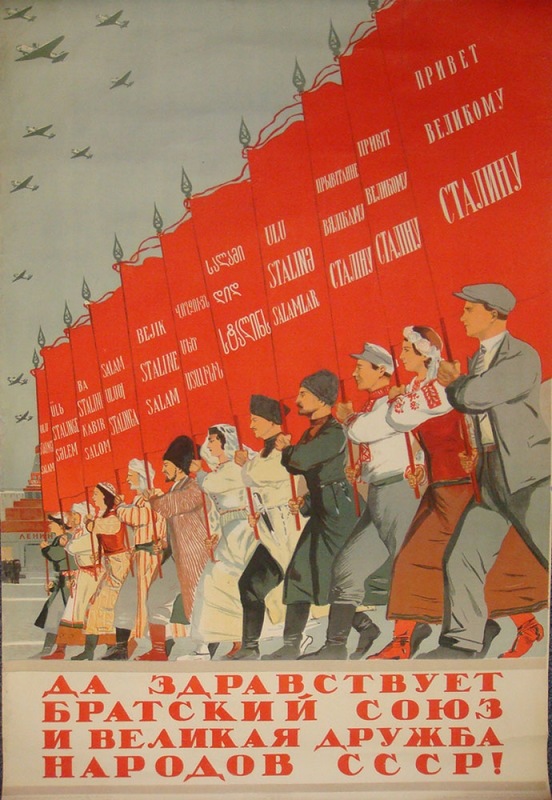
A Soviet propaganda poster glorifying the friendship and union of the peoples of the USSR, showing figures in the traditional dress of the various Soviet republics gathered around a portrait of Stalin (Unknown (anonymous, published c. 1936–1940); Public domain; Wikimedia Commons)
From indigenisation to russification
In the 1920s the Soviet occupation authorities pursued indigenisation (korenizatsiya): it created national-territorial units, promoted local languages in government, the press and schools, and drew non-Russians into the party and state apparatus — in some republics non-Russian party membership rose from about 4% (1922) to over 50% (by the late 1920s). The historian Terry Martin called this an “affirmative-action empire”, designed to reverse earlier russification and legitimise Soviet rule. From the mid-1930s this gave way to a centralising, russifying line: national elites who seemed to place their nationality above the Union were accused of “bourgeois nationalism” and many were executed. A decree of 13 March 1938 made Russian a compulsory subject in every non-Russian school from the first grade — a rule that stood until 1994.
Language and script
In a Latinisation campaign the scripts of about 70 languages — mostly from Arabic or Cyrillic — were converted to Latin in the 1920s–30s. Tatar moved from Arabic script to the Latin-based Jañalif („new alphabet”) in 1927–28. Then, once Latin was recast as a “symbol of the West”, the Turkic languages were forced onto Cyrillic: a decree of 5 May 1939 switched Tatar to Cyrillic. The two abrupt changes cut successive generations off from the literature written in the preceding script, undermining cultural continuity. See the Tatar language and the Mišär dialect.
Islam and the Turkic-Muslim peoples
Islamic courts were suppressed early and religious endowments (waqf) nationalised — among the Volga Tatars waqf activity stopped almost immediately after 1917. A campaign from 1928–29 closed maktabs and madrasas and shut mosques: of roughly 25,000 mosques in the former empire, only about 500 remained by the 1970s, most closed between 1929 and 1941. Moscow also split the Tatar-Bashkir space into separate autonomous republics to weaken Muslim unity. The Tatar Bolshevik Mirsaid Sultan-Galiev developed a “Muslim national communism”; arrested in 1923, 1928 and 1937, he was executed on 28 January 1940, after which “Sultangalievism” became a standard charge for purging Tatar and Muslim communists. See the fall of Kazan and Tatarstan.
The punished peoples — deportations
Between 1930 and 1952 roughly 6 million people were forcibly relocated inside the USSR, about 3.5 million of them ethnic minorities moved in 1940–1952. The “punished peoples” and their dates: Volga Germans (1941), Karachays (1943), Kalmyks (December 1943), Chechens and Ingush (February–March 1944), Balkars (8 March 1944), Crimean Tatars (18–20 May 1944), and Meskhetian Turks (November 1944). The Crimean Tatar deportation (Sürgün) removed at least 191,044 Crimean Tatars — about 228,392 people in all — mainly to the Uzbek SSR, as collective punishment for alleged collaboration; mortality estimates run from about 18% to 46%. Ukraine, Estonia, Latvia and Lithuania recognise it as genocide. By liquidating national republics and scattering peoples, the deportations functioned as destruction of cultures — which is why Raphael Lemkin and Norman Naimark treated several of them as national-cultural genocide. Unlike many of the other punished peoples, who were allowed home in the late 1950s, the Crimean Tatars remained barred from returning until the Soviet occupation collapsed — the mass return to Crimea began only in the late 1980s and the 1990s.
The Great Terror national operations (1937–1938)
A distinct strand of the Great Terror targeted diaspora nationalities suspected of foreign loyalties. A Politburo resolution of 31 January 1938 authorised operations against Poles, Latvians, Germans, Estonians, Finns, Greeks, Iranians, Chinese, Romanians and others. From August 1937 to October 1938 these produced 353,513 arrests and 247,157 executions — about 34% of all Great Terror victims. The Polish operation was largest (about 111,091 killed), followed by the German (~41,898) and Latvian (~16,573) operations.
“Friendship of peoples” — facade and reality
Stalin introduced the “friendship of peoples” doctrine in December 1935 to fold Russian and non-Russian groups into a single Soviet identity, in the formula that culture should be “national in form, socialist in content”. In practice minority cultures were reduced largely to sanctioned folklore and song-and-dance showcases, while the real trajectory was russification: after the war Stalin toasted “the leading role of the Russian people in the Soviet family of nations”. The result was an asymmetric bilingualism — titular nations learned Russian, resident Russians rarely learned the local language.
The Baltic states under the occupation
The June 1941 deportation removed about 10,000 people from Estonia — over 5,000 women, over 2,500 children and 439 Jews — with an estimated 60% mortality among Estonian deportees; about 59,500 were taken across the three Baltic states. The deportation took place on 14 June 1941 — eight days before Germany's invasion (22 June) — while Nazi Germany and the USSR were still cooperating under the Molotov–Ribbentrop Pact. Operation Priboi (the March deportation), 25–28 March 1949, deported over 90,000 Estonians, Latvians and Lithuanians — about 72% women and children — to force collectivisation and destroy the Forest Brothers' support; the European Court of Human Rights has held it a crime against humanity. Organised in-migration then diluted the titular nation: the Estonian share fell from 97.1% (1945) to 61.5% (1989). Russification was intensified by secret decrees of 1978 that pushed Russian into kindergartens, paid Russian-language teachers 15% more, and dominated broadcasting. See russification, the Estonianisation of the Estonian Tatars and the shadow language of the occupation.
The braided story: the Tatars and Estonia
The same machine that promised a “friendship of peoples” pursued, in both cases, the hollowing-out of a national culture: for the Tatars through the abolition of waqf and mosques, two forced alphabet changes, and the purge template of “Sultangalievism”; for Estonia through mass deportations (1941, 1949), collectivisation and demographically engineered russification. For a Mišär Tatar community that ended up inside occupied Estonia the two histories are not parallel but braided: a Turkic-Muslim minority already de-institutionalised by Soviet religious and language policy, living under the same occupation regime that was deporting and russifying the Estonian nation around it. See also communist crimes against Estonia's minorities and why the Soviet Union destroyed cemeteries.
See also
See also: What an ordinary Russian is taught about history.
Sources: Korenizatsiya (Wikipedia); Terry Martin, The Affirmative Action Empire; Russification; Latinisation in the Soviet Union; Tatar alphabets; Islam in the Soviet Union; Mirsaid Sultan-Galiev; Deportation of the Crimean Tatars; Population transfer in the Soviet Union; National operations of the NKVD; Friendship of peoples; Operation Priboi; Russification in the Estonian SSR.
See also: Minority peoples in present-day Russia.
See also: The life of Muslims in the Soviet Union.