The economic impact of the Soviet occupation on Estonia
The Soviet occupation (1940–1991) took an open, agriculture-and-export economy that in the late 1930s stood roughly level with Finland's, and over half a century reduced it to a fraction of that. This page analyses how, and by how much.
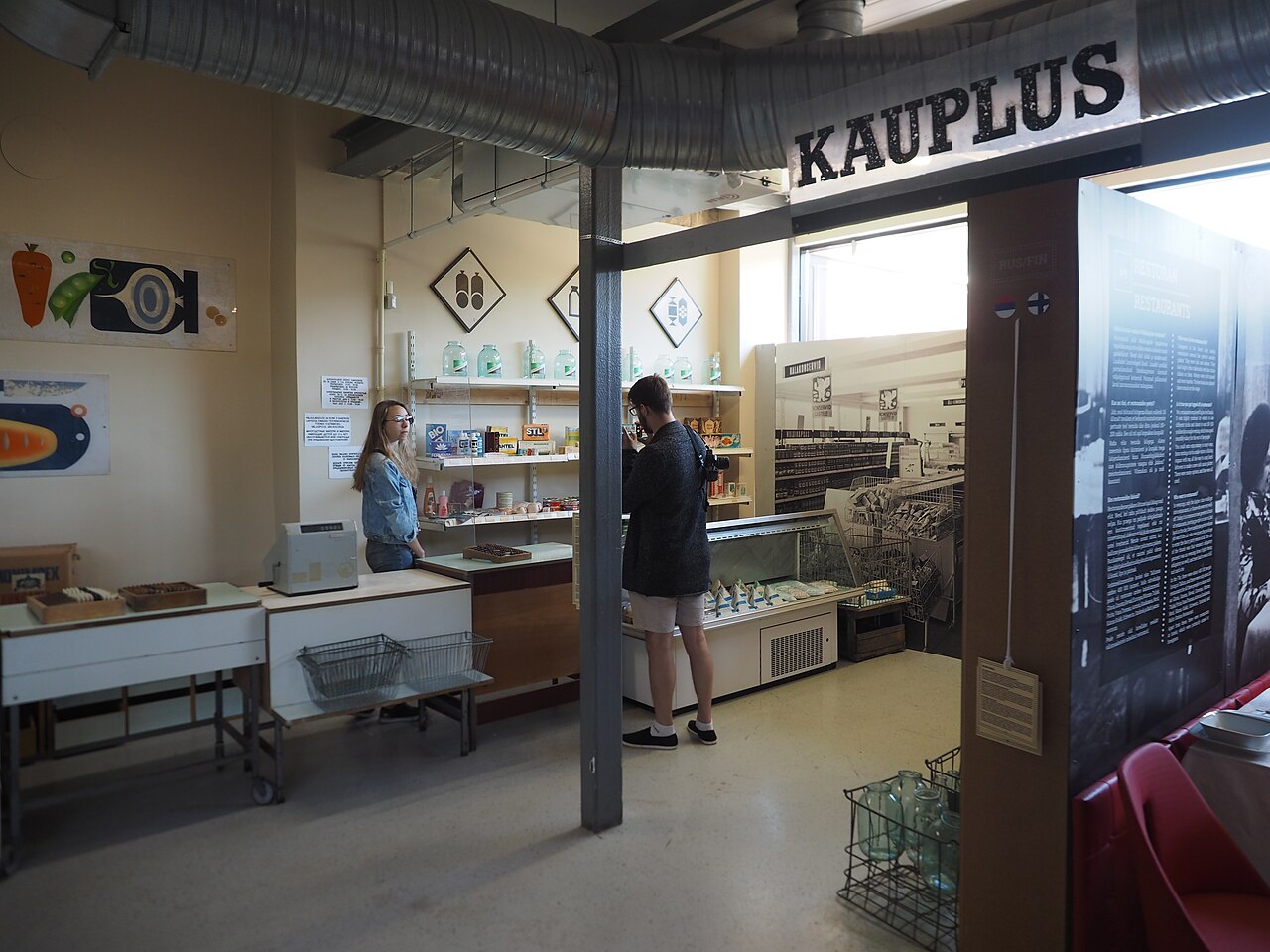
A recreated Soviet occupation-era shop interior at a museum in Tallinn, showing the period store shelves and goods (JIP; CC BY-SA 4.0; Wikimedia Commons)
The starting point: level with Finland (1920–1940)
The 1919 land reform expropriated 1,065 manor estates (96.6% of large landowners, mostly Baltic-German nobility) — about 2.34 million hectares (58% of farmland) redistributed into some 53,000–56,000 new settlement farms (the total number of farms grew to about 130,000 by the late 1930s). This created a broad class of owner-farmers, the social bedrock the occupation later targeted. Agriculture was ~59% of the economy; butter and bacon (with eggs and timber) led exports, and Britain and Germany took over 60% of them. In 1938 the purchasing power of Estonian workers' wages was 96% of the Finnish level — only 4% lower; GDP per capita was of the same order. This is the level the occupation destroyed.
Sovietisation and confiscation (1940–1941)
On 23 July 1940 the occupation authorities nationalised land, banks and major industry without compensation. In the summer of 1940, 103 banks, all large industry, mines and transport, and in stages up to 416 ships, were seized. Eesti Pank was nationalised on 10 October 1940, its assets moved to the USSR State Bank and forced to extend interest-free credit to Moscow. The sharpest instrument of the wealth grab was the confiscatory ruble conversion: from 25 November 1940 the official rate was 1 kroon = 1.25 rubles while the kroon's real purchasing power was 1 = 8–10 rubles — a roughly 6–8-fold devaluation that wiped out savings. The kroon was withdrawn on 25 March 1941. The June 1941 deportation (~10,000 people) explicitly targeted “former large landowners, merchants, factory owners” — the deliberate removal of the propertied and entrepreneurial class. See communist crimes against Estonia's minorities.
War destruction (1941–1944)
In the 1941 retreat, Soviet destruction battalions burned 3,237 farms and 13,500 buildings, and industrial equipment was evacuated to the USSR. Livestock fell in 1939–1942: dairy cattle −34%, pigs −50%, sheep −46%. The gravest single case was Narva: Soviet Air Force bombing (1944) destroyed 90–98% of the city; of 3,550 buildings only 198 remained habitable. The baroque old town was not rebuilt but bulldozed in the 1950s for Soviet apartment blocks; the population fell from 22,400 (1939) to about 6,600. Around 40% of the pre-war merchant fleet refused to return.
Forced collectivisation (1947–1949)
Forced collectivisation was decided on 21 May 1947, but rural resistance kept the voluntary phase near-empty — only ~8% of farms in kolkhozes by 20 March 1949. The instrument that broke it was the March 1949 deportation (25–28 March): about 20,600–20,700 people (~7,500 families) were deported from Estonia, over 70% women and children under 16. Collectivisation then exploded from 8% (20 March) to 64% (20 April) to 80% of farms by year's end; kolkhozes rose from 439 (1948) to ~2,898 (1949). A third of former fields (over half in places) fell out of use; output took a decade or more to recover to pre-war (1940) levels (milk only in the late 1960s). See the Sürgün and Soviet policy toward minority cultures.
The command economy and forced industrialisation
By the mid-1980s more than 90% of Estonian industry was run from Moscow through all-Union ministries. Planning “paid no attention to local resources, traditions or needs” and big new plants brought a massive influx of migrant workers. Estonia was mined for all-Union heavy industry regardless of local benefit: oil shale extraction peaked in 1980 at 31.35 million tonnes (~two-thirds of world output), and the world's two largest oil-shale power stations were built near Narva. Closed military towns vanished from the map: the Sillamäe uranium plant produced ~98,681 t of uranium products in 1950–1989, and Paldiski became the USSR's largest nuclear-submarine training centre (returned to Estonia only in 1994–1995).
To staff the industry, a Russian-speaking workforce was brought in: the ethnic Estonian share fell from ~97% (1945) to 61.5% (1989); the Russian share rose from 8.2% (1934) to 30% (1989). When Moscow's 1987 plan to expand phosphorite mining in Virumaa — which would have brought tens of thousands of new workers and devastated the environment — was revealed, the Phosphorite War broke out: the “Phosphorite — no thanks” campaign forced the occupation authorities to back down on 18 September 1987, a catalyst of the national movement. See russification.
A net contributor, not a net recipient
Soviet propaganda claimed that Moscow subsidised and industrialised the Baltics. The reality was the opposite: the Baltic states — including Estonia — were net contributors, not net recipients, in the Soviet Union. Significantly more was extracted from these territories than was ever invested back, even counting large military spending. From Latvia, over 18% of revenues were net-transferred out in 1946–1990; Lithuania sent about a third of its annual national budgets to the all-Union budget throughout the occupation (over half before 1958). The Baltic republics’ national income stood above the USSR average. The myth of generous Soviet “aid” conceals the revenues and profits siphoned off — Estonia’s higher productivity and resources (oil shale, industry) fed the all-union economy at manipulated prices, not the other way round.
The deficit economy
Soviet Estonia was defined by the defitsiit — chronic shortage from prioritising heavy industry over consumer goods. Rising wages against fixed prices pushed demand past supply, producing queues and empty shelves; ration cards returned in the late 1980s. Alongside it thrived a shadow economy — speculation, smuggling of Western goods and the blat system of favours, where access depended on connections, not money. The ruble was non-convertible; breaking from it was so vital to recovery that Estonia was the first ex-Soviet republic to leave the ruble zone, introducing the kroon on 20 June 1992.
The ecological cost
North-eastern Estonia became a sacrifice zone. The oil-shale industry left ~200 Mt of ash, ~90 Mt of mining waste and 70–80 Mt of spent shale; about 500 km² — ~15% of Ida-Viru County — is out of use under pits and landfills. Sillamäe's radioactive waste was dumped in a tailings pond on the Baltic shore, a serious hazard by the 1990s. Soviet military installations covered over 800 km²; cleaning up the military damage was later estimated at ~US$4 billion. The ecological argument became the socially acceptable engine of national mobilisation.
The divergence from Finland: the measurable cost
Two economies roughly equal in 1938 diverged sharply. The multiple depends on the metric and year:
Wage purchasing power (Cato, Estonia as % of Finland): 96% (1938) → 58% (1988) → 22% (1992) → 83% (2018). By 1992 Finland was ~4.5× Estonia.
GDP per capita: ~equal in 1938 (Maddison) → by 1992 Finland ~US$24,000 vs Estonia ~US$2,800 in nominal terms — an ~8-fold gap (about 3–4.5-fold in purchasing power).
Parity in the 1930s and near-parity again by the 2010s bracket the occupation as the interval in which Estonia fell to roughly a quarter to an eighth of its free Nordic twin — a lost half-century.
IME and the economic case for independence
The falling living standards of the early 1980s (the “years of stagnation”) were read as a direct result of over-centralisation. On 26 September 1987 the Tartu paper Edasi published the proposal Self-Managing Estonia (IME) (Estonian ime also means “miracle”). Its four authors — Edgar Savisaar, Siim Kallas, Tiit Made, Mikk Titma — sought to separate Estonia's economy from the all-union complex: its own budget and currency, local control of enterprises, direct producer–consumer trade. IME grew into a mass public education campaign in market principles and paved the way to the restoration of independence on 20 August 1991. As the Soviet occupation collapsed, Estonia was left with an inefficient planned economy and large imbalances; the 1992–1993 transition trough was deep (industrial output −30%, real wages ~−45%, prices +10,000%). See the Treaty of Tartu — the continuity doctrine by which 1991 is the restoration of the state, not its creation.
Connection to our story
The same occupation that stripped Estonia's economy also struck the Estonian Tatar community: the merchants' businesses were nationalised, the community's property and sacred places expropriated (see No one escaped the Soviet Union). The wrecking of Estonia's economy and the suppression of its minorities are two faces of the same occupation machine.
See also
Sources: Cato Journal (2021), Estonia vs Finland; Estonian World — a hundred years of the Estonian economy; Estonian Land Reform of 1919; History of Eesti Pank; Bombing of Narva; Operation Priboi; Oil shale in Estonia; Phosphorite War; Demographics of Estonia; Economy of Estonia; Isemajandav Eesti (IME); Occupation of the Baltic states (Wikipedia); Reinterpretation of Baltic economic history (2024).