Tatar life in Tallinn
Tallinn was the oldest and most enduring centre of the Estonian Tatars. Where the Narva community was destroyed in the Second World War, Tallinn's lives on to this day. The city's Tatar story runs from an 18th-century soldiers' settlement through the merchant flowering of the pre-war republic to the Muslim congregation of restored Estonia.
A soldiers' settlement
The oldest layer of Tallinn's Tatar community descends from 18th-century soldiers who stayed on after long military service. The veterans bought land and built houses — the Tatar settlement (Tatar Sloboda) arose, its main street still called Tatari Street; Kadriorg was nicknamed the 'Tatar Nest' for its many Tatars. Between 1834 and 1862 about 50 Muslims lived in Tallinn, with their own mosque and imam. In the early 20th century the community rented rooms for religious holidays in the fire station by the Russian market.
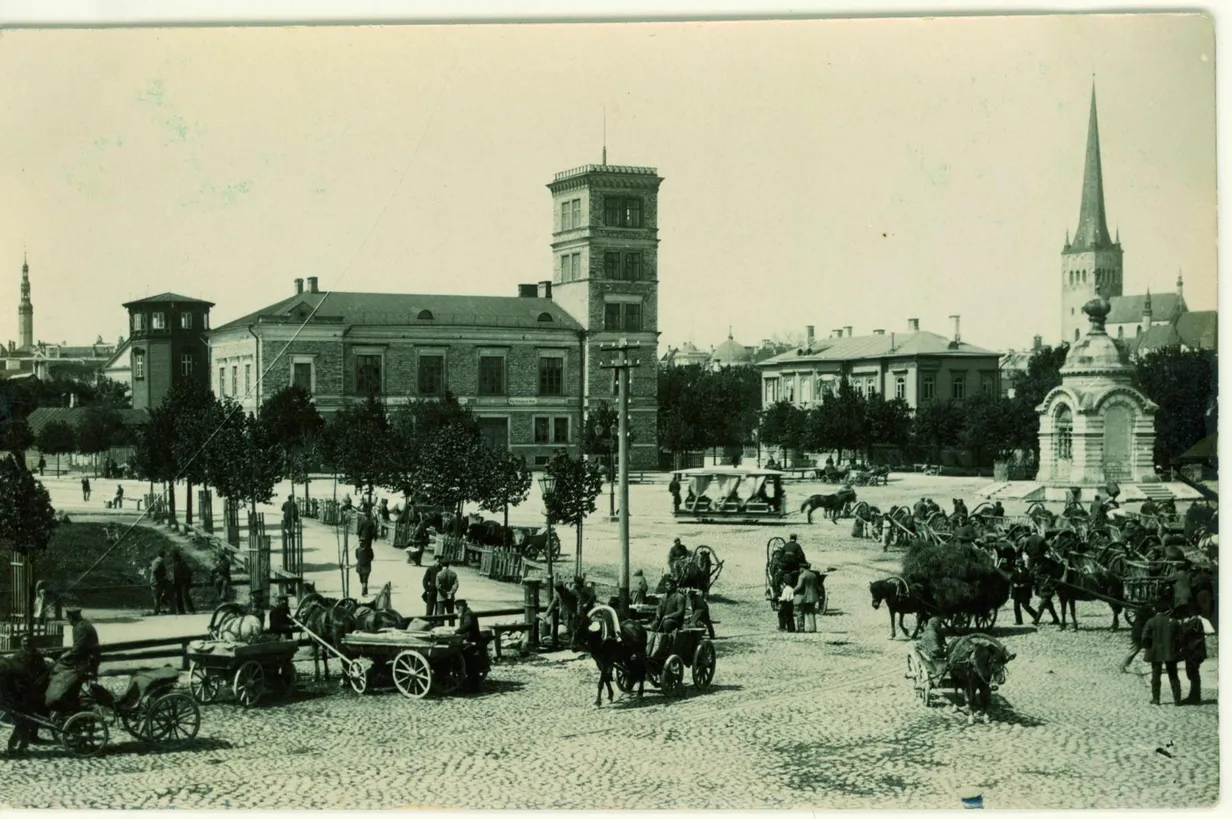
The fire station by the Russian market, where the Muslims held prayers in the early 20th century. Photo: Tallinn City Museum.
A merchants' town
After the abolition of serfdom in 1861 a new wave arrived from the Nizhny Novgorod region — Mišär merchants. The merchant Zakir Zakerov, with a successful clothing shop on Viru Square, brought a dozen young men from his home village as apprentices at a time. In the 1930s the best-known Tatar businessmen in Tallinn were the fur merchants Sibgadulla and Hairulla Mähdejev and Fateh Zakerov, and the lace merchant Umiar Zarip. Peddlers sold fabric, lace, furs and bootlaces, going door to door with their wares.
The known Tatar shops in Tallinn and their locations:
Zakir Zakerov — clothing shop on Viru Square.
Sibgadulla Mähdejev — fur shop on Gonsiori Street.
Hairulla Mähdejev and Fateh Zakerov — fur shop on Aia Street.
Umiar Zarip — lace shop at the corner of Sauna and Väike-Karja streets.
Umiar Aizatullin — clothing and textile shop at Tartu Street 9.
The prayer and school premises were in the mulla's flat at Raua Street 57 (also the Sunday school) and the Suve Street 4 prayer hall.
Religious and social life
In the 1930s Friday prayers were held in the mulla's flat at Raua Street 57 and a prayer room at Suve Street 4; 60–70 Tatars gathered on holidays. Religious life was led by imam Adiatulla Minahztetin (educated in Kazan and Bukhara) with muezzin Ismael Devlet-Shahh. The Tallinn Muhammadan religious society became a legal entity on 13 March 1940. A Tatar Cultural Society was active, its board made up of the community's respected men; there was a choir and a Sunday school that ran in Sibgadulla Mähdejev's house at Raua 57 (teacher Arif Rami from Finland).
Customs and home
Tatar social life was lively: both the Islamic and the Christian calendars were used, and alongside Muslim holidays Christmas and Easter were marked (no Christmas tree indoors, but gifts were exchanged and eggs coloured). Homes resembled Estonians' but had carpets on the walls, and the place of honour went to the samovar — tea mattered. The ban on pork was kept; the most popular meat was horse. The Tatars kept close company and cared for their poorer members.
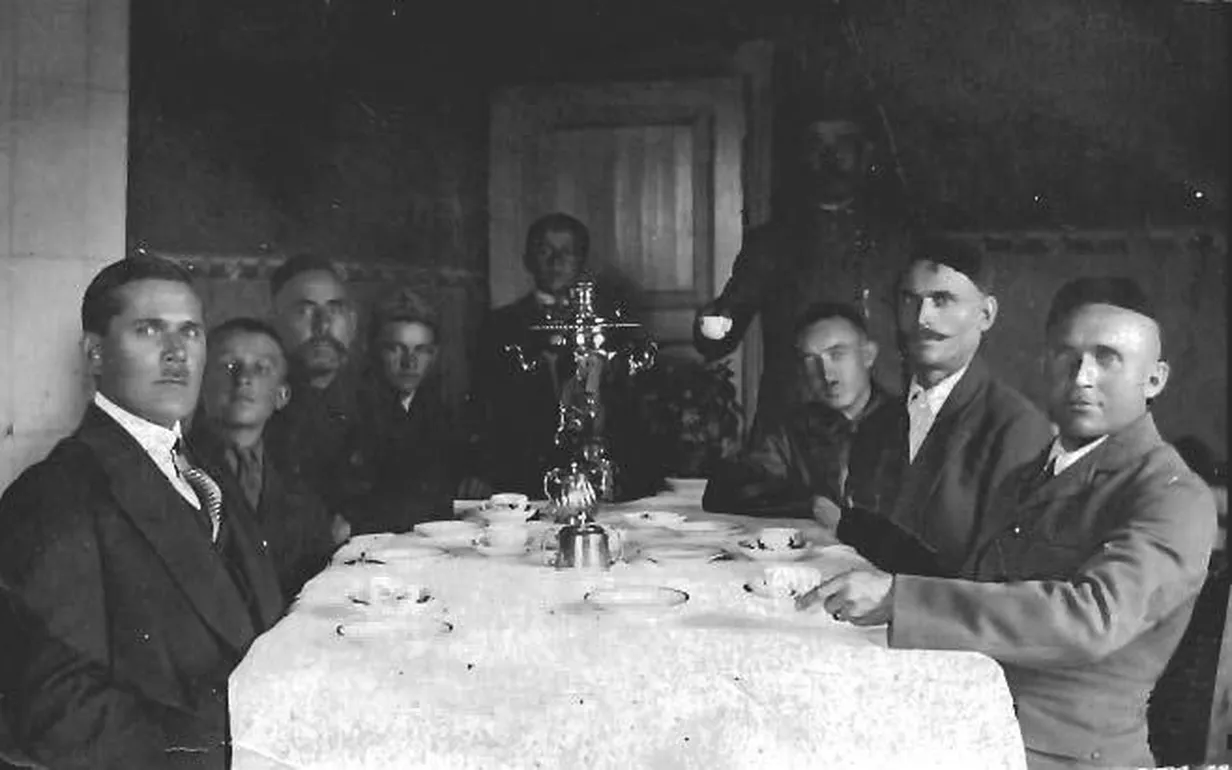
Estonian Tatars at the tea table in the 1930s. Photo: Tallinn City Museum.
The cemetery
In the early 20th century Sibgadulla Mähdejev founded the Tatar cemetery beside the Siselinna cemetery, enclosing it with a stone wall and a crescent-topped iron gate. For decades the cemetery was the backbone of the community. It was destroyed under the Soviet occupation: the 1944 bombing damaged the drainage and it was not allowed to be repaired, because the land had been expropriated and the authorities had other plans for it; in the 1950s the cemetery was closed and relatives reburied at Liiva, and a motor depot and a petrol station were built on the old ground.
Occupation and today
The 1940 Soviet occupation dissolved the religious societies. After Narva's destruction, the Tatars who remained there largely moved to Tallinn, but the old community faded into invisibility under the occupation. In 1988, during perestroika, Tatars with pre-war roots founded the Tatar Cultural Society (chairman Timur Seifullen); in 1989 the Tallinn Islamic Congregation was re-established, becoming the Estonian Islamic Congregation uniting all Estonia's Muslims. Today Tallinn is again the main home of the Estonian Tatars — the 2011 census counted 1,012 Tatars in the city.
See also
Sources: Toomas Abiline and Ringo Ringvee, 'Estonia', in Muslim Tatar Minorities in the Baltic Sea Region (Brill, 2016), pp. 105–127; eestitatarlased.ee. Name-forms vary between sources (Mähdejev ~ Megdejev).