Minority peoples in present-day Russia
The Russian Federation is home to more than 190 peoples, yet as central power tightens and russification continues, the space for minority languages and cultures steadily narrows. This is the world in which the Tatars — Russia's largest minority people — still live, and it is why the Estonian Tatar community's language-preservation work matters.
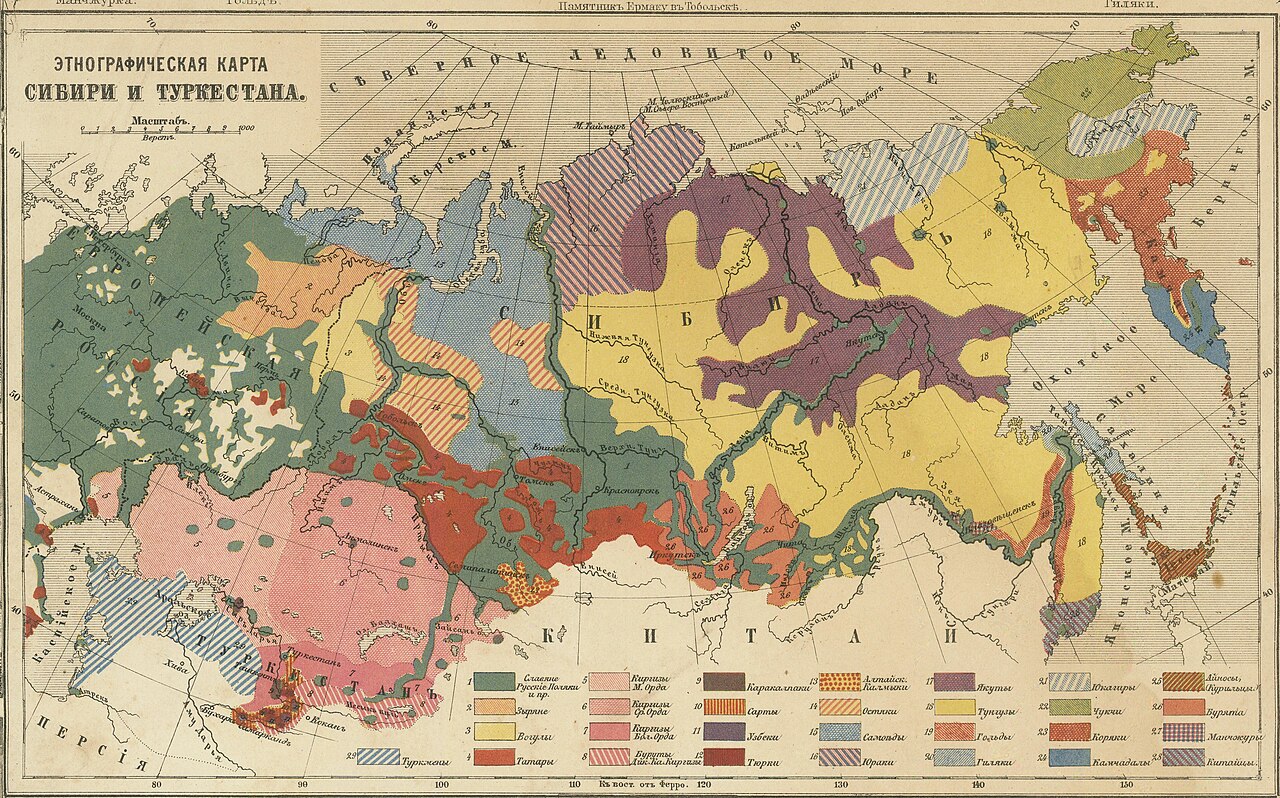
An 1890 ethnographic map showing the settlement areas of the various peoples and ethnic groups of the Russian Empire (F. A. Brockhaus (Brockhaus publishing house), 1890; Public domain; Wikimedia Commons)
Cutting native-language teaching
In July 2017 Russia's president stated that no one should be forced to learn a language that is not their mother tongue, and ordered prosecutors to check the compulsory teaching of minority languages. That autumn, compulsory Tatar-language schooling was ended in Tatarstan. On 3 August 2018 a federal law made native-language study voluntary: it may be taken only on a parent's written application, and the hours were cut from about five or six to two a week (later a recommendation to limit it to one). A 2002 law, moreover, permits only Cyrillic for the written languages of Russia — which is why the Kremlin blocked Tatarstan's attempt to switch to a more logical Latin alphabet. The same machine known as russification runs on.
Languages in danger
By UNESCO's Red Book of Endangered Languages, only three of Russia's official languages are not endangered — Tatar, Yakut and Tuvan. Among the Finno-Ugric peoples, an estimated more than half no longer speak their mother tongue. Cutting native-language teaching in the first years of school speeds up language shift, especially in cities where assimilation is strong.
Shrinking numbers: the 2021 census
By Russia's official 2021 census the number of Tatars fell from about 5.3 million (2010) to 4.7 million — a drop of nearly 600,000. Others fell more steeply still: Mari by 22.6%, Chuvash by 25%, Udmurts by 30%. These results are heavily disputed, however: census workers have admitted that data was falsified. The figures should therefore be read as a trend rather than exact truth — but the trend is clear.
Tatarstan: the loss of special status
Tatarstan was the last of Russia's republics to lose its special status. The 1994 Moscow–Kazan power-sharing treaty lapsed in 2017; the same year compulsory Tatar teaching ended; and in 2022–2023 a federal law changed the republic leader's title from president to glava (head), rais in Tatar. See The fall of Kazan and Tatarstan.
War and minorities (2022–)
The mobilisation for the war against Ukraine that began in 2022 fell disproportionately on minority regions — it was completed first in the ethnic republics. According to analyses, a Buryat is about 7.8 times and a Tuvan 10.4 times more likely to be killed than an ethnic Russian; Buryats make up about 1.16% of identified casualties though they are only 0.3% of the population. The most vulnerable are the small-numbered indigenous peoples of the North and Siberia, who by law should be exempt from military service altogether — researchers warn that within a generation some of these peoples could disappear.
The Crimean Tatars under occupation
After the 2014 occupation of Crimea the Crimean Tatars are again under pressure: their representative body, the Mejlis, was banned and activists have been repressed. The same people already suffered the 1944 deportation — see Sürgün — the deportation of the Crimean Tatars.
The link to us
The Tatars are Russia's largest minority people, and the same russification that our ancestors met in the empire and later in the Soviet Union runs on today. That is exactly why the Estonian Tatar community documents and revives Mišär — in a free Estonia, where it can be written in its own Latin alphabet. See also the Soviet Union's policy toward minority cultures and the cultural genocide of the Estonian Tatars.
See also: What an ordinary Russian is taught about history.
Sources: Minority language education in Russia (ICELDS, 2018); Russia's 2021 census results (RFE/RL); Ethnic minorities disproportionately killed (The Moscow Times); Ethnic minorities and mobilisation (CBC); Tatarstan's president title abolished (RFE/RL); Languages of Russia (Wikipedia); Minority languages under siege in Russia and Crimea (UNPO).
See also: Russia and its soldiers: the war in Ukraine.