Tatar life in the Russian Empire
When Kazan fell in 1552, the Volga Tatars became subjects of an Orthodox Christian empire. For nearly 350 years their life swung between two poles — the pressure of forced assimilation and hard-won rights. This was the world in which the Estonian Tatars' Mišär ancestors also lived, before itinerant trade carried them west.
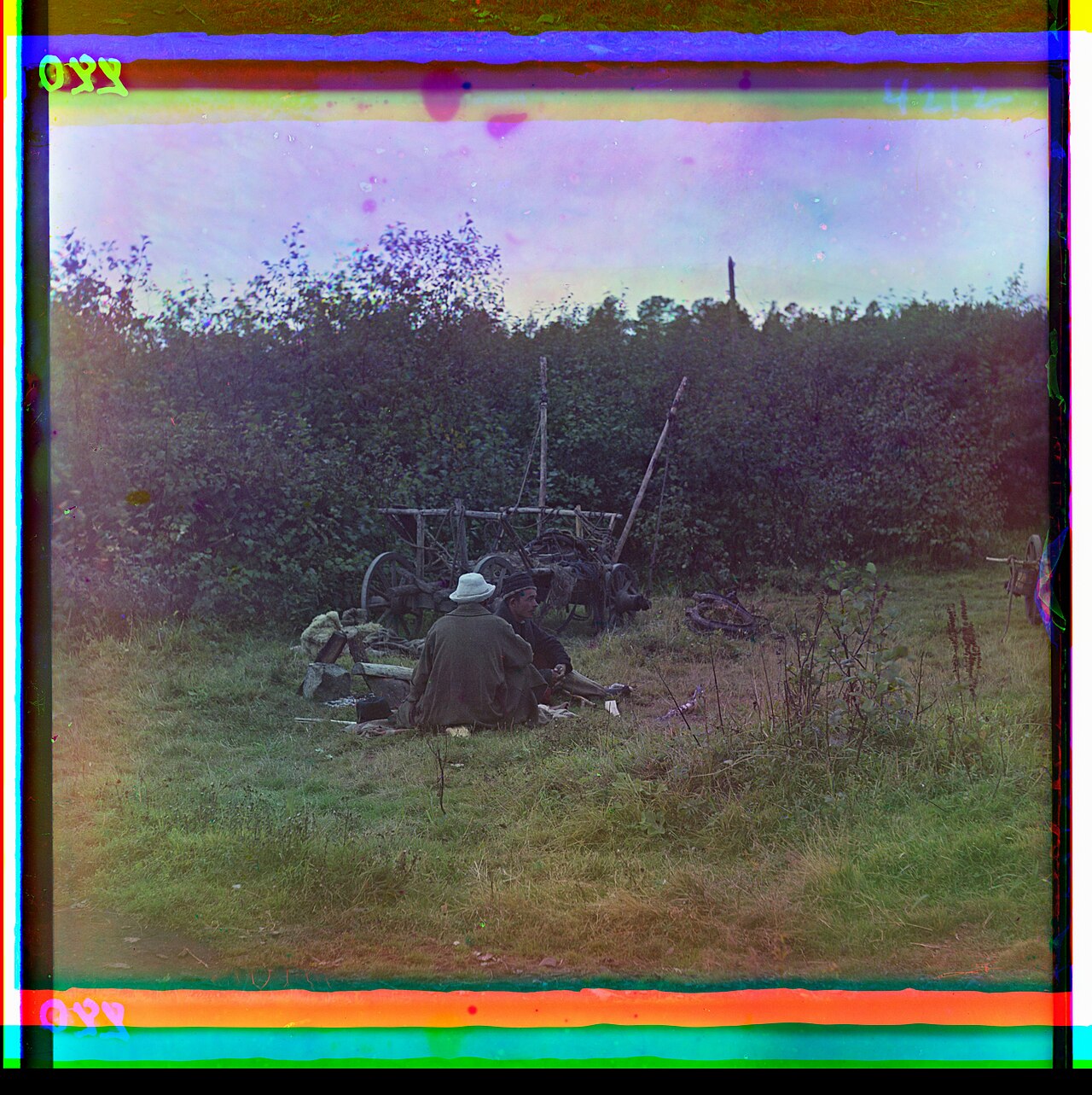
Two Tatar men resting by a campfire in a hay meadow, with a horse-cart and mowing machine beside them, in the Ural region in 1909 — one of Prokudin-Gorsky's early colour photographs (Sergei Prokudin-Gorski; Public domain; Wikimedia Commons)
A lost state and the pressure to convert
After the conquest of Kazan the Russian state pursued a policy of assimilation: forced Christianisation, economic coercion and educational russification went hand in hand. The Tatars took part repeatedly in the great peasant revolts — those of Stepan Razin (1670–1671) and Yemelyan Pugachev (1773–1775). The pressure peaked in the mid-18th century: the Office of New Convert Affairs, founded in 1740, sent out missionaries — the archimandrite Dimitri Sechenov baptised over 10,000 people in two years (1740–1742). A 1742 edict ordered mosques demolished: by a 1744 report, 418 of the region's 536 mosques had been destroyed. Out of forced Christianisation came the Kräshens — the baptised Tatars. The office was closed in 1764.
Catherine II and the recognition of Islam
The turn came under Catherine II. Her 1773 edict of religious toleration ended the demolition of mosques, and on 22 September 1788 the empress founded the Orenburg Muslim Spiritual Assembly, seated in Ufa. This state-controlled body administered mullahs, mosques and marriage and burial registries for the Muslims of the whole Volga-Ural, Siberia and the Kazakh steppe; its first mufti was Mukhammed-zhan Khusainov (1788–1824). Though it was meant to bring Islam under state supervision, it also gave Islam a legal footing for the first time — by 1883 it oversaw about 4,093 mosques and nearly 2.14 million Muslims. An edict of 1784 restored to the Tatar murzas and princes their noble status and privileges in return for service, though they were forbidden to own Christian serfs.
The serving Tatars and the Mišärs
In the empire's service the Tatars formed a military estate of their own — the serving Tatars. In the 16th century thousands of Tatar cavalrymen served Moscow; during the Livonian War their number reached about 5,850 (in an army of some 33,400 men). The Mišärs — the second large branch of the Sunni-Muslim Volga Tatars, whose ethnic character had taken shape around the Qasim Khanate — held the empire's eastern defence lines. From 1798 to 1865 they belonged to the Bashkir-Meshcheryak Host and took part in the 1812 war against Napoleon. They settled villages of the Sergach country (Nizhny Novgorod governorate), Meshchera and Penza; the 1897 census counted some 622,600 Mišärs (later counts tended to undercount them). It is from here — the Mišär villages of Sergach — that the Estonian Tatars descend.
Merchants and itinerant trade
The Tatars were valued middlemen in the empire's commerce: they linked Russian merchants with the Muslim east and south, trading furs, leather, fish and honey and reaching the markets of Central Asia and the Kazakh steppe. The poor-soil Mišär villages of Sergach turned to itinerant trade after the abolition of serfdom (1861) — fabrics, furs, soap — and the journeys reached through Saint Petersburg to Finland and Estonia. This was the road that brought the Mišärs to Tallinn.
Education and awakening: Jadidism
At the end of the 19th century a reform movement arose in Tatar culture — Jadidism (Arabic usul-i jadid, “the new method”). The Crimean Tatar educator Ismail Gasprinski (1851–1914) opened the first new-method school in 1884 and, from 1883, published the newspaper Tercüman. The new-method schools taught phonetic literacy and secular subjects — geography, history, mathematics — alongside religious instruction. Tatar book- and periodical-publishing flourished: 166 Tatar-language titles appeared between 1905 and 1917, and by 1916 there were over 5,000 Jadid schools in the empire. This renewal was a response to the pressure of russification; after the 1905 revolution Muslims entered organised politics for the first time.
The link to the Estonian Tatars
The Estonian Tatars' direct ancestors were the Mišärs of the Sergach country — serving Tatars who became merchants. It is exactly this imperial-era world — Islam under the Orenburg Assembly, the service estate and the trade road — that they carried with them. The first Tatars reached Estonia as soldiers in Russian troops, and a lasting community formed on the back of the late-19th-century travelling traders.
See also: Tchaikovsky and Estonia.
Sources: Mishar Tatars (Wikipedia); Orenburg Muslim Spiritual Assembly (Wikipedia); Jadid (Wikipedia); Volga Tatars (Encyclopedia.com). See also: The fall of Kazan and Tatarstan, the serving Tatars, the Mišärs' road to Tallinn.