The riddles of the Codex Cumanicus — all 50
Pages 119–120 of the German part of the Codex Cumanicus preserve about fifty riddles in Cuman (Kipchak) — the oldest recorded collection of Turkic folklore (the Turkologist Andreas Tietze called them the earliest variants of riddle types shared by the Turkic peoples). This page presents, for the first time, all of the riddles as printed in Géza Kuun's 1880 edition (nos. 1–50, edition pp. 143–148), with the manuscript's answers and the meanings from Kuun's Latin interpretations.
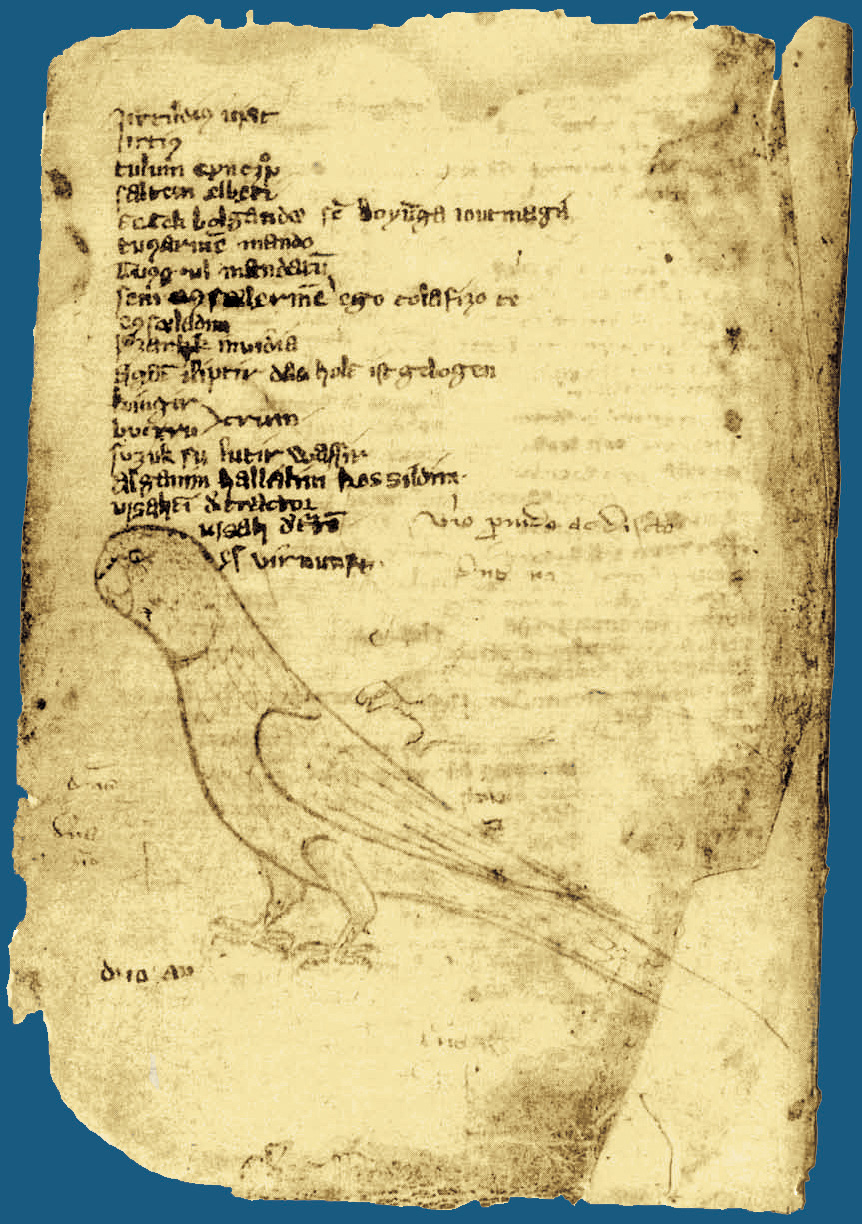
A page from the Codex Cumanicus manuscript, one of the oldest written sources of the Kipchak language (Unknown (14th-century scribe); public domain; Public domain; Wikimedia Commons)
The manuscript gives the answer to most riddles in the form ol … dir ("it is …"). Some leaves are torn or faded — Kuun himself notes that several riddles are "illegible or hard to read"; these are marked in the table. A Mišär equivalent is given only where the word is attested in our dictionary.
No. | Riddle (Kuun's spelling) | Answer (Cuman) | Meaning | Mišär equivalent |
|---|---|---|---|---|
1 | Tap tap tamyzik, tamadirgan tamizik, kulagaceb kojedirgan tamyzik | köbelek | butterfly | — |
2 | Biti biti bittidim, bes agacka bitidim, konesim juurdim, beki cirmadim | kina | hemp rope | — |
3 | Kara kara kula xuvsaptur | iglik | wedge | — |
4 | Itip itip irgalmas, icindagi cayhalmas | uru | seed | — |
5 | S(i)leysin jagi silkip bolmas, sirma tonu bugup bolmas | jumurtka | egg | jomõrka |
6 | Ak koy(engin) avzu joh | jumurtka | egg | jomõrka |
7 | (pikk mõistatus altun/komis saadikutest) | uzum | grape | özöm |
8 | Apac edi jabovli, altun basli cohmarli | turna | crane | torna |
9 | Senda menda joh, sengir tavda joh, utlu tasda joh, Kipcahda joh | kussut | a thing that is nowhere | — |
10 | (kockar muzi… kahjustatud) | turke (?) | sparrow | — |
11 | Uzun agac basinda ulu bitis bitidim | kesanu (?) | a throwing club | — |
12 | Ovlu kelgay dep… kah jerda sahladi | … bile balik | a fish in a net | balõk |
13 | Kislamis kani necik juhmamis, hap ortada kislamis | kani jav | the fat of curdled milk | — |
14 | Bes bash elci keliir… (viie peaga käskjalg) | tove | camel | döjä |
15 | Ac | keregi | necessity | — |
16 | Siyr sirti, koy kogaci | — | answer missing in the manuscript | — |
17 | Keca utahi kegede semirrir | huun (huvun) | melon | kavõn |
18 | (rebenenud leht — kahjustatud) | — | (damaged) | — |
19 | … kis kislar, bucu jay jaylir | sirih | the desert (per Kuun) | — |
20 | Olturgani oba jer, baskani bagir camek | uzegi | stirrup | — |
21 | Capcacik ustunki capcacik | hamis | reed | — |
22 | Jazda jangi kelin jagunadir | hamis dasi | also the reed | — |
23 | Jazda javli tokmak jatir | kirpi | Kuun: eyelids (kirpik); modern reading: hedgehog | kerpe |
24 | Jazda javli hays jatir | ylan | snake | jõlan |
25 | Icer, jer, inina kirer | bicak | a (folding) knife | põtsak |
26 | Salp kesim sansis ohlu | kok bile julduz | the sky with its stars | kük |
27 | Burusis buz teser | koy bogu | the vault of heaven (per Kuun) | — |
28 | Ongli soluli ayrga otus tume oneydim | kujas, ay, julduz | sun, moon and stars | kojaš |
29 | Altu ayrga tura tuser, al torha jayli tuser | — | explanation missing in the manuscript | — |
30 | Ox otemis otemis, jiy kolda kisla | bej kulaga | the lord's servant | — |
31 | (fragment) | — | (illegible) | — |
32 | (selgitus puudub) | — | explanation missing in the manuscript | — |
33 | Bilgenimni bildim… | — | the intellect | akõl |
34 | (väike tükike, mis süttides mustaks pöördub) | — | fire | ut |
35 | (väike kollane tükike) | — | gold | altõn |
36 | (libe pikk rada) | — | knife and whetstone | — |
37 | Bu bardi, izi joh | kema | a boat | köjmä |
38 | (kannatuse järel ahastus) | — | donkey | išäk |
39 | (kui suu avab, ilmub ta vägi) | — | donkey | išäk |
40 | (nahkkotikese all väike tuum) | — | nut | — |
41 | (kaheksa auku sinu peas…) | — | a squinting look (per Kuun) | — |
42 | Maymacik | kirpi | Kuun: eyelids; modern reading: hedgehog | kerpe |
43 | (möirgav, mürisev…) | ylagan (?) | (partial: a bellowing thing) | — |
44 | (tema väänded on neetud) | — | a stretching snake | jõlan |
45 | (rände tarvis — must, äär kokku õmmeldud) | — | a tent with its two sides tied | — |
46 | Setelar setele tubu, burkitdar jogartin kelgan… | — | a spark | — |
47 | Tama kellir desirler, kuyruhu ucu su… | — | a spark | — |
48 | Tama kellir desirlar | kezerge | a glow, inflammation (per Kuun) | — |
49 | Beltirdagi kese | jit kelga | a guest, a newcomer | — |
50 | (kahjustatud; … sart aygir savlavlati kisnaymis) | kazar (?) | (fragmentary) | — |
Notes. The texts follow Kuun's printing (OCR-close; brackets and question marks are Kuun's own uncertainty or damage marks). Meanings follow Kuun's Latin interpretations ("I. e. …"); for nos. 23 and 42 Kuun read the answer as kirpik (eyelids), while modern editions read kirpi (hedgehog) — both are given. A famous detail: riddle no. 9 mentions Kipchak itself ("Kipcahda joh" — "not even in the Kipchak land").
See also: The Codex Cumanicus and the Kipchak-Cuman language (the best-known riddles with translations), and the Codex volume in this site's library.
See also
Sources: Géza Kuun, "Codex Cumanicus" (Budapest 1880), XII. Aenigmata cumanica, pp. 143–148 (texts) and interpretations pp. 149 ff. — the digitisation is in this site's library; Andreas Tietze, "The Koman Riddles and Turkic Folklore" (1966, cited via secondary sources).