Edigü (Yedigei)
Edigü (c. 1352–1419; Idegäj in the Tatar epic, also known via Russian as Yedigei/Jedigei) was a commander of the Manghit tribe who ruled the Golden Horde as its de facto sovereign in its age of decline and founded the Nogai Horde. His life gave rise to the greatest epic of the Tatar peoples — which the Soviet occupation authorities banned in 1944.
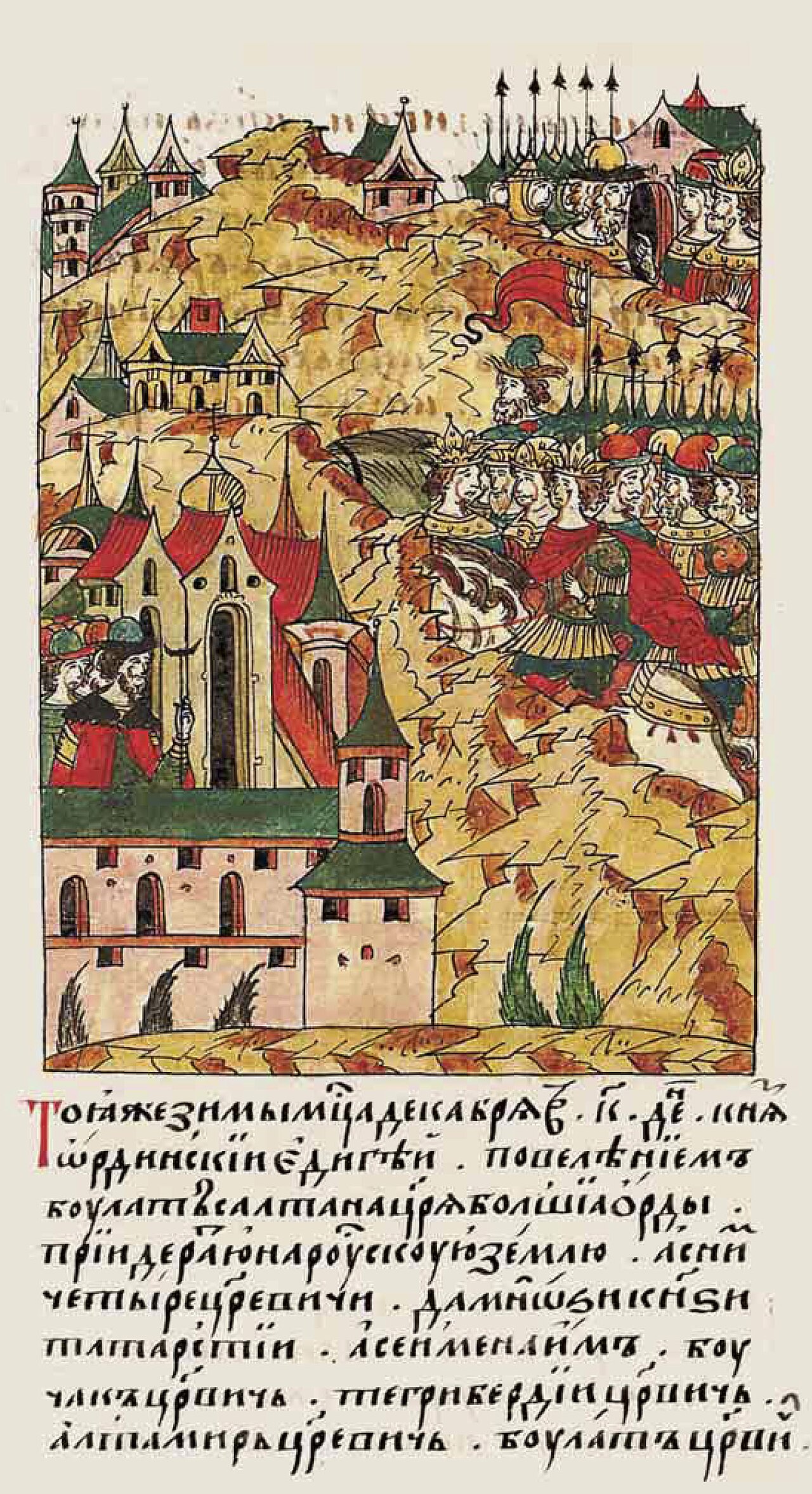
A 16th-century illustrated chronicle miniature depicting the 1408 campaign of Edigu (Idegei), emir of the Golden Horde (Anonymous illuminators of the Illustrated Chronicle (Litsevoi svod), 1560s–1570s; Public domain; Wikimedia Commons)
Rise to power
Edigü's father Kutlukiya was killed in 1378 after falling out with Khan Tokhtamysh. Edigü first served as Tokhtamysh's general, then turned against him and allied with Timur. In 1397, as an ally of Timur-Qutlugh, he became commander-in-chief of the Golden Horde's armies, and from then on ruled the state for nearly two decades through puppet khans — never claiming the throne himself, as he was not of Genghisid descent.
The Battle of the Vorskla (1399) and the peak of power
In 1399 Edigü crushed the joint army of Tokhtamysh and Grand Duke Vytautas of Lithuania on the Vorskla River — one of the decisive battles of medieval Eastern Europe. In 1406 his agents killed his old enemy Tokhtamysh in Siberia. After Timur's death (1405) Edigü's power grew further: he also ruled Khwarazm (until 1412). In 1408 he led a great campaign against Russia — burning Nizhny Novgorod, Rostov and other towns and besieging Moscow, which had not paid tribute for decades.
Fall and death
In 1412–1413 Edigü lost control of the major cities and withdrew to Khwarazm. In 1419 he was killed by Qadir Berdi, the last surviving son of Tokhtamysh. Posthumously Edigü became the founder-figure of the Manghit ulus — the later Nogai Horde; his dynasty lasted there about two centuries. His descendants later became the Moscow princely families Urusov and Yusupov.
The epic 'Idegäj'
Edigü's life grew into the greatest oral epic of the Tatars and the other successor peoples of the Golden Horde — 'Idegäj', over 10,000 verse lines, performed by improvising bards into the early 20th century. It is the Tatar national epic, with versions known also among the Nogais, Bashkirs, Kazakhs and other Turkic peoples.
1944: the epic banned
On 9 August 1944 the Central Committee of the All-Union Communist Party (Bolsheviks) adopted a resolution on the 'ideological errors' of the Tatar party organisation, condemning the study of Golden Horde history as 'glorification of a reactionary feudal state' and banning by name the popularisation of the epic 'Idegäj'. Tatar historical scholarship and the national epic were taboo for decades on Soviet orders — the same erasure of history that struck the Estonian Tatar community under the occupation. The epic was rehabilitated and published in full only in the perestroika years.
See also
Sources: the Wikipedia article 'Edigu'; studies of the 9 August 1944 CC resolution in Tatar historiography (e.g. Kazan University research); the Mardjani Foundation edition 'Tatar folk epic Idegei'. The birth year c. 1352 and the epic's length are estimates.