The Golden Horde
The Golden Horde (also the Ulus of Jochi or the Kipchak Khanate) was a great power of the 13th–15th centuries, ruling the steppes from the Danube to Siberia, centred on the lower Volga. Originally the north-western wing of the Mongol Empire, it quickly became a Turkic-speaking Kipchak state — and it was in the Golden Horde era that the world of today's Tatar peoples, the Mišärs included, took shape.
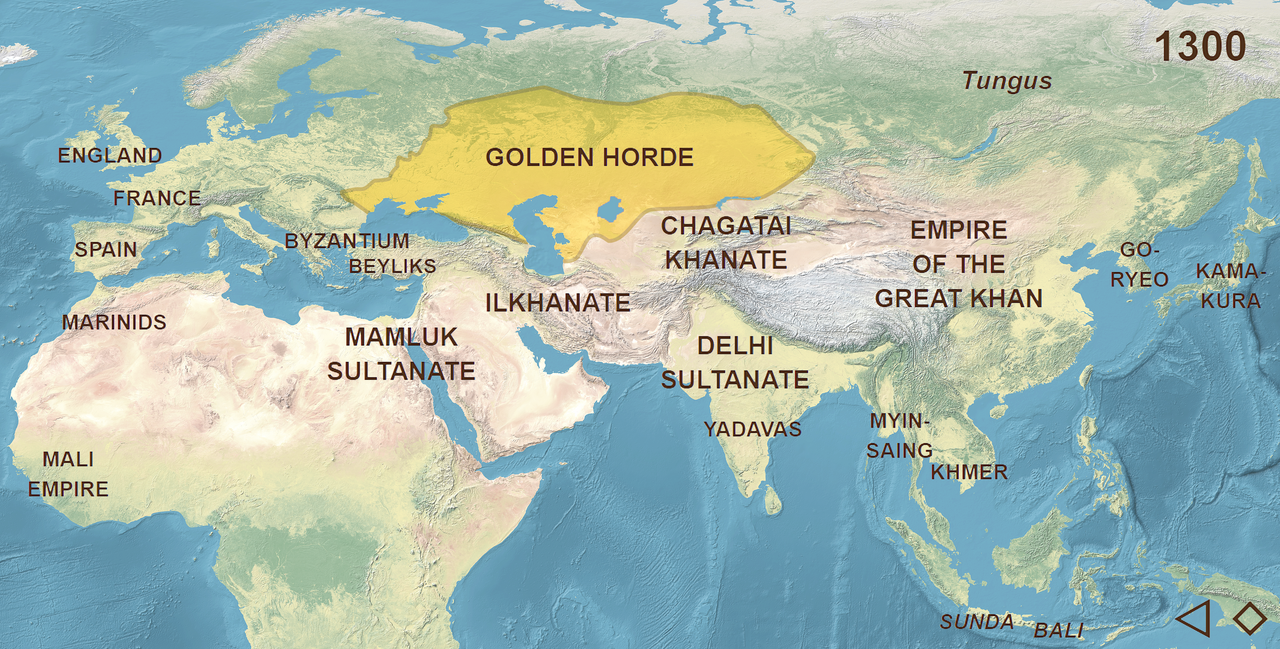
Map showing the extent of the Golden Horde across Eurasia around the year 1300, highlighted in gold among neighbouring states (Base map naturalearthdata.com (public domain); released under CC0; Public domain (CC0 1.0 Universal); Wikimedia Commons)
Birth (1236–1242)
Genghis Khan's grandson Batu (c. 1205–1255) crossed the Volga in 1235–1236 and crushed Volga Bulgaria; in December 1240 Kiev fell. Returning from the Central European campaign, Batu consolidated his domains and in the early 1240s founded his capital, Sarai, on the lower Volga. Batu's dynasty ruled unbroken until 1359.
State and people: a Mongol elite, a Kipchak population
The ruling stratum was Mongol, but the bulk of the population were Kipchaks and other Turkic peoples — the state replaced the earlier Cuman–Kipchak confederation and Turkicised within a couple of generations. The name 'Golden Horde' is later; contemporaries spoke of the Ulus of Jochi, and historians also use 'Kipchak Khanate'. The realm was motley: Tatars, Bulgars, Kipchaks, Mordvins, Russians, Greeks and others lived under the same rule.
Islam and the golden age
Of the khans, Berke (r. 1257–1266) was the first to adopt Islam, but it became the state religion under Özbeg Khan (1312–1341): in 1314 he built the mosque of Solkhat in Crimea, and by about 1315 the Horde was Muslim. Özbeg's reign was also the state's peak. The new capital, Sarai Berke, grew into one of the largest cities of the medieval world — estimates run to hundreds of thousands of inhabitants.
The Golden Horde era also produced the greatest source of the Kipchak language: the Codex Cumanicus, whose oldest part was compiled around 1303 for Europeans trading in the Horde's lands. The Mišär language belongs to the same Kipchak line.
Decline and break-up
After Batu's line ended in 1359, succession strife weakened the state. The Battle of Kulikovo (1380) and above all Timur's devastating campaign of 1395 broke the Horde's power. In the 15th century it dissolved into successor khanates: the Nogai Horde (early 15th c.), the Khanate of Kazan (1438), the Crimean Khanate (1443), the Khanate of Astrakhan (1459) and the Khanate of Sibir; the last remnant state, the Great Horde, faded by the early 16th century.
The Golden Horde and the Tatars
For the Tatar peoples the Golden Horde is the key era. The middle Volga became a melting pot in which the heirs of Volga Bulgaria and the Kipchaks fused into the Volga Tatars; the Khanate of Kazan was the Horde's direct successor. The Mišär story runs on the same track: in the Golden Horde period Kipchaks built strongholds in the Meshchera region around the Oka and the Sura, and the Mišär ethnic character was finally shaped around 1400–1500 in the Qasim Khanate — likewise a successor state of the Horde. The Mišär dialect preserves archaic Kipchak features to this day.
See also
Sources: the Wikipedia articles 'Golden Horde' and 'Batu Khan'; the Estonian Encyclopaedia and Vikipeedia 'Kuldhord'; Abiline and Ringvee (Brill, 2016) on the formation of the Mišärs. Medieval city populations are period estimates.