The Uyghurs
The Uyghurs were a Turkic people whose Khaganate (744–840) inherited the power of the Turkic Khaganates in Mongolia. In our story they are a kindred Turkic people and a carrier of steppe literacy, not a direct Mišär ancestor — a collateral branch of the same family that carries our story's deep spine on from the Göktürks.
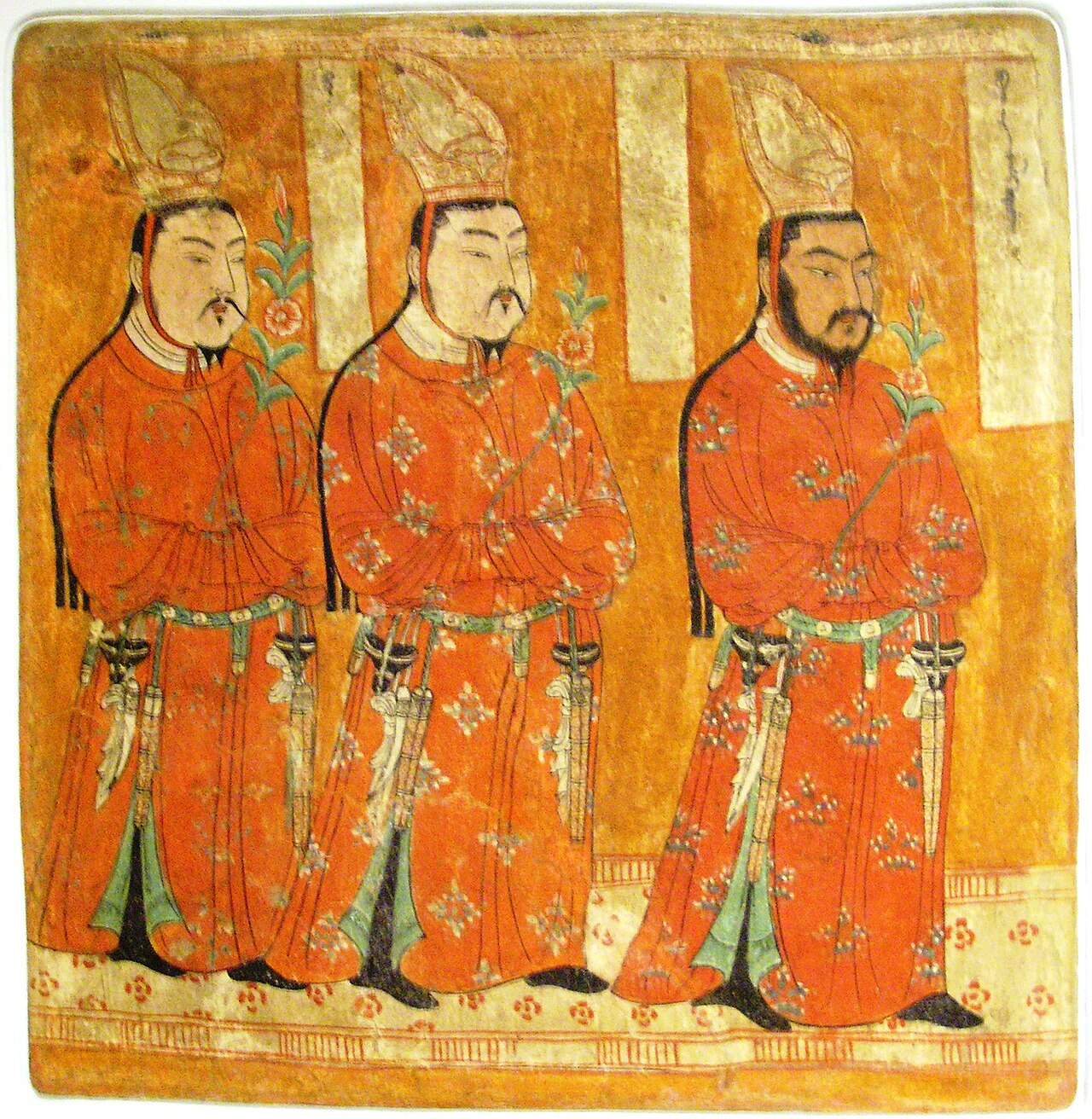
Uyghur princes depicted as donors, wall painting from the Bezeklik Thousand Buddha Caves (cave 9), 9th–12th century (Anonymous medieval mural (Bezeklik, Cave 9, 9th–12th c.); photograph released to the public domain by Wikimedia user Gryffindor; Public domain; Wikimedia Commons)
The Uyghur Khaganate (744–840)
In 744 a coalition of Uyghurs, Basmyls and Karluks overthrew the Second Turkic Khaganate; the Uyghurs then took sole power and founded their Khaganate in the same sacred heart of Ötüken in the Orkhon valley. The first qaghan was Qutlugh Bilge Köl; the capital became Ordu-Baliq (Karabalgasun) on the Orkhon — one of the largest medieval cities of Inner Asia.
The Khaganate rose to prominence by helping the Tang dynasty suppress the An Lushan rebellion (755–763). In 762/763 Bögü Qaghan made Manichaeism the state religion — the one major steppe empire to do so (under Sogdian priestly influence). In 840 the Yenisei Kyrgyz shattered the Khaganate and took Ordu-Baliq; the Uyghurs fled south and west.
After 840
The fleeing Uyghurs founded new states in the Tarim Basin: the Kingdom of Qocho (Idiqut) around Turfan and the Ganzhou Uyghurs. They became largely Buddhist (later, from the 10th century, Islam spread among them through the Karakhanids' orbit). Their great cultural legacy is the Old Uyghur alphabet (derived from the Sogdian script): the Mongols adopted it, and from it came the vertical Mongolian script. Uyghur scribes served as literate administrators across the Mongol Empire.
Old and modern Uyghurs
It must be said plainly: the medieval Uyghurs are not the modern Uyghurs of Xinjiang in any simple linear sense. The modern ethnonym was revived in the 20th century (the 1921 Tashkent conference; made official in Xinjiang in 1934). Today's Uyghurs speak a Karluk-type Turkic language, are Muslim and descend from a mixture of peoples of whom the old Uyghurs are only one component. Scholars regard the continuity as partial and reconstructed, not seamless.
The tie to the Mišärs
The Uyghurs are not ancestors of the Mišärs. They are the eastern collateral branch of the Turkic family — a sibling, not a parent. Their importance to us is twofold: they are the direct successor of the Turkic Khaganates in the deep-history spine of the steppe that is also the Mišärs' shared background; and they were great carriers of Turkic literacy. The Mišärs' own line runs instead through the Kipchak branch — the Uyghurs are a relative, not a forebear.
See also: The Uyghurs today.
Sources
This article draws on: Uyghur Khaganate; Uyghurs; Old Uyghur alphabet; Qocho (English Wikipedia); Uiguurid (Estonian Wikipedia). The old-vs-modern Uyghur continuity and the state-religion date (762/763) are flagged as open in the text. See also this knowledge base's pages: the Turkic Khaganates, Proto-Turkic, the Orkhon inscriptions and the Kipchak steppe.