Proto-Turkic and the Turkic language family
Proto-Turkic is the reconstructed common ancestor of all the Turkic languages — a language preserved in no writing, but rebuilt by the comparative method from later languages. It is the deepest root of the Mišär language and the foundation of our whole language project: the Estonian Tatar alphabet stands in the Latin-script line of the Turkic languages, not the Cyrillic one.
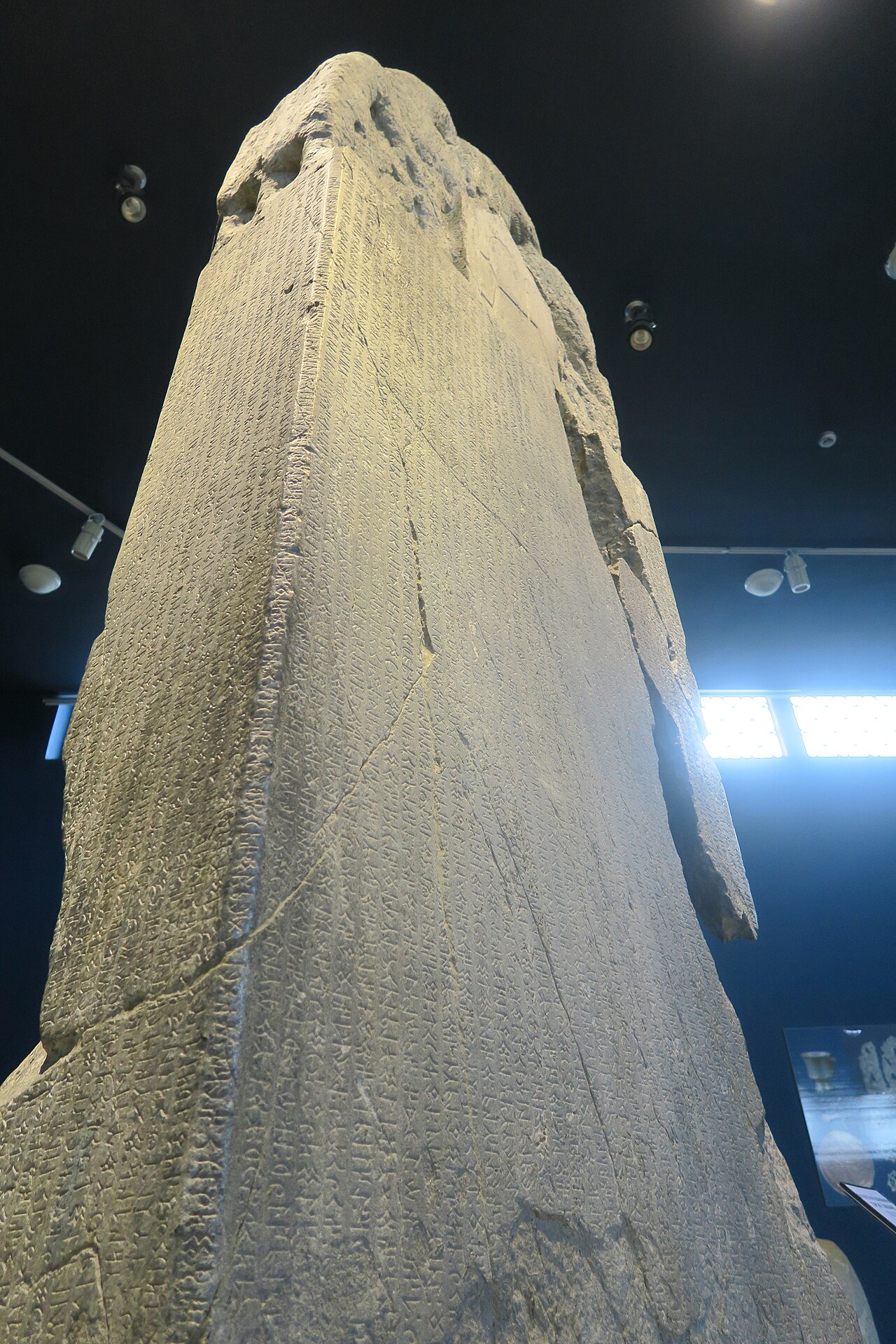
The Kul Tigin memorial stele, part of the early 8th-century Orkhon inscriptions carved in Old Turkic script, in the Orkhon Valley, Mongolia (Vezirtonyukuk; CC BY-SA 4.0; Wikimedia Commons)
Age and homeland
Proto-Turkic is broadly placed in the 1st millennium BCE; the decisive split between the Oghur and Common Turkic branches is dated to around the turn of the era (c. 50 BCE – 50 CE). The homeland is disputed — proposals cluster in the eastern Central Asian steppe, Mongolia and Manchuria and the Altai zone; most scholars agree the language spread from east to west. Culturally (though not securely linguistically) the Proto-Turkic world is often linked to the Xiongnu horizon.
The oldest direct evidence is the Old Turkic Orkhon inscriptions (7th–8th c.), cross-checked against early Oghuz and Kipchak material and — crucially — against Chuvash, the only surviving member of the divergent Oghur branch.
The Turkic family tree
Proto-Turkic split into two primary branches:
The Oghur (Bulgar) branch — western; today only Chuvash survives (plus the extinct Bulgar). Its diagnostic feature is rhotacism-lambdacism: where Common Turkic has z/š, the Oghur branch has r/l.
The Common Turkic branch — every other Turkic language. Its sub-branches are Southwestern (Oghuz: Turkish, Azerbaijani, Turkmen), Northwestern (Kipchak), Southeastern (Karluk: Uzbek, Uyghur) and Northeastern (Siberian: Yakut, Tuvan).
It is under the Kipchak branch that Tatar falls — and Mišär within it.
What we know of Proto-Turkic
Reconstructable core features pass straight into Mišär: vowel harmony (back vs front vowels, like a–ä, o–ö, u–ü, õ–i in our alphabet), agglutination (long chains of suffixes on an invariant root; no gender, no articles) and a definite consonant system. Sample Proto-Turkic words (written in Latin with an asterisk): *kün “sun/day”, *yïr “song”, *at “horse”, *köz “eye”, *sub “water”, *yol “road”. Mišär keeps much of this core vocabulary to this day.
Writing systems and honest limits
Turkic languages have been written in turn in the Old Turkic runiform script, then Arabic (Old literary Tatar), in the 20th century in Latin, and under Soviet rule in an imposed Cyrillic. The Estonian Tatar alphabet belongs to the Latin line the project deliberately chooses over Cyrillic.
In honesty it must be said that the wider “Altaic” hypothesis, which would group Turkic with Mongolic and Tungusic into one macro-family, is disputed in linguistics and by many rejected — the shared features are attributed rather to long language contact. Nor is Mišär merely a “sub-variety of Kazan Tatar”: Radlov and Samoylovich classed Mišär with the Kipchak-Cuman group and noted it is among the closest living languages to the Cuman of the Codex Cumanicus (see why Mišär is closest to Cuman).
Sources
This article draws on: Proto-Turkic language; Turkic languages; Kipchak languages; Mishar Tatar dialect (English Wikipedia); Turgi keeled (Estonian Wikipedia). See also this knowledge base's pages: the Turkic Khaganates, the Kipchak steppe, the Mišär dialect and the Tatar language.