The Orkhon inscriptions
The Orkhon inscriptions are the oldest surviving extensive text in a Turkic language — the oldest written root of Turkic. They are stone memorial steles in the Orkhon valley of central Mongolia, raised by the rulers of the Second Turkic Khaganate in the 8th century. For us they are the earliest written witness of the language family to which Mišär also belongs.
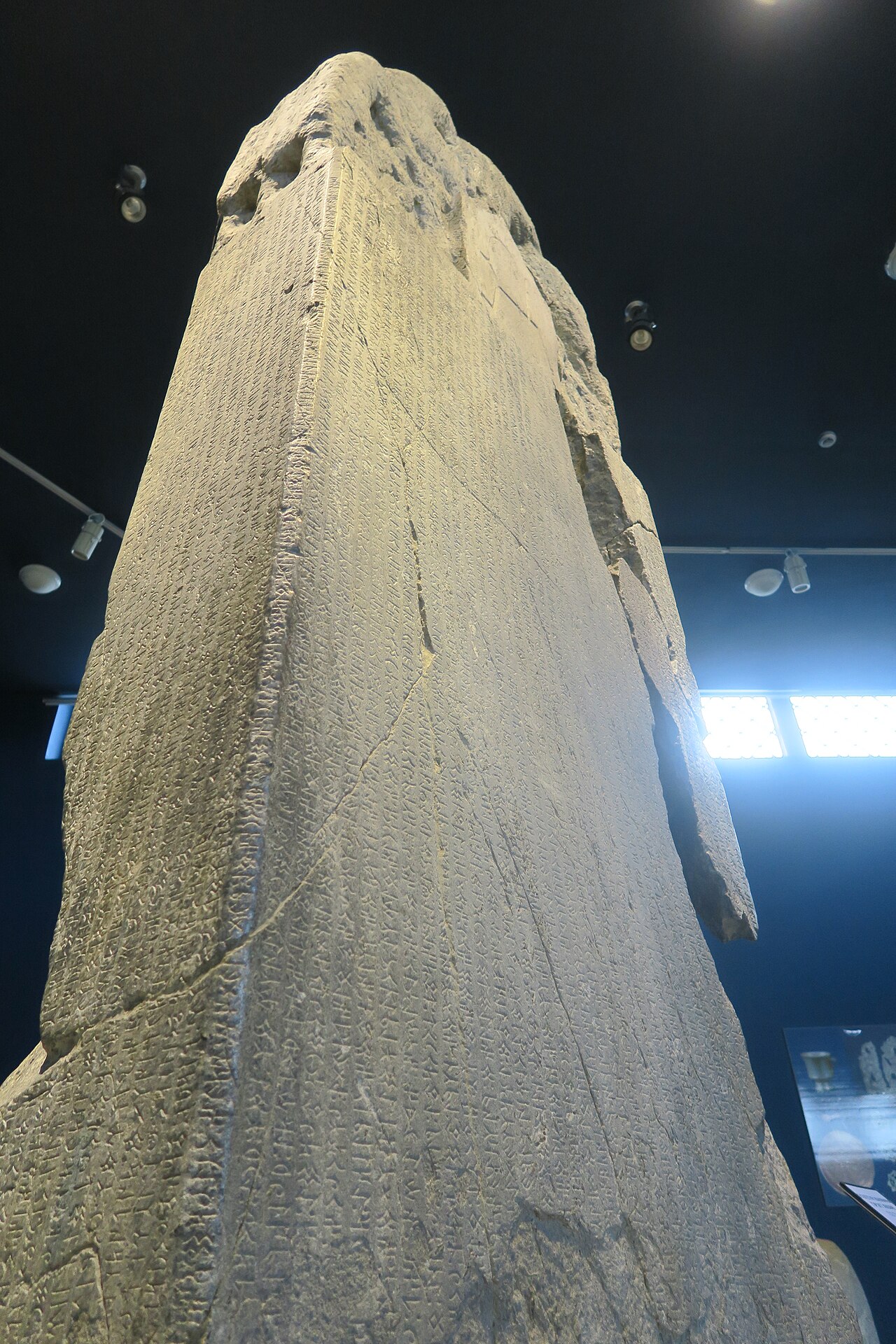
The Kul Tigin stele of the Orkhon inscriptions, carved in Old Turkic runic script, in the Orkhon Valley of Mongolia, erected in 732 (Vezirtonyukuk; CC BY-SA 4.0; Wikimedia Commons)
The inscriptions
The two principal monuments are the Kul Tigin stele (c. 732) and the Bilge Qaghan stele (c. 735); related to them is the somewhat earlier Tonyukuk inscription (c. 716–720). Kul Tigin (c. 684–731) was a military commander, his elder brother Bilge Qaghan (c. 683–734) the reigning qaghan; both were sons of Ilterish Qaghan. Bilge commissioned the Kul Tigin monument in memory of his brother; the texts were composed by Bilge's kinsman Yollıg Tigin — one of the earliest named authors in Turkic literature. The steles are partly bilingual: the main text in the Old Turkic runiform script, the Kul Tigin monument also carrying a Chinese inscription.
The content tells of the Turks' origins, their golden age, their subjugation by the Tang dynasty and their liberation under Ilterish; Bilge warns his people against submitting to Chinese influence and calls for unity. One famous passage reads, in the translation tradition of Thomsen and Tekin, roughly (the wording varies by translator): “O Turkic people… if the sky above does not collapse and the earth below does not give way, who could destroy your state and your institutions?”.
Discovery and decipherment
The steles were located in 1889 by the expedition of Nikolai Yadrintsev; the texts were published by Vasily Radlov. The script was deciphered by the Danish philologist Vilhelm Thomsen, who announced the result to the Royal Danish Academy in December 1893 (Radlov reached similar results almost simultaneously). Thomsen's key was the Chinese clue (the names Kul Tigin and Bilge) and the recognition of the words Türk and Tengri (sky, sky-god), from which the whole vowel-harmony logic of the alphabet opened. The decipherment is a founding landmark of Turkology.
The Old Turkic runiform script
The script of the inscriptions is called the Old Turkic script, the Orkhon script or the Turkic runes (runiform — visually rune-like but unrelated to the Germanic runes). It has about 38–40 signs, is written right to left, and its consonant signs come in pairs by vowel harmony (one set for back, one for front vowels) — a script tightly fitted to Turkic vowel harmony. Its probable origin (per Thomsen and later scholars) is the Aramaic alphabet via Sogdian and Pahlavi; a partly indigenous origin (from tamga clan-marks) has also been argued but is unproven. The script was used in the 8th–10th centuries across the Turkic world (also the Yenisei and Talas inscriptions).
Why it matters to us
The inscriptions document Old Turkic — the oldest written stage of the Turkic family, the common ancestor of all its branches, including the Kipchak branch and the Mišär language (distantly, not directly). They also mark the beginning of a Turkic literate tradition that ran on through the Old Uyghur, Arabic and finally Latin scripts. The Estonian Tatar alphabet is the newest link in that ~1,300-year story of writing — and its Latin, non-Cyrillic choice stands in exactly that long line.
Sources
This article draws on: Orkhon inscriptions; Old Turkic script; Tonyukuk inscriptions; Kul Tigin (English Wikipedia); Orhon inscriptions (Britannica). The quoted line is a paraphrase of the Thomsen/Tekin translation tradition, whose wording varies — not a fixed canonical text. See also this knowledge base's pages: the Turkic Khaganates, Proto-Turkic, the Uyghurs and the Codex Cumanicus.