The Turkic Khaganates
The Turkic Khaganates (Göktürks) were the first states to bear the name Türk and to spread the Turkic language across Eurasia. In their world all the later Turkic peoples took their start — including, distantly, the Mišärs, whose language belongs to the same family. The Khaganates are not the direct ancestor of any single people today but the shared birth-horizon of the whole Turkic family.
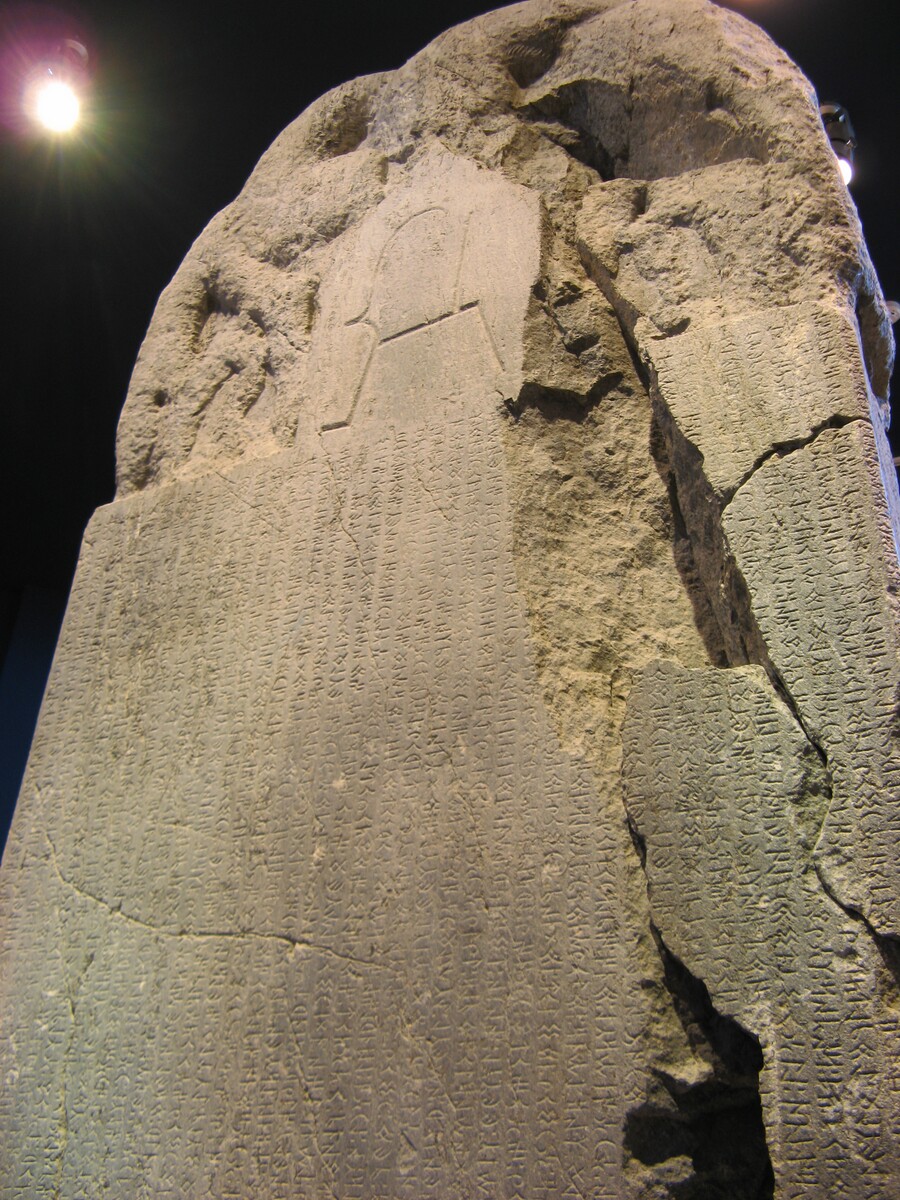
The Kul Tigin memorial stele in the Orkhon Valley, Mongolia, one of the 8th-century Turkic Khaganate (Göktürk) inscription monuments (Betta27; Public domain; Wikimedia Commons)
The First Khaganate (552–630)
In 552 Bumin Qaghan (of the Ashina clan) overthrew the ruling Rouran and founded the First Turkic Khaganate, seated at Ötüken. It was co-ruled: Bumin's brother Istämi led the western wing and expanded westward. At its height (c. 576) it reached from Manchuria to the Black Sea — the first transcontinental Central Asian empire, controlling much of the Silk Road.
After Taspar Qaghan's death (581) succession disputes began, and by 603 the state split into Eastern and Western Khaganates. The Tang dynasty conquered the East in 630 (battle of Yinshan) and the West in 657.
The Second Khaganate (682–744)
In 682 Ilterish Qaghan rallied the scattered Turks against the Tang and restored the Khaganate on the Orkhon river. Its peak is tied to Bilge Qaghan (716–734), his war-leader brother Kul Tigin and the elder statesman Tonyukuk. In 744 a coalition of Uyghurs, Basmyls and Karluks overthrew the last qaghan, and power passed to the Uyghur Khaganate.
The name “Türk” and the Orkhon inscriptions
The Turkic Khaganate was the first state to use the name Türk as a political name; its exact etymology is uncertain (often glossed as “strong”). From this state name grew the ethnonym of the whole Turkic family.
The Khaganate's most famous legacy is the Orkhon inscriptions — the oldest surviving extensive Turkic text, carved in the early 8th century (c. 732 and 735) into stones in the Orkhon valley of central Mongolia, in the Old Turkic runiform script. Bilge Qaghan raised them in memory of his brother Kul Tigin and of himself; the text tells of the Turks' origins, their golden age, their subjugation by China and their liberation under Ilterish. The inscriptions were found in 1889 by Nikolai Yadrintsev and deciphered in 1893 by the Danish philologist Vilhelm Thomsen — the key to reading all Old Turkic writing.
The tie to the Mišärs
The Turkic Khaganates are the Mišärs' ancestors only indirectly and by branching. No straight line runs from the Ashina dynasty to any people today; the Khaganates were a multi-tribal world from which different Turkic branches grew. The Mišärs connect to it through the Kipchak branch, which formed in the later steppe age. The Khazars and Bulgars were western offshoots of that same world. Honestly put: the Khaganates are the shared deep background of the whole Turkic family — of which Mišär is a part — not the Mišärs' direct pedigree.
Genuine uncertainty remains: a genetic study of an Ashina princess pointed to Northeast Asian ancestry, suggesting Turkic spread by cultural diffusion rather than migration; and the popular link to the earlier Xiongnu is traditional, not proven (see the Huns and the Xiongnu).
Sources
This article draws on: First Turkic Khaganate; Second Turkic Khaganate; Göktürks; Orkhon inscriptions; Old Turkic script (English Wikipedia); Türgi kaganaat (Estonian Encyclopaedia). See also this knowledge base's pages: Proto-Turkic, the Kipchak steppe, the Khazar Khaganate and the Huns and the Xiongnu.