The Kipchak Steppe (Dasht-i Qipchaq)
The Kipchak Steppe (Dasht-i Qipchaq) was a vast grassland from the Danube to the Irtysh, held in the 11th–13th centuries by the Cuman-Kipchak confederation. It was not a centralised state but a network of nomadic tribes — and the Kipchak language is the direct ancestor of Mišär.
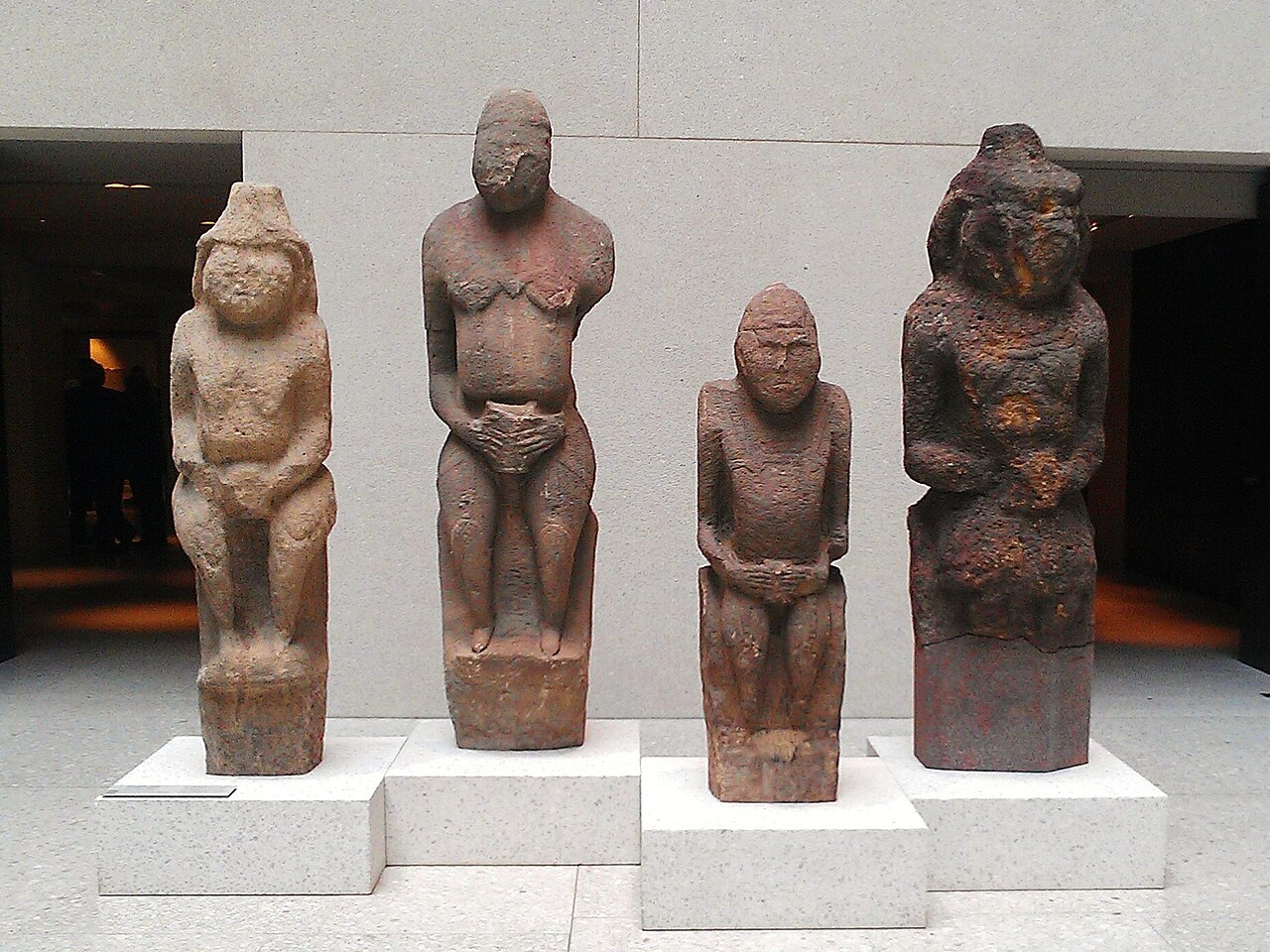
Four Kipchak (Cuman) stone statues from Ukraine on display in the Neues Museum, Berlin (Ethan Doyle White; CC BY-SA 3.0; Wikimedia Commons)
A people without a state
The Kipchaks were Turkic nomadic pastoralists who in the 11th century took over the steppes north of the Black and Caspian Seas. They founded no single state but moved in clans and tribal unions, trading, waging war and making alliances with neighbouring peoples. Europe knew the western branch as the Cumans (Estonian kuumen); in the Islamic world and later historiography they bear the name Kipchak.
Language and the Codex Cumanicus
The Kipchak language became the lingua franca of the medieval steppe, understood from Crimea to the Mamluk sultans of Egypt. Its greatest source is the Codex Cumanicus, whose oldest part was compiled around 1303 — a dictionary and texts for Europeans trading in Kipchak lands. Mišär belongs to this same Kipchak line; that is why the Mišär vocabulary stands remarkably close to the language of the 1303 codex.
The Golden Horde and legacy
In 1236–1240 the Mongols conquered the Kipchak steppe. The Kipchaks were not destroyed but absorbed: the Mongol elite ruled, but most of the population and the language remained Kipchak — which is why the Golden Horde is also called the Kipchak Khanate, and why today's Volga Tatars, Mišärs, Kazakhs, Nogais and others carry the Kipchak linguistic heritage. Some Kipchaks fled west to Hungary, where they became the Cumans (Hungarian kunok).
See also
Sources: the Wikipedia articles 'Cuman–Kipchak confederation', 'Kipchaks' and 'Codex Cumanicus'; this knowledge base's Codex pages.