Tamerlane: Sword of Islam (book)
Timur: (1336–1405). Islami mõõk, maailmavallutaja is the Estonian edition of the English historian and journalist Justin Marozzi's biography of Timur (Tamerlane) — originally Tamerlane: Sword of Islam, Conqueror of the World (HarperCollins, 2004), published in Estonian by Kunst in 2010 (translated by Martti Kalda, “Kuningaraamat” series, 528 pp.). For our knowledge base it is a central source on the man whose wars against the Golden Horde set loose the world from which the Mišär principalities were born.
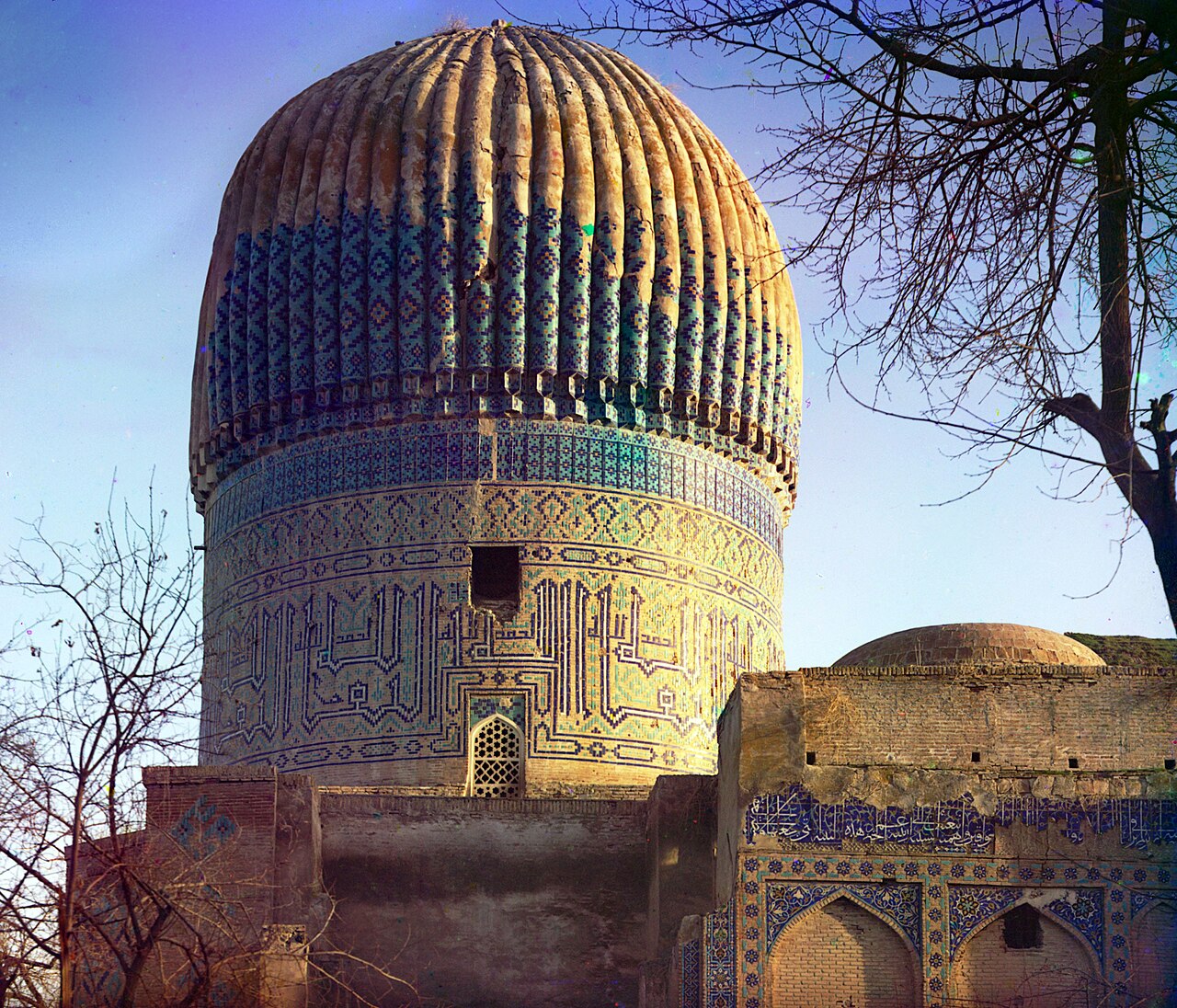
The turquoise dome of the Gur-e-Amir mausoleum in Samarkand, the tomb of Timur (Tamerlane), in an early 20th-century color photograph (Sergei Mikhailovich Prokudin-Gorskii (1863–1944); Public domain; Wikimedia Commons)
The author
Justin Marozzi (b. 1970) is an English journalist, historian and travel writer: he read history at Cambridge (Gonville & Caius, first-class honours 1993) and worked for the Financial Times, the BBC and The Economist. His later book Baghdad: City of Peace, City of Blood (2014) won the 2015 Ondaatje Prize; Islamic Empires: Fifteen Cities that Define a Civilization followed in 2019.
About the book
Marozzi combines history with travelogue: he travelled in Timur's footsteps in Uzbekistan and beyond, weaving the story of the medieval chronicles together with observations of today's Central Asia. The book was a Sunday Telegraph Book of the Year and became the best-selling biography of Timur. Marozzi's thesis: Timur was at once a merciless razer of cities and a tireless builder — illiterate, yet a skilled chess player, strategist and patron of the arts, under whose rule Islamic art and architecture flourished in Samarkand.
Timur (1336–1405)
Timur began in Central Asia as a sheep-thief and highwayman and built one of the largest empires in the world: Central Asia and Asia Minor, Persia, the Golden Horde and northern India fell under his power. In 1398 he sacked Delhi; in 1402 he crushed the Ottoman sultan Bayezid I at the battle of Ankara and took him prisoner. He died in 1405 on his way to conquer China. His capital Samarkand was built with the spoils of war into the most splendid city of the world; the towers of skulls raised before conquered cities remained the symbol of his cruelty.
Timur and the Golden Horde — the knot of our story
For us the book's most important part is the chapter on the Golden Horde and the “prodigal son” (1387–1395): Timur had himself raised Tokhtamysh to the Horde's throne, but the protégé turned on his benefactor. Timur crushed him twice — at the Kondurcha in 1391 and on the Terek in 1395 — and then destroyed the Horde's trading cities together with the capital, Sarai. The Silk Road trade was diverted south, and the Golden Horde never recovered.
It is in this world that our story unfolds: in Timur's camp rose Edigü, later the Horde's de facto ruler and founder of the Nogai Horde; and in the turbulent years of the first war between the Horde and Timur (c. 1388), Prince Bekhan founded the Temnikov Principality beyond the Moksha river — the historical heartland of the Mišärs. The Horde's disintegration, set off by Timur's wars, within a century also produced the Qasim Khanate — so Timur's story is directly tied to how the Mišärs, and ultimately the Estonian Tatars, came into the world.
The Estonian edition
The book appeared in Estonian in 2010 from the Kunst publishing house in the “Kuningaraamat” series, translated by the orientalist Martti Kalda. The Estonian blurb sums it up: Timur can be set beside Alexander the Great or Genghis Khan — a man who began as a sheep-thief and highwayman built one of the world's largest empires, and was not merely a destroyer but also a builder, a skilled strategist, a cunning politician, an excellent chess player and a patron of the arts and sciences.
Sources
This article draws on the Estonian edition's data (Raamatukoi; Kunst, 2010), the English Wikipedia (Justin Marozzi) and the presentations of the English edition (HarperCollins 2004; Internet Archive; Publishers Weekly). See also this knowledge base's pages: the Golden Horde, Edigü, the Temnikov Principality and the Kipchak steppe.