Estonian Swedes
The Estonian Swedes (Estonian rannarootslased or eestirootslased; Swedish estlandssvenskar) are a historical Swedish-speaking minority who lived for centuries along the coast and islands of north-western and western Estonia — a region the Swedes themselves called Aiboland. Once numbering up to nearly 10,000, the community was almost entirely scattered during the 20th-century occupations, when the great majority fled across the sea to Sweden in 1943–1944. Their fate echoes that of the Estonian Tatars — a small minority whose vitality was broken by the occupation.
About the name
The term Estonian Swedes (eestirootslased) came into wider use only after the occupation began and the community fled to Sweden. Because almost the whole community had fled to Sweden, a name was needed to distinguish them from the native Swedes there — so Swedes from Estonia came to be called Estonian Swedes. In Estonia itself the community's older and more natural name is rannarootslased, the coastal Swedes.
Aiboland: where they lived
The Estonian Swedes' settlements were mainly the western islands and coast. Vormsi (Ormsö), Ruhnu (Runö), Osmussaar (Odensholm) and the Pakri islands (Rågöarna) were predominantly Swedish-speaking into the early 20th century; a mixed population lived on the Noarootsi (Nuckö) peninsula, Naissaar and at Vihterpalu, with Swedes also at Riguldi and at Reigi on Hiiumaa. The Estonian-Swedish dialects belonged to the eastern varieties of Swedish but were not uniform: Ruhnu had its own distinct variety, the Vormsi–Noarootsi–Riguldi dialect another, and the Pakri–Vihterpalu area a third.
Settlement and the rights of free men
The Swedes settled the coast of present-day Estonia mainly in the 13th–14th centuries, arriving across the sea from Swedish-speaking lands. The first written mention comes from 1294, in the town law of Haapsalu; a letter of 1341 confirmed the islanders' right to live and manage their property under Swedish law. The coastal Swedes were thus free peasants — unlike the enserfed Estonian peasantry — and this “old Swedish liberty” remained central to their self-understanding for centuries.
Population
Census figures give a fairly consistent picture of the community's size. The 1897 census recorded 5,768 Swedes in the Governorate of Estonia. The Republic of Estonia's 1922 census counted 7,850 Estonian Swedes (about 0.7% of the population) and the 1934 census 7,641. On the eve of the Second World War their number is estimated at nearly 10,000. The community's peak thus fell in the 1920s–1930s.
National awakening and the Republic of Estonia
In the late 19th and early 20th century a Swedish national awakening took hold among the Estonian Swedes. In 1918 the Swedish-language newspaper Kustbon (“The Coastal Dweller”) began publication, linking the scattered coastal-Swedish districts. In 1920 the Birkas agricultural folk high school opened at Pürksi (Noarootsi), and in 1931 a Swedish private gymnasium at Haapsalu. The Republic of Estonia granted its minorities broad rights: the 1925 Law on the Cultural Autonomy of National Minorities was one of the most progressive of its time in Europe. The Swedish People's League (Svenska Folkförbundet) was active, and in the summer of 1933 the first Estonian Swedish song festival was held in Haapsalu.
Catastrophe: the occupations and the 1943–1944 flight
The community was broken by the era of 20th-century occupations. Already in 1939 the Soviet Union forced military bases upon Estonia, and during the first Soviet occupation in 1940 the inhabitants of Pakri, Naissaar and Osmussaar were forcibly moved off their home islands to make room for the Soviet military. The German occupation followed (1941–1944). At the war's end, in 1943–1944, the great majority of Estonian Swedes evacuated across the sea to Sweden — in part in an organized way, with the permission of the German authorities. Official records show 6,554 Estonian Swedes in Sweden on 8 June 1945; only about a thousand remained in Estonia.
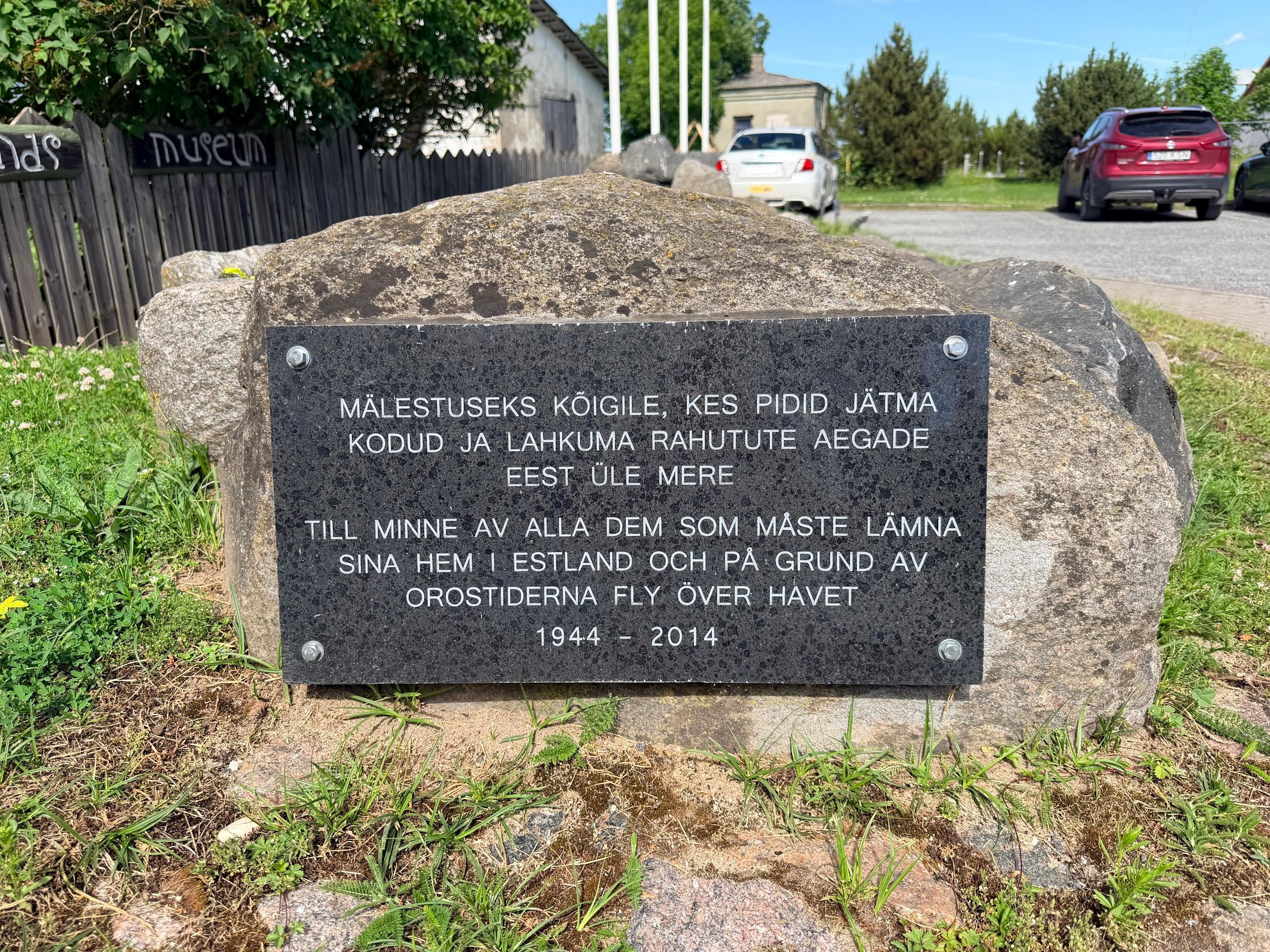
A memorial stone to all who had to leave their homes and flee across the sea from troubled times (in Estonian and Swedish, 1944–2014) — the same flight that carried most of the Estonian Swedes to Sweden.
Under the Soviet occupation
After 1944 the western Estonian coast and islands became a closed border zone of the Soviet occupation, with strictly limited access. The former Swedish villages stood empty or were resettled, the language and culture vanished from public life, and for the few who remained the occupation meant the silencing of their heritage. Because the coastal Swedes spoke Swedish and had ties to Sweden, the occupation authorities regarded them with suspicion — at times the occupation soldiers even accused the coastal Swedes of being NATO, i.e. Western, spies, precisely because of their Swedish speech. Like many other communities in Estonia, the coastal Swedes too were forced to rebury their relatives when the old cemeteries were destroyed or closed. In this way the centuries-old coastal-Swedish community almost entirely disappeared from Estonia.
After the restoration of independence
After the restoration of Estonia's independence in 1991, the coastal-Swedish heritage began to revive. The Coastal Swedish Museum (Rannarootsi Muuseum) was founded in Haapsalu, a Swedish-oriented gymnasium operates at Noarootsi, cultural societies (Svenska Odlingens Vänner) and a representative body of the Estonian Swedes were re-established, property was restituted, and ties with the community in Sweden restored. Today the number of Estonian Swedes and their descendants in Estonia is estimated at a few hundred. The community is small, but its language, history and culture are honoured once again.
A parallel with the Estonian Tatars
The story of the Estonian Swedes echoes that of the Estonian Tatars: both are small historical minorities whose thriving community was broken by the Soviet occupation. As with the Tatars, the coastal Swedes' villages were scattered and their churches and cemeteries left empty or neglected. And like the Tatars, since the restoration of independence the Estonian Swedes have been winning back their heritage.
See also
Sources: Wikipedia (Estonian Swedes; Rannarootslased); Rootsi-Mihkli congregation (history of the Estonian Swedes); M. Kuldkepp et al., The Estonian Swedish National Minority and the Estonian Cultural Autonomy Law of 1925 (Nationalities Papers). Population figures: the 1897, 1922, 1934 and 2021 censuses.