The Huns and the Xiongnu
The Huns and the Xiongnu were powerful steppe peoples who preceded the Turkic age. They are often called “the Turks' ancestors”, but this is disputed and largely unproven. This is the point where the Mišärs' traceable pedigree dissolves into speculation: solid ground begins only with the Turkic Khaganate (552); everything earlier is the shared dim background of the steppe world.
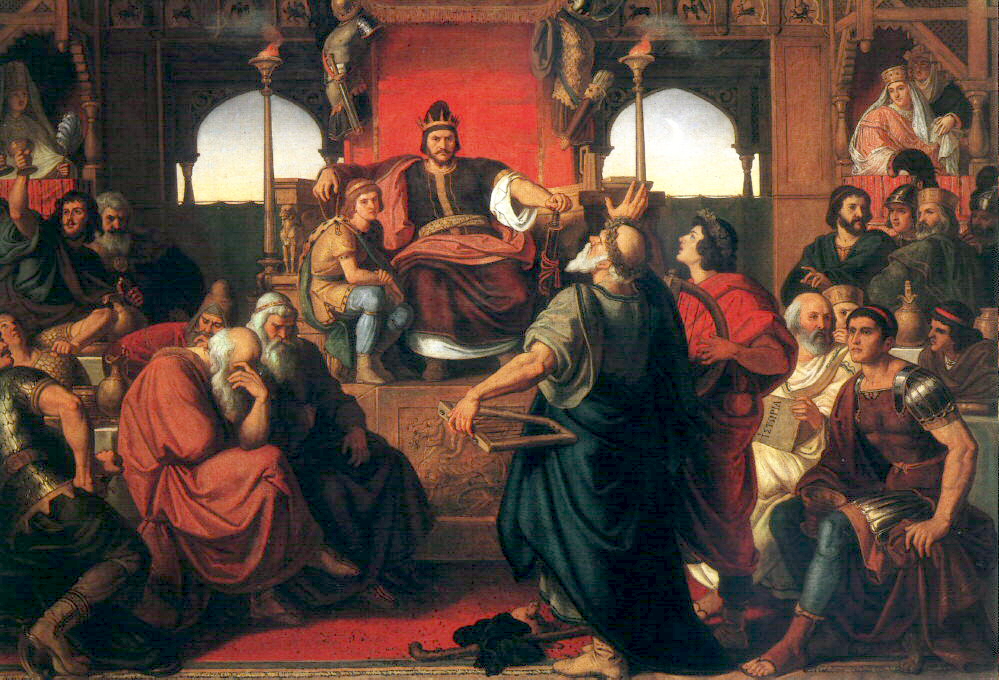
Mór Than's 1870 painting "The Feast of Attila", depicting the Hunnic ruler Attila seated at his court banquet. (Mór Than (1828–1899); Public domain; Wikimedia Commons)
The Xiongnu
The Xiongnu were an empire of pastoral nomads on the Mongolian steppe, roughly 3rd century BCE to 1st century CE. It was welded into one state by Modu Chanyu (c. 209–174 BCE). The Xiongnu were a multi-ethnic confederation, not a single “people”. Their rise coincided with China's unification: the building of the Great Wall is partly tied to holding them off, and long wars were fought with the Han dynasty in the 2nd–1st centuries BCE. In 48 CE the state split into Southern and Northern Xiongnu; the northern branch was broken and scattered westward.
The Xiongnu language is genuinely unknown: no script or text survives, only a few words in Chinese sources. Turkic, Yeniseian, Mongolic, Iranian or a mixture have all been proposed; none is proven. A recent study (Bonmann et al.) even proposes that the core Xiongnu language was Yeniseian (a Palaeo-Siberian language) — arguing against the old Turkic assumption. This is a new hypothesis, not a settled verdict.
The Huns
The Huns were horse-warriors who appeared on Europe's edge in the 370s, shattered the Goths and Alans and set off the Migration Period. Their peak was under Attila (c. 434–453), whose confederation reached from the Black Sea to the Rhine; he raided the Balkans, Gaul (battle of the Catalaunian Plains, 451) and Italy. Right after Attila's death in 453 the empire fell apart — the subject peoples revolted and broke Hunnic power at the battle of Nedao (c. 454).
The idea that the Xiongnu and the Huns were the same people was floated in the 18th century by the French orientalist Joseph de Guignes on the basis of name similarity. Modern scholarship is cautious: the names may be related, but no proven ethnic or linguistic continuity spans that ~300-year gap. A 2025 ancient-DNA study (PNAS) found some genetic links between certain European Hun-era individuals and the Xiongnu elite — suggestive, but it does not settle the question.
What is defensible and what is not
Defensible: the Xiongnu and the Huns were real, powerful steppe peoples belonging to the shared deep background of the Central Asian steppe world out of which the securely Turkic peoples later also grew. Peoples moved and mixed across this zone, and some genetic and cultural threads do run east to west.
Not defensible: to claim the Xiongnu or the Huns were specifically Turkic, a single ethnicity, or the direct ancestor of any group today — including the Mišärs. No traceable line runs from them to the Mišärs; asserting one would substitute myth for evidence. Honest bottom line: they belong to the shared deep layer of steppe heritage the Mišärs' Turkic descent ultimately draws on, but a direct pedigree to the Mišärs cannot be drawn.
A threshold, not a link
The first securely Turkic-named state is the Turkic Khaganate (552) — the earliest point where “Türk” is an attested, self-applied, language-anchored identity. Everything earlier — the Xiongnu, the Huns and the dim centuries between — is prehistory relative to the Turkic name. So in our chain the Huns and Xiongnu stand as a threshold, not a link: solid ground begins in 552, and everything east and earlier of it is shared steppe backdrop, not documented Mišär descent. (See the whole chain: the formation map.)
Sources
This article draws on: Xiongnu; Xiongnu language; Huns; Attila (English Wikipedia); 2025 ancient-genome study (PNAS). The recent Yeniseian-language and DNA studies are presented as notable fresh findings that themselves show how unsettled this is — not as a new truth. See also this knowledge base's pages: the Turkic Khaganates, Proto-Turkic and the Kipchak steppe.