The Siege and Fall of Kazan (1552)
The fall of Kazan on 2 October 1552 ended the Khanate of Kazan and opened the Volga to Muscovy's eastward expansion. This page describes how the city fell and why — a companion to the overview.
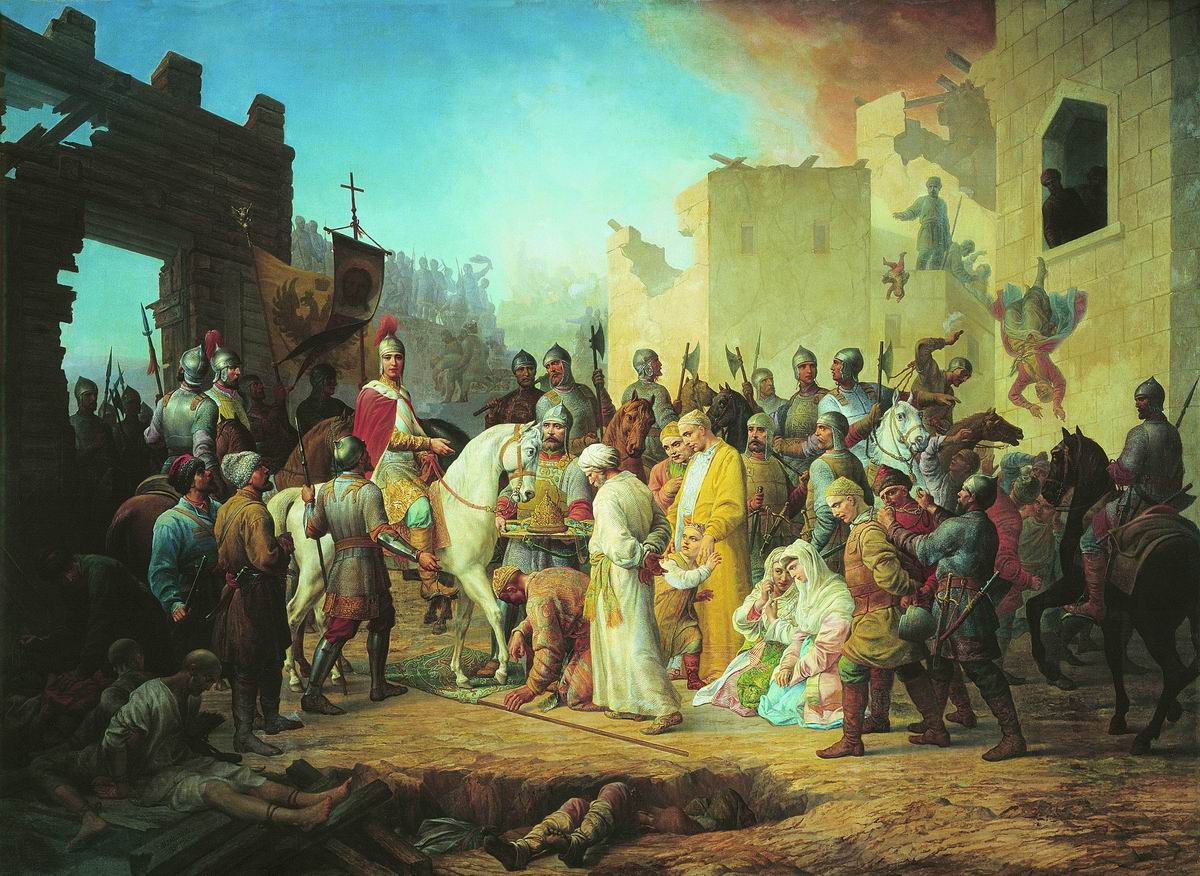
The 1552 siege and capture of Kazan by the forces of Ivan the Terrible (Pyotr Shamshin (1811–1895); Public domain; Wikimedia Commons)
Causes: the Volga, trade and slave-raiding
The deepest cause was Muscovy's eastward expansion and its drive to control the Volga trade route, which linked the north to Astrakhan and the Caspian. As the Golden Horde fragmented, several successor states contended for the middle Volga. Slave-raiding sharpened the conflict: Kazan war-bands raided the Muscovite borderlands and took captives to the Kazan markets or traded them down the Volga to Crimean and Ottoman intermediaries — a major source of the khanate's income.
A century of puppet struggles: Moscow vs. Crimea
In 1487 Ivan III took Kazan and installed the puppet khan Muhammad-Amin, establishing a protectorate — Russian merchants could trade freely, though revolts followed (1496, 1500, 1505). In 1521 Kazan broke free of Moscow and allied with Crimea, Astrakhan and the Nogay Horde; the Crimean-backed khan attacked Muscovy with his allies. The khanate split into pro-Moscow and pro-Crimean camps: in 1545 a pro-Moscow revolt deposed Khan Safa Giray and enthroned Moscow's client Shah Ali, from the Qasim Khanate.
The regency crisis and the final years (1549–1552)
Safa Giray died in 1549 and his three-year-old son Ütämeš-Giray became khan under the regency of his mother Söyembike. Rule was weak and Moscow exploited it. Earlier campaigns (1524, 1530, 1550) had failed, but in 1551 Moscow built the wooden fortress of Sviyazhsk on the Volga upriver from Kazan (built by the military engineer Ivan Vyrodkov) as a base for the assault. That same year the west bank of the Volga was ceded to Moscow, and Söyembike and Ütämeš-Giray were taken to Moscow as prisoners. Shah Ali was enthroned a second time but expelled in February 1552; the anti-Moscow camp then invited the Astrakhan prince Yadegar Muhammad and the Nogays. This was the last step before the siege.
The siege (August–October 1552)
Based at Sviyazhsk, Ivan IV (the Terrible) reached Kazan with an army of about 150,000 men and 150 cannon; it comprised the streltsy (musketeers), Moscow and Qasim cavalry, and Russian and foreign gunners and military engineers. The city was defended, by varying estimates, by 30,000–75,000 men (some sources count in the Cheremis, i.e. Mari, of whom there were about 20,000). The siege began on 22–23 August; from 29 August the Russian guns bombarded the town. Vyrodkov built a roughly 12-metre wooden siege tower mounting ten heavy and fifty light cannon. The gunpowder mines were decisive: the engineers (the chronicles name their leader as an Englishman called Rozmysl) blew up the city's underground water source, leaving the defenders without drinking water. On 2 October the wall was blown open by the Nogai and Ataliq gates, and a general assault took the city.
Massacre and aftermath
The losses were heavy and the numbers vary between sources. Russian casualties are put at about 15,355; on the Kazan side sources speak of up to 65,000 dead and missing (civilians included), while other estimates are lower (about 20,000). The city was sacked, the mosques destroyed and the khanate annexed into the Tsardom of Russia; Khan Yadegar Muhammad was captured and later baptised. Forced Christianisation began, out of which the Kräshens — the baptised Tatars arose. Saint Basil's Cathedral in Moscow was later raised to commemorate the victory. The long-term consequences of annexation are covered in the overview.
The link to us
The fall of Kazan is above all the catastrophe of the Kazan Tatars. By 1552 the Mišärs were already long the Russian state's serving Tatars — some of the Qasim cavalry even fought on Moscow's side. The Estonian Tatars' line runs through the Mišärs, not the Kazan Tatars.
Sources: Siege of Kazan (Wikipedia); Khanate of Kazan (Wikipedia); Russo-Kazan Wars (Wikipedia); Kaasani khaaniriik (Estonian Wikipedia); Kazan Falls to Ivan the Terrible (History Today).