Why Mišär is the closest living language to Cuman
In the judgement of the classics of Turkology, the living language closest to the Cuman (Kipchak) of the Codex Cumanicus is Mišär — the language of the Estonian Tatars' ancestors. This page sums up who made that claim and why it holds.
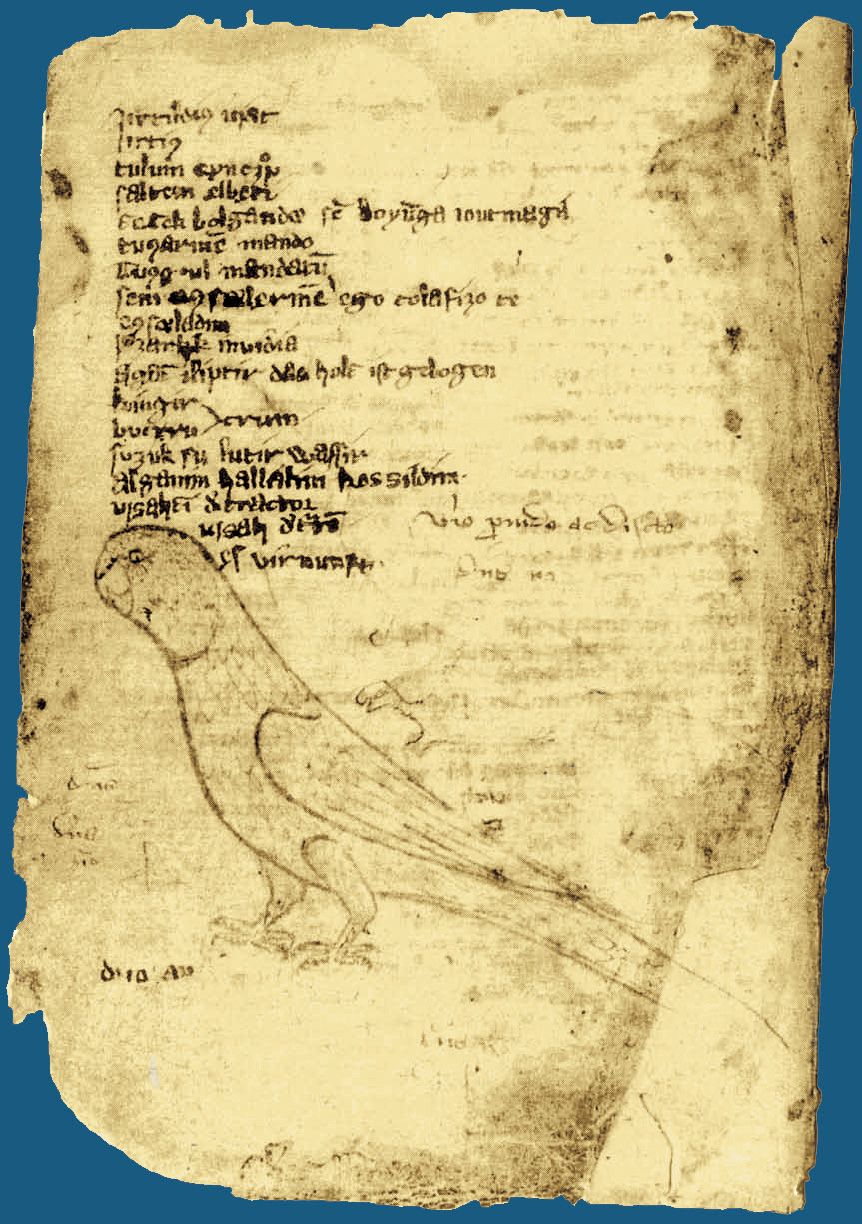
A page from the medieval Codex Cumanicus showing a parrot — a 14th-century manuscript of the Kipchak-Cuman language, held in Venice (Unknown (14th-century scribe); Public domain; Wikimedia Commons)
The position of Radlov and Samoylovich
The greatest Turkologist of the 19th century, Vasily Radlov, concluded that of the living languages it is the Mišär dialect of Tatar that stands closest to the Cuman of the Codex. Alexander Samoylovich, whose classification of the Turkic languages is foundational to this day, reached the same conclusion. In their scheme Mišär belongs to the Kipchak-Cuman group — the same branch as Crimean Tatar, Karaim, Kumyk and Karachay-Balkar — and not to the Kipchak-Bulgar group that holds Kazan Tatar and Bashkir. On this view Mišär is not merely “a dialect close to Cuman” but a living continuation of the same branch.
The literature singles out the Sergach subdialect — that of the Nizhny Novgorod Mišärs, including the Estonian Tatars' ancestors — as “faithfully close to the ancient Kipchak language”.
First reason: an origin without the Bulgar substrate
The prevailing scholarly view is that the Mišärs descend from the Golden Horde Kipchaks who settled west of the Volga — in the Meshchera and Oka country, apart from the towns of Volga Bulgaria. Kazan Tatar formed on the substrate of the Bulgars' remnant language and the Finno-Ugric neighbours (Mari, Udmurt): the local linguistic base fed the new language a series of sound innovations. The Mišärs stayed aside — their language carries the steppe-Kipchak shape forward without the intermediary layer of the Bulgar towns.
Second reason: the sound system
The differences are clearest in the sounds. The Kazan dialect (and the literary language built on it) went through a series of innovations that Mišär does not know:
Feature | Cuman (Codex, c. 1330–40) | Mišär | Kazan Tatar |
|---|---|---|---|
Affricate č | bičak “knife” — affricate | Retained: southern tš, Sergach ts (põtsak) | Weakened to a sibilant (literary pıçak) |
The vowel a | Unrounded a | Unrounded a | Rounds towards å |
Volga vowel shift | Absent (old values) | Did not take hold | Underwent it (with Bashkir) |
k/g vs q/ğ | Latin spelling velar | Velar k/g | Uvular q/ğ |
Three things deserve emphasis. First: the Codex's č is still an affricate in Mišär — and the Sergach ts (our põtsak) is its clearest living trace; this is why the Estonian Tatar alphabet has its own letter ts. Second: Mišär a is plain and unrounded as in old Kipchak. Third: the Volga vowel shift that reshaped Kazan Tatar and Bashkir — a hallmark of the mid-Volga language area — did not take hold of Mišär vocalism.
Third reason: geography and isolation
The left-bank Volga language area (Kazan Tatar, Bashkir, Mari, Udmurt) generated shared innovations over the centuries. The Mišärs lived outside it, across the Volga. A language left out of the waves of innovation keeps its archaic shape — just as Icelandic is the living language closest to Old Norse because it developed on an island, away from the Scandinavian innovations.
Objections and the modern view
The position of Radlov and Samoylovich is classic scholarship; the modern standard classification places all of Tatar — Mišär included — in the Kipchak-Bulgar subgroup, and Mišär's exact place is debated.
There is a hypothesis (Velyaminov-Zernov and others) that the Mišärs are Turkicized descendants of the Finno-Ugric Meshchera tribe; some genetic data supports a mixed origin. Linguistically, however, the dialect is purely Kipchak — origin and language need not coincide.
The Cuman of the Codex itself carried Oghuz influences — it was no “pure” Kipchak.
Honestly: the claim “closest of all” comes from the 19th-century classics and is repeated in the sources to this day, but modern comparative Turkology would rather phrase it: Mišär is one of the closest living forms to the language of the Codex, because it has preserved the archaic Kipchak sound system that the neighbouring dialects innovated away.
See also
Sources: V. Radlov (the judgement on Cuman and Mišär closeness; as reported in the Cuman language and Mishar Tatar dialect overviews); A. Samoylovich (classification of the Turkic languages); Wikipedia “Cuman language”, “Mishar Tatar dialect”, “Mishar Tatars”, “Kipchak languages”, “Tatar language”; “Comparative Phonology of Historical Kipchak Turkish and Urum Language” (DergiPark); “Is Volga Vowel Shift Turkic Induced?” (Academia.edu); Géza Kuun, Codex Cumanicus (Budapest 1880).