Turkic and Tatar heritage in Russian culture
The Golden Horde — the Tatar-Mongol state of the Kipchak steppe — ruled the Russian lands from about 1240 to 1480. Two and a half centuries of overlordship left a deep Turkic-Tatar imprint on the Russian language, statecraft, nobility and everyday life. How much of it is there? A great deal — though its exact extent is debated among historians.
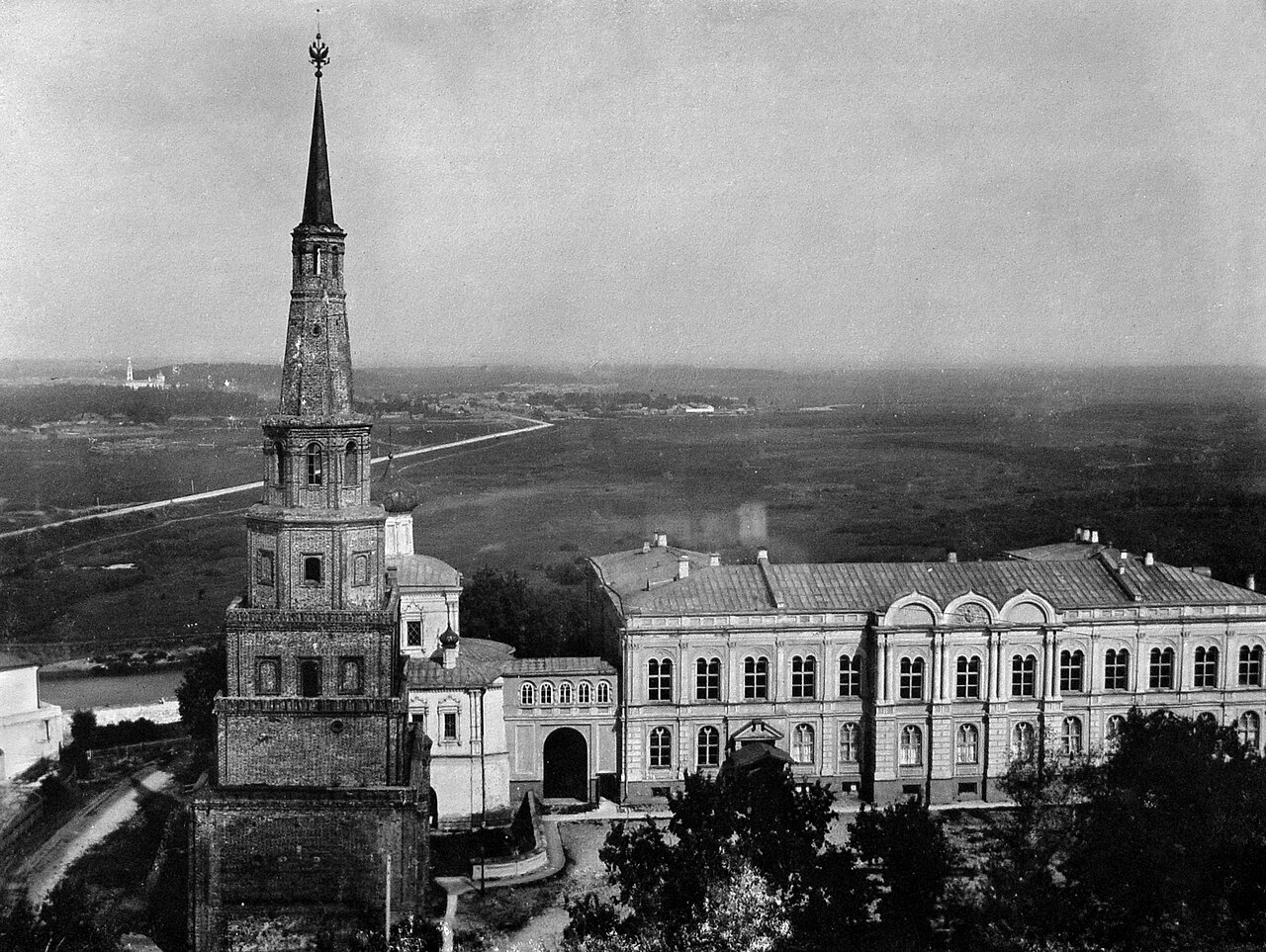
The Söyembikä Tower in the Kazan Kremlin, a historical photograph from the Russian Empire period — a symbol of the Tatar past within a Russian-ruled city (Public domain; Wikimedia Commons)
Language and loanwords
Russian contains an estimated 2,000-plus words of Turkic origin. Much of its state and financial vocabulary dates from the Golden Horde period: den'ga (money), kazna (treasury), tamga (a trade tax — whence tamozhnya 'customs'), yam (the postal-relay system) and yamshchik (coachman), yarlyk (a khan's decree, later 'label'), karaul (guard), kazak (Cossack). Everyday speech took in arbuz (watermelon ← Persian xarbuza), baklazhan (aubergine), balyk (cured fish), kaftan, bashmak (shoe), sunduk (chest), kirpich (brick), chugun (cast iron), almaz (diamond ← almas), loshad' (horse, attested already in the 12th century) and stakan (glass).
These words and their Turkic-Tatar sources are examined in detail on a separate page, “Souvenirs from the Golden Horde”.
Statecraft and the economy
The Russian principalities took over a range of military, diplomatic and administrative-financial practices from the Golden Horde. From the Mongols came the yam — a network of relay stations and fresh horses that the Muscovite state used for centuries. Trade was taxed through the tamga (whence Russian tamozhnya 'customs'); taxes were levied on the basis of population censuses. The words for the treasury (kazna) and money (den'ga) are of the same legacy.
How far this shaped the nature of the state is contested. The so-called Eurasian school argues that Mongol rule strengthened centralisation, autocracy and serfdom; other historians (e.g. Charles Halperin) are more cautious and do not see the Mongols as the main source of Russian autocracy. The truth is likely in between: the institutional borrowings were many, but other factors also shaped the Russian state.
Nobility and names
A significant share of the Russian nobility descended from Tatar aristocracy. By a 17th-century compilation (Zagoskin), 156 noble families were of Tatar or Eastern origin, 168 of the Rurikid (Viking) line, 42 of unspecified Russian origin and 452 from Western Europe or Poland-Lithuania. A modern estimate holds that about a third of Russian noble families have Turkic roots.
The best-known example is the Yusupovs, descended from the 16th-century Nogai ruler Yusuf (a Golden Horde successor state); his sons entered the service of Ivan the Terrible and received great estates. After Vasily II the number of Tatars entering the Muscovite nobility rose sharply, and Russian and Tatar families intermarried. Many Russian surnames combine a Turkic-Tatar given name with the Russian suffix -ov/-in (e.g. Yusupov ← Yusuf). The Tatar ancestry claimed for some famous families (Godunov, Karamzin, Turgenev, Aksakov) is, however, traditional and of varying reliability — to be taken with caution.
Cuisine and everyday life
Material culture came with the loanwords. From food, Russian cooking took in arbuz (watermelon), baklazhan (aubergine) and balyk (cured fish); from dress, the kaftan and bashmak (shoe); from the household, the sunduk (chest) and stakan (glass). A word often carries the object or custom with it.
Genetic and demographic trace
There is a well-known saying, “Scratch a Russian and you'll find a Tatar.” Genetically, however, the trace is more modest and varies by region — most ethnic Russians are predominantly East Slavic. The Tatar heritage in Russian culture is thus chiefly historical, linguistic and institutional rather than genetic.
The Estonian Mišär Tatars are themselves a Kipchak-descended community, so this heritage is part of their wider story. See also: “Souvenirs from the Golden Horde: Turkic and Tatar words in Russian”.
See also
Sources: Charles J. Halperin, “Russia and the Golden Horde: The Mongol Impact on Medieval Russian History”; the Wikipedia articles “Serving Tatars” and “House of Yusupov”; the Turkic-loanword surveys “Turkic words in Russian” (Languages of the World, A. Pereltsvaig) and “Turkisms in Russian” (Reed College).